
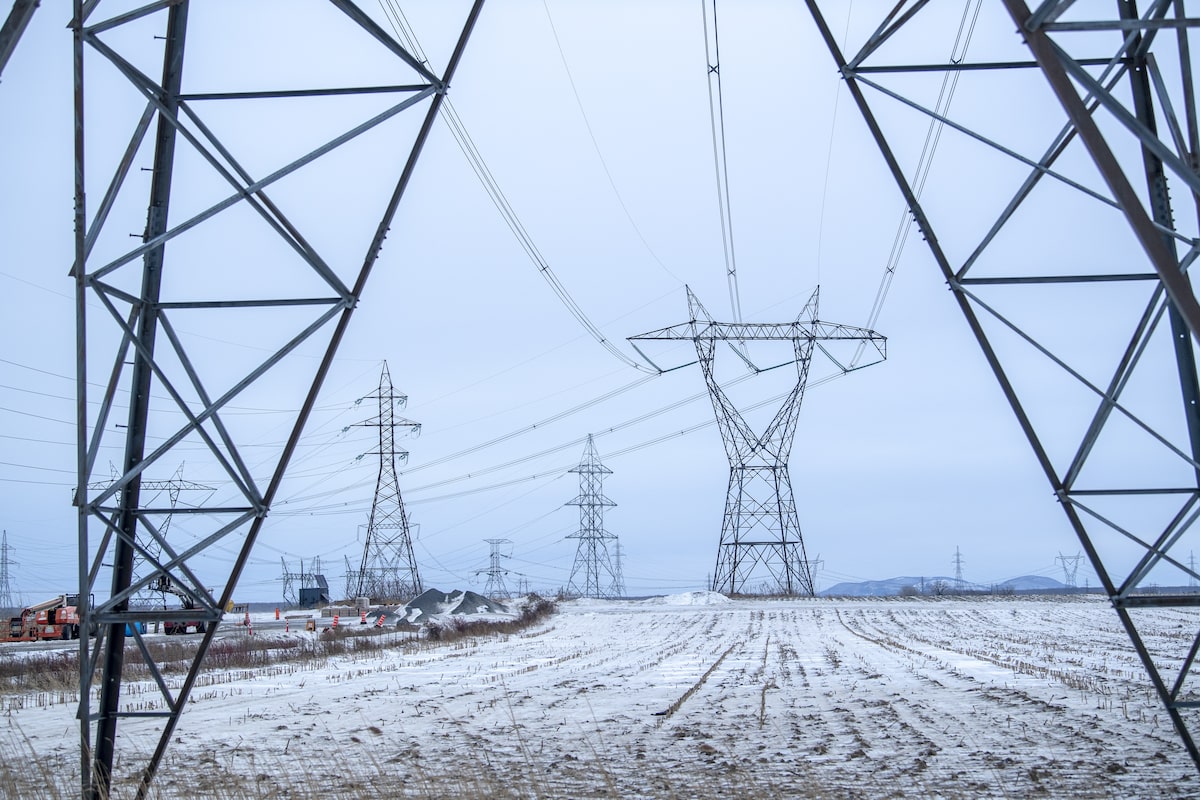
Power lines go to a Hydro-Quebec transformer near Varennes, Que. Water levels in northern reservoirs fell for the fourth straight year.Andrej Ivanov/The Globe and Mail
Hydro-Québec’s export volumes have fallen for the fourth straight year as the utility deals with a drop in its northern water reservoirs that it hasn’t experienced since the 1960s.
The provincial Crown corporation, one of the world’s biggest producers of hydroelectricity, shipped 11.8 terawatt-hours (TWh) of power outside Quebec in 2025 at an average price of 15 cents a kilowatt-hour, according to annual results published Thursday.
Exports by volume have declined every year since 2021 and are now barely a third of what they were that year, the numbers show. The utility commanded a higher price for the power it did ship out, however, and was able to generate export revenue of $1.7-billion last year – 14 per cent higher than in 2024.
Over all, Hydro-Québec reported a net profit of $2.9-billion for 2025 on total revenue of $18-billion, including a record volume of power sold to customers within the province. The income included a gain of roughly $250-million on the sale of its 20-per-cent stake in renewable power producer Innergex to the Caisse de dépôt et placement du Québec.
Chief executive officer Claudine Bouchard and her team are carrying out an ambitious investment plan worth $200-billion to develop new clean-power-generation facilities and improve the reliability of the grid to meet an expected doubling of electricity demand in Quebec by 2050. It involves tripling wind-power production and building 5,000 kilometres of new transmission lines, among other initiatives.
Hydro-Québec becomes net importer of power in reversal from past years
The effort is being complicated by the low runoff levels flowing into Hydro-Québec reservoirs over the past three years. As a result, the utility has had to buy more power from outside the province – imports last year were $1.1-billion more than the year before – and take other steps when needed.
Hydro-Québec temporarily suspended shipments to Massachusetts, with which it has a 20-year export agreement, during an extreme cold snap in January. Infrastructure for a separate long-term export contract with New York is expected to come online sometime this spring.
The last time the utility experienced similar levels of consistently low runoff was from 1961 to 1963. That was followed by three years of increases compared to annual averages.
Hydro-Québec has 28 large reservoirs that it uses to produce hydropower, fed by rain and snow melt. The largest is the Caniapiscau reservoir, with a surface area of 4,359 square kilometres, that supplies the power stations of La Grande in the James Bay region.
Water cycles are unpredictable and demand for power continues to grow. But Hydro-Québec insists it has the resources necessary to handle it, with multiyear reservoir storage capacity and interconnections to grids outside the province.
To control its available resources and maximize profitability, the utility tries to export electricity when prices are high and import it when they’re lower to replenish its stocks. The strategy has worked so far and there’s no specific water reservoir threshold at which “suddenly things change,” chief financial officer Maxime Aucoin told reporters.
“We are actively and dynamically managing the situation,” Mr. Aucoin said. “We’re consistently trying to be one step ahead.”