
Story Links
Although many years have passed, Ihor Brezdun can still remember summer days as a child spent in Lviv, Ukraine, in the small village of Rozhirche.
While technically born and raised in Moscow, Brezdun’s whole family is Ukrainian. His parents moved to Russia’s capital for work-related opportunities, but every summer since he was three, Brezdun would go back to the Lviv –18 hours away – to spend time with his grandparents and friends.
“I’ve always felt like my home, and my heart, is in the Ukraine. All of my memories, all of my childhood, I remember from the Ukraine,” he said happily.
“Almost every day we would find something to do. We didn’t have any technology, we just came up with random stuff. We would swim in the river, maybe play some soccer. There was a really big soccer field, and all the guys from the village, they would gather there and play.”
As Brezdun got older, his passions grew. In the classroom, athletic therapy was a particular interest. On the track, he developed into a sensational 400m hurdler, with a provincial medal to his name.
Brezdun had many goals and dreams back home, but his world was flipped upside down in 2022, following Russia’s invasion of the Ukraine.
The years following were filled with uncertainty. But amidst it all, Brezdun’s attitude has remained positive. It speaks volumes about his character.
He lives with gratitude for all that’s in front of him, while embracing everything he’s overcome.
“I try to enjoy every moment,” he beamed.
“Every challenge brings me one step closer to my dreams, and I always keep that in mind. When I look back on what I’ve gone through, I realize that I have to be thankful to God that I overcame the struggles that I have faced, and I’m able to live a better life.”
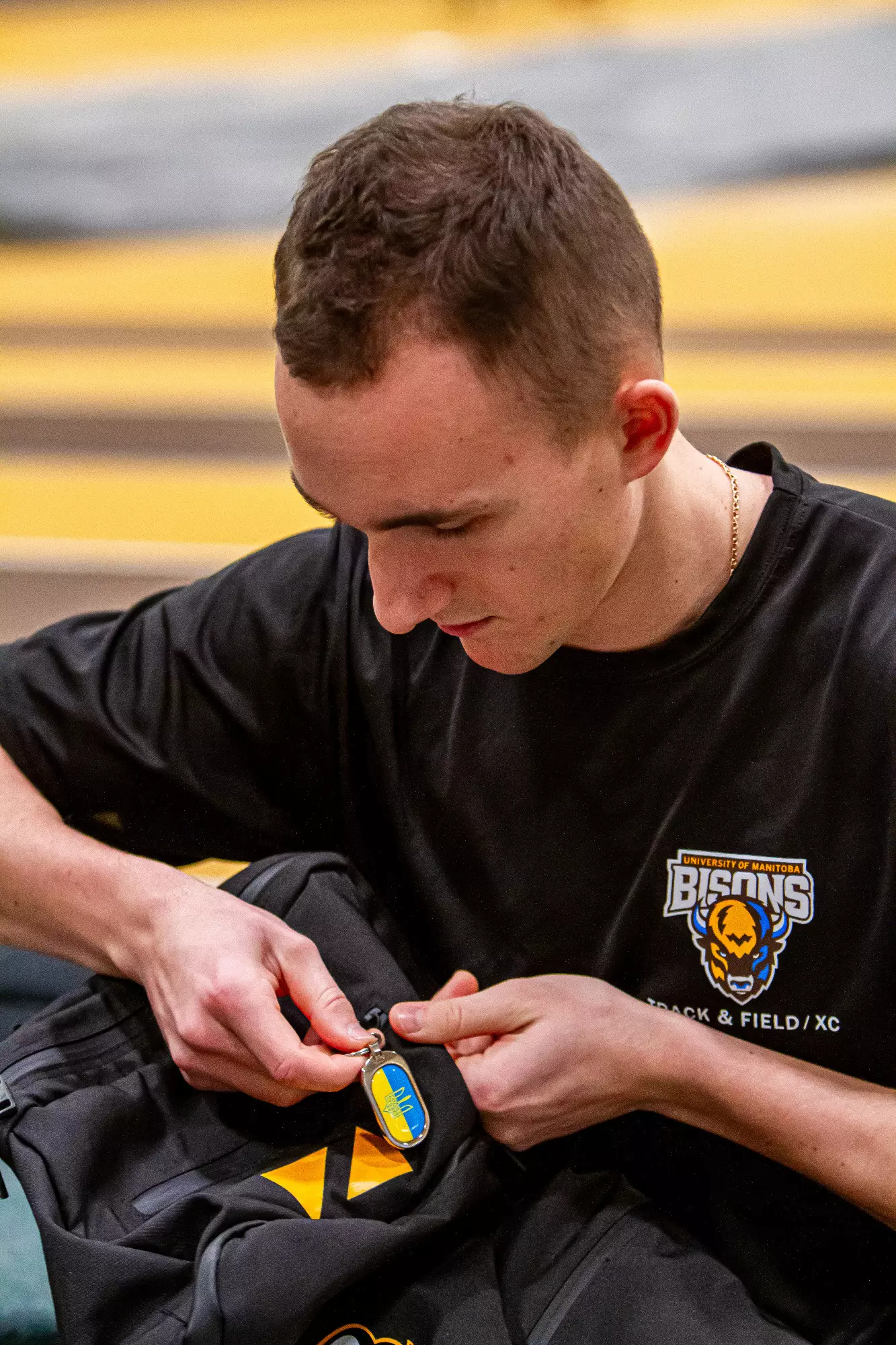
Brezdun carries a keychain with the Ukrainian flag on it, to remind him of his roots / Photo by Samantha Keen
A new chapter
When the war started, Brezdun was still in Moscow with his parents. He was in grade 11, and only had a few months left until graduation (the Russian school system follows an 11-year structure).
In a short span of time, all that he knew changed. By October, he was on his way to Canada, starting a new, unfamiliar chapter in his life.
“When the war started, my parents were so frustrated. It was tough for them. For some reason, I didn’t really realize what was happening. I didn’t get involved in too much politics and what was going on, I was more focused on school and track,” he admitted.
“I tried not to take it too personally. I just wanted to stay away from all that stress and all the things going on there. About a month after the war started, my parents found out that Canada had a simplified program for Ukrainians to help them get their visa. We applied to that right away. I was the first one to fly to Canada because my parents got their visas later. I was 18 at that time so it was fine.”
Brezdun’s first Canadian destination was Toronto, where he was forced to adapt on the fly.
He originally rented a room with his uncle and one other person, in a space no bigger than 200 square feet. But not long after, Brezdun was forced to find another place to live.
The following month was a blur, filled with crazy experiences, chance encounters, new friendships and plenty of memories.
“I didn’t know anyone in the city. With the prices there, it was so tough. Luckily, I met some guy from Kazakhstan. I randomly saw his videos on TikTok. We met once. I texted him to see if he had a bed to sleep on. Surprisingly, he agreed. I lived with that guy in downtown Toronto for a couple of weeks. It was the best experience,” said Brezdun.
“During that time, I worked in a small grocery store, and eventually found a room for myself. It was so chaotic. I was feeling lost. I had a job at that time, so I had to commute to work an hour and back.”
Amidst an insane schedule, Brezdun still found time for track and field. He began training with the University of Toronto’s program, creating strong bonds and firm connections in a foreign place.
During a hectic and stressful time in his life, the track became a happy place, a constant amidst the chaos.
“I was so warmly welcomed when I first got there. Even though I was under a lot of stress being new to the country, the athletes and coaches made me feel comfortable,” he added.
“Besides that, when I had problems with finding accommodation, a guy from their team, Shun, let me live with him for a bit until he left for the holidays. And then through him, I met his friends who also helped me with my housing situation. I can’t thank them enough. They were a huge help for me.”
During the Christmas season, Brezdun’s mom called to ask how things were going. His parents and sister were settled in Winnipeg at that time, and after a long, emotional conversation, he knew it was time to pack up and move to Manitoba, to reunite with his family.
“I was so exhausted, because I was working almost 50 hours a week. The store would put me on the night shifts more often, so I was closing up, and after that I would have to commute home, which was at least an hour bus ride. The bus schedule was so crazy that sometimes I would have to walk 30 minutes to the next bus stop. When my mom called me to ask how things were going, I was so sad and exhausted. I started crying, saying it was hard,” he said.
“I didn’t want to move, because I liked the atmosphere of Toronto, but I didn’t like the situation I was in. The next day, I checked the flight prices to Winnipeg. It was $300 for a one-way ticket to Winnipeg. I thought yeah, I should move to Winnipeg. I bought the ticket for December 31, and we spent the new year together.”
‘A blessing in disguise’
Life became less stressful when Brezdun settled in Winnipeg. Reunited with his family and with dreams of attending university, he had plenty to look forward to.
But in order to attend university, Brezdun would need to pay his way. He earned money through a variety of avenues, the most notable being a roofing job, where he spent all day on his feet in the smouldering sun.
When that was done, Brezdun went to the track. He knew he wanted to keep training, whether he was in school at the University of Manitoba or not, and that’s exactly what he did.
One of his first contacts with the Bisons, was assistant coach Gee-ef Nkwonta. What stood out to the award-winning coach right away, was Brezdun’s maturity.
“It’s funny, I didn’t actually know how old he was until two years in. I thought he was way older than he was, because of how he carried himself,” said Nkwonta.
“I would have thought right now he was 24. I remember when we had the talks of him coming to university, and he said he was turning 19. It was like, woah, since when? I thought he wasn’t in school because he was done school. I didn’t know he was first year out of high school and taking a gap year.”
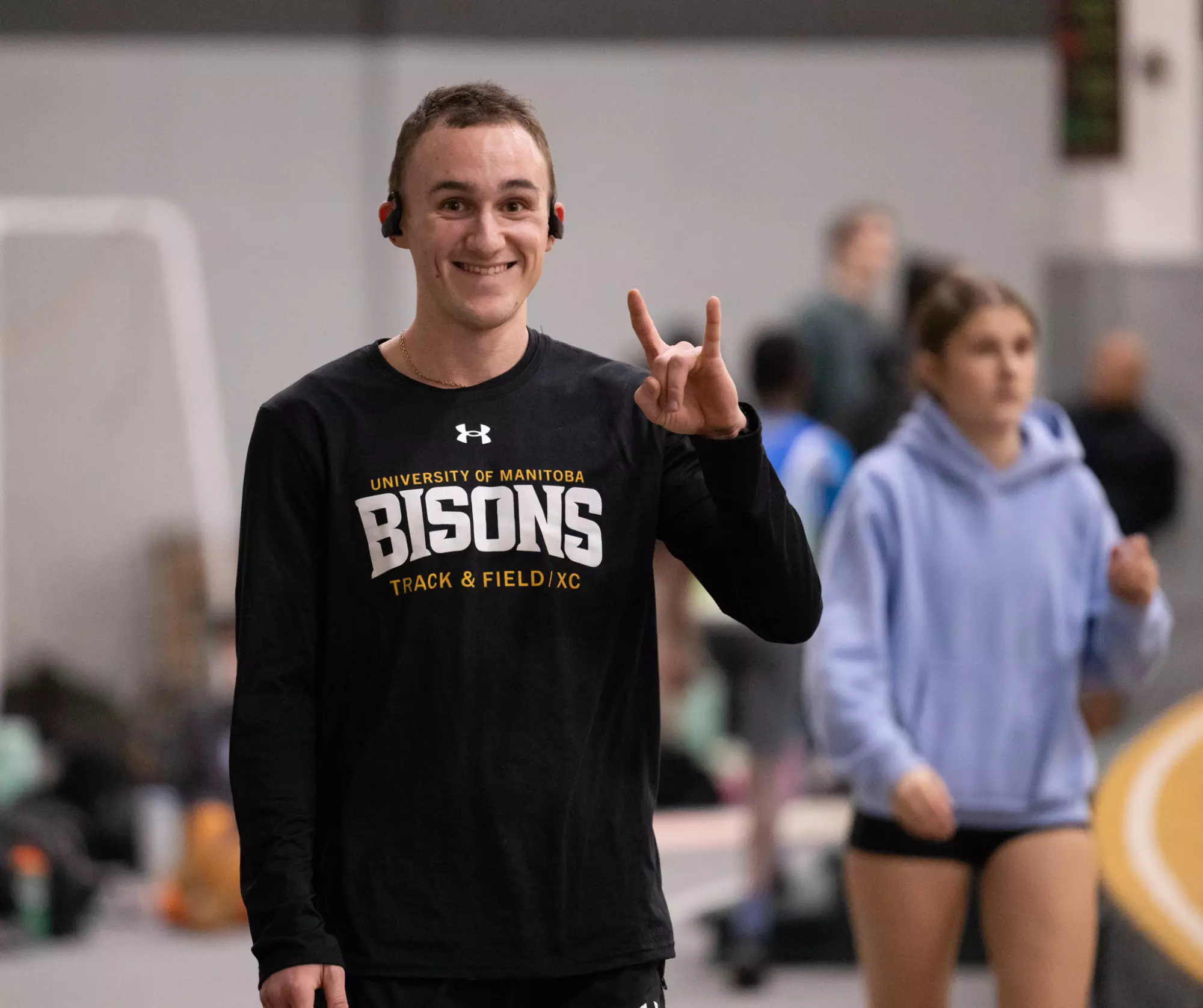
Nkwonta trained Brezdun through the club system while he wasn’t a Bisons student-athlete, and after enrolling at UM, he’s remained his coach.
Through shared experiences within the program, Brezdun’s authenticity, curiosity and positivity have all made a difference.
“He’s authentically him, all of the time. He’ll ask a million questions and be curious with everyone, not just to me. He wants to be around, he wants to have conversations and talk with people. He’s going to be who he is. That’s been really helpful,” said Nkwonta.
“He’s been one of those people who’s been a leader without trying to be. It’s been a blessing in disguise for him to walk into our track.
Athletically, much the same as his personal life, it’s Brezdun’s resilience that’s stood out.
Indoors, he’s competed in the 60m hurdles, as well as the 300m and 600m, as well as the 4×400 relay. Outdoors, the 400m hurdles are his bread and butter, where he represented Manitoba this past summer at the Canada Games.
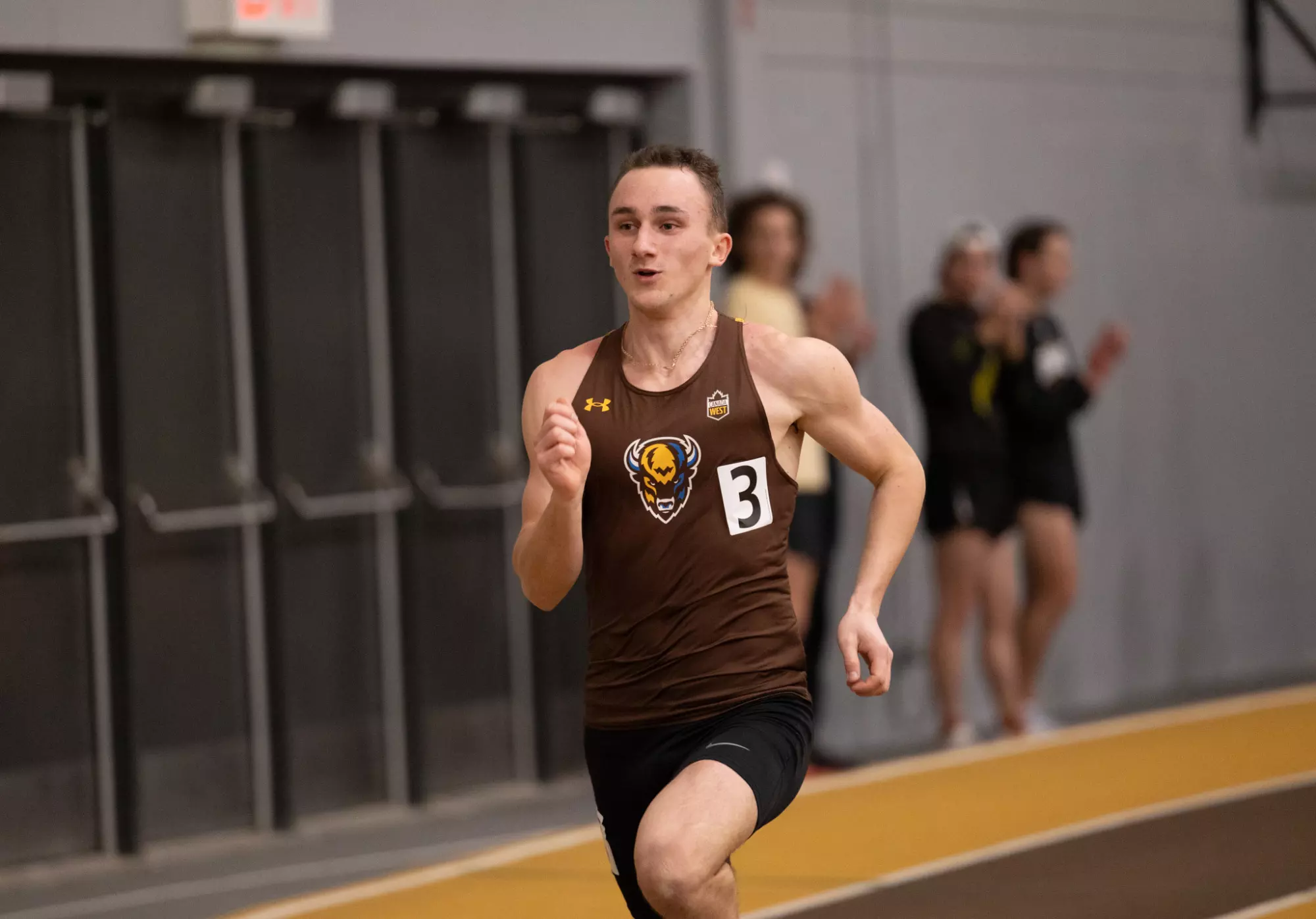
“His body holds up well. He’s kind of a swiss army knife. He’s good at a lot of things,” Nkwonta remarked.
“He’s a 400m hurdler, that’s his main thing. The 400 hurdles outdoors are 36 inches, indoors for men they’re 42. It’s a huge jump. For someone who’s not a tall guy you have to be technically proficient. Knowing Ihor, we said if anyone can do it, it’s probably him. We did some indoor hurdling with him, and to keep the fitness up for the 400s, we put him in 300s and 600s, just a bunch of events. He ended up being kind of okay at a lot of them.”
Brezdun reached the travel standard in his first season of eligibility a year ago, and was a part of Manitoba’s men’s roster that four-peated as Canada West Champions in 2024-25, while also travelling to nationals as an alternate on the 4x400m relay team. He once again hit the standard in 2025-26.
“He does a lot of the common things uncommonly well. He doesn’t come from all the bells and whistles,” said Nkwonta.
“You know what you’re going to get when you put him out there. That’s the biggest thing at a championship meet. You don’t really want a wild card for the most part, you want someone who’s reliable.”
In the classroom, Brezdun is enrolled in the Faculty of Kinesiology and Recreation Management, pursuing his passion in athletic therapy. He’s also a talented photographer who’s produced content for Bison Sports’ social media accounts.
He’s firmly established a new life in Winnipeg, and made countless friends through track, and school.
Regardless as to what he’s doing, you’ll find Brezdun with a smile on his face, joyful, thankful, and at home.
“It’s helped me a lot, being a member of this community, being a student-athlete. I’ve met such great people. It makes me feel happier in general. All of my friends are here in university. I’m really grateful for the things that people have done for me, helping me and being friendly. It was a huge adjustment for me, for the first few years, getting used to the people. It was a different mentality. Now, I feel like I am part of this community. Even though I am not Canadian, it feels like I am here, at home.”