
Breadcrumb Trail Links
Published Mar 03, 2026 • Last updated 1 hour ago • 4 minute read
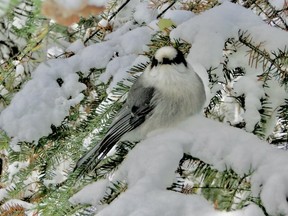 Canada jays are well prepared for the seasonal change from the abundance of summer to the drought we call winter. Photo by Phil Burke /Postmedia filesArticle content
Every year, I usually take an excursion to one of the best places in our region to locate northern boreal species: the southern corridor along Highway 60 in Algonquin Park.
Advertisement 2
This advertisement has not loaded yet, but your article continues below.
Article content
Travelling from the east gate of the park just past the town of Whitney, several boreal locations such as spruce bog and boreal forests support a variety of local and northern bird species. These include Boreal Chickadees, Spruce Grouse, Canada Jay, Black-backed Woodpeckers, Pine Siskins, Common Redpolls, Pine Grosbeaks and, if lucky, Red and White Crossbills.
Article content
Recommended Videos
Article content
In addition to the special habitats in the park, there is always a chance to observe birds along the highway corridor itself. Here one might find Bald Eagles, Ravens, Crows, Wild Turkeys and Owls.
In early February, Vince Agnesi, Rob Cunningham, and I ventured into Algonquin Park on a cold and snowy day, spurred on by the many photos of birds taken in the park by the photographers on the Pembroke Area Field Naturalists’ Facebook page. Unfortunately, we knew our time in the park would be limited due to a possible major snowstorm forecasted for mid-afternoon that day.
Advertisement 3
This advertisement has not loaded yet, but your article continues below.
Article content
About a mile outside the east gate around the town of Whitney, we were pleased to observe a large flock of Evening Grosbeaks. This was fortunate as these were the only Evening Grosbeaks we observed that day.
Our first stop occurred on the Opeongo Road. We had hoped to find Black-backed Woodpecker, Spruce Grouse and Canada Jays. Unfortunately, the only birds we encountered were a large number of Black-capped Chickadees and a White breasted Nuthatch. The Chickadees were quite friendly and we enjoyed feeding them seeds from our hands.
From Opeongo Road we went to the Park Visitor Centre to warm up and to visit the bird feeders that are situated just below the observation deck at the back of the Centre. At the feeders, we were pleased to find a flock of Pine Grosbeaks and several Blue Jays. The Blue Jay population in the park varies year to year, and this year appeared to be good for them. There were also several Black-capped Chickadees and a Hairy Woodpecker.
Advertisement 4
This advertisement has not loaded yet, but your article continues below.
Article content
After our late lunch, we visited the Spruce Bog Trail not far from the Visitor Centre. On this trail we encountered two Common Ravens that appeared quite tame, and to our delight, three Canada Jays. I was pleased to see them as I didn’t find them last year at all. These birds were also quite tame and ate sunflower seeds from our hands. At this location we also encountered Black-capped Chickadees and a Red-breasted Nuthatch.
After spending some time on the Spruce Bog Trail, we returned to the Visitor Centre and observed a solitary American Tree Sparrow under the bird feeders.
From the Centre, we went to the Loggers’ Museum to look for birds, but only encountered more Black-capped Chickadees and Red breasted Nuthatches.
Advertisement 5
This advertisement has not loaded yet, but your article continues below.
Article content
For all our efforts, we were only able to locate 10 bird species. The highlights of the excursion included the sighting of Canada Jays and both Evening and Pine Grosbeaks.
Similar to our area, what was noticeably absent were the northern migrants such as Dark-eyed Junco, Pine Siskin, Common Redpoll, and both Red and White-winged Crossbills. Several of the boreal species were also missing including Spruce Grouse, Boreal Chickadee and Black-backed Woodpecker. I was also surprised not to locate a single hawk or Owl species.
In terms of bird sightings, it was a good excursion but not one of our best! However, it is always a joy to be out in nature.
The local scene
On the local scene, the weather has turned relatively mild since the cold in January and early February. However, we are still getting periods of snow, which will delay many of the early spring migrants. We are still anticipating the arrival of the Horned Larks. These birds can be found on the sides of dirt roads, eating gravel and quickly flying into the fields when a car approaches. Look for the distinctive pointed wings.
Advertisement 6
This advertisement has not loaded yet, but your article continues below.
Article content
As I write this column. I have had no reports of spring birds, although we should expect the arrival of Robins, Red-winged Blackbirds Common Grackle and Canada Geese soon. However, I have had numerous reports of Barred Owls in yards and along the roads in our area.
Local sightings
Back on Feb. 14, during a drive around our area, Patricia Swan located a Barred Owl, Bald Eagle and a small flock of Snow Buntings. Nice finds, Patricia!
On Feb. 16, Paul Burgess located a lone male Ring-necked Pheasant on Kolsmith Road in the Whitewater region. This is obviously an escapee from somewhere, as they are not natural to our area nor do they migrate. It is a nice bird to observe!
On this same date, Dee Campbell reported a Cooper’s Hawk devouring an unfortunate Blue Jay in her yard.
On Feb. 19, Leo Boland spotted a Barred Owl in Pembroke. Several others also spotted this owl. It has been a great month for Barred Owl sightings!
Finally, on this same date, Dave Colton photographed a Brown-headed Cowbird in his area. Could this be our first spring bird?
Please call me with your sightings at 613-735-4430, or email me at hooles@bell.net . For more information on upcoming nature events, just google the Pembroke Area Field Naturalists’ website or like us on Facebook.
Article content
Share this article in your social network