
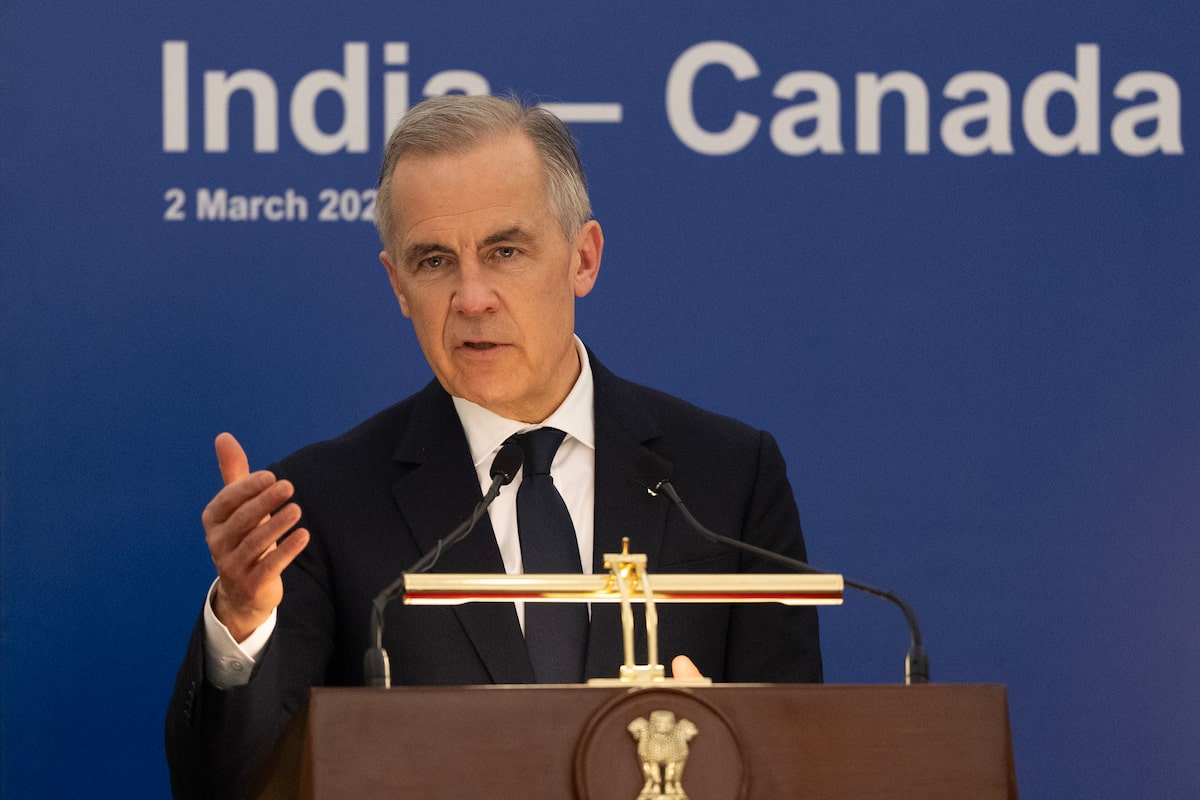
Prime Minister Mark Carney participates in a meeting with the India-Canada CEO Forum in New Delhi, India on Monday.Adrian Wyld/The Canadian Press
John Turley-Ewart is a contributing columnist for The Globe and Mail, a regulatory compliance consultant and a Canadian banking historian.
The American tariff bluster is back. Last week Jamieson Greer, the U.S. Trade Representative, tweaked our noses when he told the CBC that “If Canada wants to agree that we can have some level of higher tariff on them while they open up their markets to us on things like dairy and other things, then that’s a helpful conversation.”
“Helpful conversations” are included in Prime Minister Mark Carney’s agenda this week, but not with the Americans. Instead, the Prime Minister headed to the Pacific region on Thursday to continue trade talks with India, Australia and Japan. “Canada has what the world wants – abundant energy, critical minerals, expertise in technology, and world-class talent,” according to the government’s news release promoting his trip.
Missing is the obvious. The world also wants our proximity to the United States. It differentiates Canada in the global market and is another reason why Canada needs a deal with the Trump administration on a renegotiated USMCA.
This, according to TD Economics, helps explain strong investment inflows into Canada from Britain in 2025. TD economists note that “over 40 per cent of U.K. filings were acquisitions of Canadian software companies … suggesting U.K. investors see Canadian tech as both promising and a natural gateway to North American markets.”
Carney secures $2.6-billion uranium supply deal with India, launches talks on trade deal
The Prime Minister’s Office says the trip is to “diversify trade, attract new investment, and secure new partnerships.” Mr. Carney’s strategy leads the political zeitgeist in Canada, where last week a poll by Nanos Research for The Globe and Mail suggested most Canadians do not see our southern neighbour as a trustworthy ally.
Importantly, diversification efforts are bearing some fruit. Global Affairs Canada reports that this country’s trade data from December, 2025, shows that “Annual goods exports to the United States fell 5.8 per cent, mitigated almost completely by a 17.2-per-cent export gain to non-U.S. markets.”
The data also shows that the “U.S. share of Canadian goods exports fell 4.2 percentage points to 71.7 per cent in 2025 compared to 2024, the lowest share since the early 1980s,” when Canada did not have a free-trade deal with the U.S. Some of that decline, however, has come in high value-add manufactured goods, shedding jobs associated with them. Auto production, for instance, dropped by 5.4 per cent in 2025 and is likely to continue to decline in 2026.
Nevertheless, more trade deals between Canada and countries such as India, Japan and Australia add ammunition to use in this country’s battle against aggressive U.S. economic pressure. Mr. Carney’s trip isn’t just about diversification – it helps circle the wagons to protect access to U.S. markets the USMCA deal provides, a deal that will be renegotiated this year.
A recent academic paper by two economists, one from the Federal Reserve Bank of Dallas, the other from Southern Methodist University, tracks the history of U.S. tariffs and quantifies strategic trade-offs. It makes clear the Trump administration’s primary objective in the USMCA renegotiation.
Anand declines comment on links between Indian consulate and Nijjar slaying
They argue President Donald Trump and his trade representatives bluff with “steeper tariff increases as the fallback in failed negotiations.” But the objective is securing “agreements on tariffs at or above the 10-per-cent floor – without provoking retaliation – using carve-outs and exemptions to facilitate agreement.”
Surrender is what success looks like for the Trump administration. In such a scenario, the economists say, the U.S. “could raise fiscal revenue while delivering modest but positive welfare gains for U.S. consumers.”
If Canada retaliates with its own tariffs, point out the economists, the gains the Trump administration seeks are eliminated, even if the U.S. government fully rebated the tariffs to American households. This reinforces former prime minister (and economist) Stephen Harper’s call last month for Canada to hit back with its own tariffs on U.S. goods.
Canada is now heading into the major battle in the trade war with the U.S. that Mr. Trump started, and there is one way to win: Deny the Trump administration’s efforts to impose tariffs on Canada that go unanswered, making Canada a less attractive destination for foreign investment, while sending jobs south.
Retaliatory tariffs will squeeze Canadian pocketbooks even harder at a time of an affordability crisis. Jobs will be lost. Hiring will stall. New trading partners will offer some relief if not moral support. But the fight must be fought.
Mr. Carney’s foreign trips rallying new trade allies to our side signals he is preparing to fight that battle, as he must.
It will be the fight of our lives. Godspeed.