
When water isn’t spurting up from the holes in the ground, you’d walk past it without knowing it’s an essential piece of cooling infrastructure and a gathering place for people of all ages. But at noon during a late July heatwave, the Halifax splash pad is full of life. Kids are screaming bloody murder as they run through the cool streams; their caregivers are benchwarmers waiting on the sidelines. You can only place your bare foot on the dry concrete beside it for a second — it’s that hot.
Climate change is making heat waves like this one more common, longer, hotter and more widespread. And while people feel the heat no matter where they live, urban environments are hotter than their rural counterparts. The concrete that covers sidewalks and roads retains heat, leading to cities warming at twice the global average rate. Depending on where you live and how many trees shade your home, the phenomenon — known as the urban heat island effect — can be even more intense.
It prompted us at Canada’s National Observer to consider the ways people interact with their urban environments in an age of extreme heat. Our research brought us to an oft-overlooked solution: splash pads. They are built with kids in mind, but also serve as refuges for people of all ages without air conditioning. Making homes cooler is an essential piece of the climate puzzle (during BC’s deadly 2019 heat dome, the majority of deaths occurred at home), but building and maintaining public cooling infrastructure is also key, said Lorien Nesbitt, who leads the Urban Natures Lab at the University of British Columbia.
“We can’t be asking heat-vulnerable people to stay in their houses for a month at a time, even if it’s nicely air conditioned, and especially if it’s not,” she said. “So how do we allow people to be in the community, to be with their friends?”
98%
of fatalities occurred indoors
67%
of fatalities were among those 70 years of age or older
56%
of those who died lived alone
28%
of fatalities occurred among those who lived in neighbourhoods that were materially deprived, which is used as a measure of poverty.
69%
of fatalities occurred in homes without adequate cooling systems such as air conditioners or fans or were unhoused.
80%
those who died were on three or more chronic disease registries
Canada’s National Observer put together a panel of experts — and me — to find the country’s best splash pad. Nesbitt joined Sehjal Bhargava, a preventive medicine resident physician at the University of Ottawa and a member of the Canadian Association of Physicians for the Environment, and, perhaps most expert of all, a real-live kid, to serve as the panel of judges.
We combed through examples in all major cities, and all agreed that there are a few important things that make a splash pad great: accessibility, trees nearby for shade, benches for caretakers to sit at and bathrooms were all things we considered. We also looked at the neighbourhood each splash pad was in. Is it dense? How many people is it serving? Is it in a low-income neighbourhood where people are less likely to have cooling, which in turn, means it’s probably in an area of the city where the urban heat island effect is more extreme?
Hotter summers prompted us to consider the ways people interact with their urban environments in an age of extreme heat. Our research brought us to an oft-overlooked solution: splash pads.
The one we settled on was Grange Park in downtown Toronto. The splash pad isn’t fancy, but it’s usable. There are water spouts for kids and adults alike to run through and a metal fountain that you can sit under. Emmy, who is seven years old and a bit of a splash pad connoisseur, said the fountain was “pretty cool,” and that it makes the splash pad a bit more interesting, though she is not against a simpler set-up.
There is seating along the perimeter and nearby trees that offer shade. There’s also a playground right beside it, which Nesbitt said was a bonus — kids get bored (she speaks from experience as a parent) and will want to alternate between a playground and a splash pad. It’s also in one of the densest areas of the city. What we thought was especially notable was that the splash pad was specifically designed to accommodate people with mobility aids.
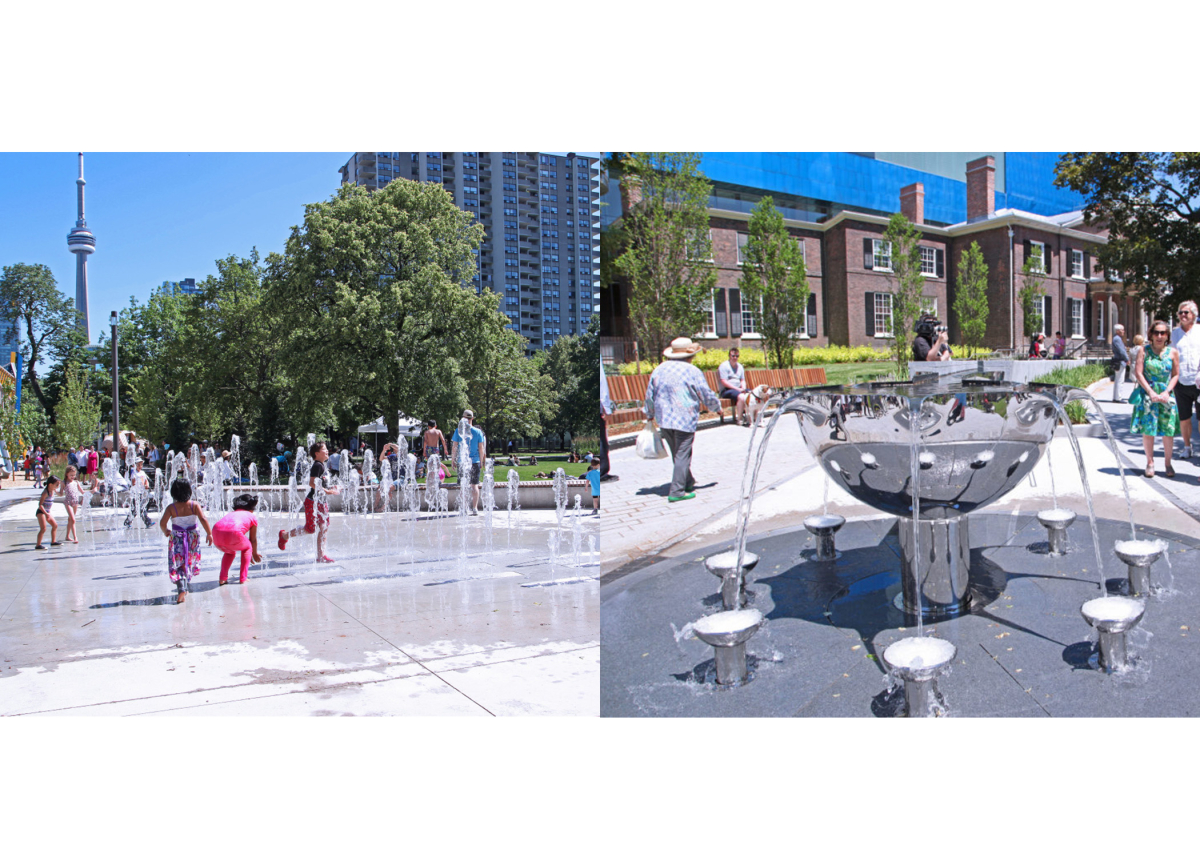 Grange Park in downtown Toronto. Images courtesy of the City of Toronto
We also considered it in the broader context of splash pads in Toronto. The city has 171 splash pads in total, which is at the higher end of what we see in Canada. The chart below shows the total number of splash pads in major Canadian cities, along with how many splash pads there are per 100,000 residents. We agreed that having a splash pad in walking distance is ideal, but they should at least be accessible by public transit.
Another notable splash pad we came across was the one at Maclean Park in Vancouver, which has just 2.1 splash pads per 100,000 residents (compared to Ottawa’s 13.4, at the top of the pack). Maclean Park is the closest splash pad to the Downtown Eastside, the hottest and lowest-income neighbourhood in the city. Many people in the neighbourhood live in single-room occupancy units, or SROs, which Nesbitt said often have windows that don’t open, making them especially warm. Unhoused residents of the Downtown Eastside are also especially vulnerable to the impacts of extreme heat. In response to the lack of cooling infrastructure in the neighbourhood, a community-run cooling bus is operating this summer, handing out cold water, harm reduction supplies, food and other items.
In addition to the Maclean Park splash pad being in a neighbourhood that would benefit from it, it has fun colours, a nearby bathroom and ample tree coverage.
Someone in the Downtown Eastside looking to cool off might be more likely to head to a splash pad than a cooling centre, both Nesbitt and Bhargava pointed out. That means there is a connection between splash pads and the most harmful impacts of extreme heat — Bhargava noted that since most deaths occur indoors, getting more people outside to splash pads could be something a city like Vancouver could consider.
Cities are responding to increased extreme heat in different ways. Some are debating maximum temperature policies, which would require landlords to keep rental units below a certain temperature. During heatwaves, major cities operate cooling centres, which are air-conditioned spaces that people can go to escape the heat. They are often community centres or other municipally operated buildings.
Those cooling spaces aren’t accessible for everyone, and a report out of the University of British Columbia found that people seeking cool places during heatwaves in Vancouver found the communication on where and when the spaces were open to be confusing. Instead, they often turned to malls and other existing public spaces.
While the report focused on indoor spaces, lead author Liv Yoon says splash pads could be another way to address barriers for people who aren’t using cooling infrastructure administered by their municipalities. Immunocompromised people, for example, could feel safer seeking cooling outdoors. You’re also around others when you’re outside, which can keep people safe during extreme heat.
Community connection is another aspect that they could serve, noted Yoon, who said cooling spaces need to be more holistic to work. Nesbitt noted that cooling centres, as they stand, “don’t fit into people’s lives,” but splash pads could.
While they’re viewed as a place just for kids, thinking of them as an intergenerational gathering place would also make them more useful to the broader community, noted Bhargava. If cities thought of them as places for everyone, and prioritized putting them in the hottest neighbourhoods, splash pads could be transformed into a piece of cooling infrastructure useful to all. There is some evidence of cities considering them as such: Montreal has extended the hours of splash pads during heatwaves.
Emmy drew her ideal splash pad before we met up to talk about them. It was a muggy, rainy summer day in Halifax, and she brought intel from splash pads locally and from a recent trip to Montreal. Ideally, she said a splash pad should have a big bucket that dunks water down, lots of water spraying up from the ground, something fun like a butterfly or a caterpillar, and shade because sunscreen washes off when you’re playing in the water. She also said benches and picnic tables are an asset, and that she likes the idea of water runoff from splash pads feeding nearby plants.
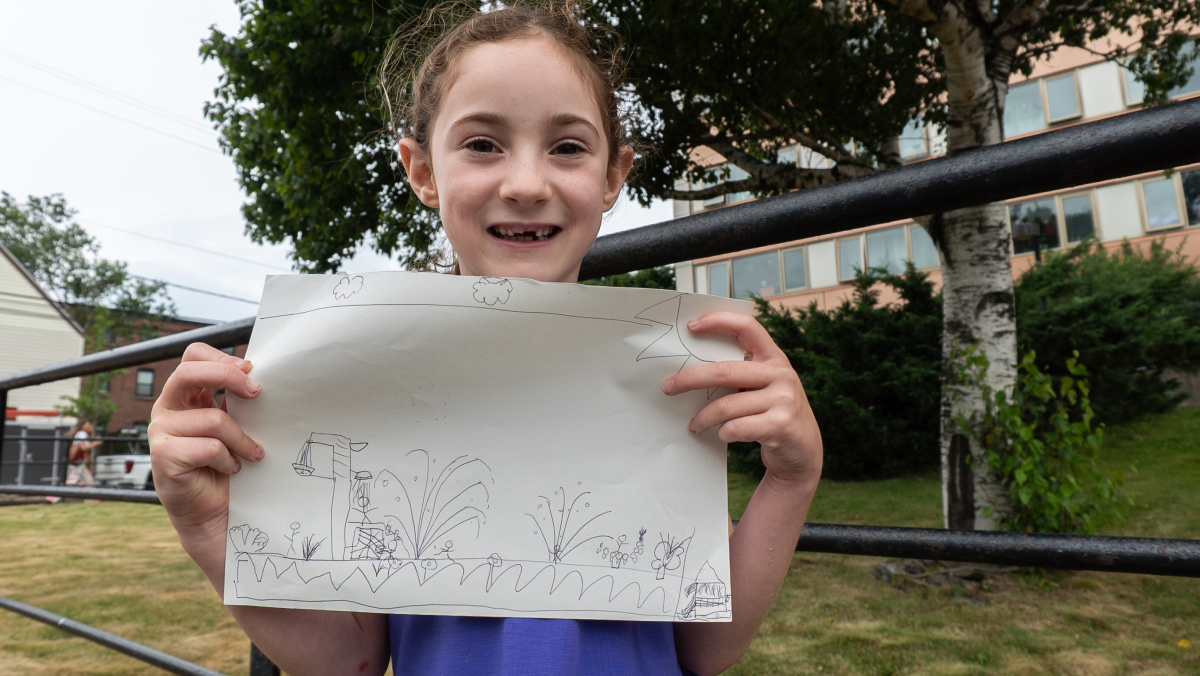 Emmy with her drawing of her ideal splash pad. Photo by Cloe Logan / Canada’s National Observer
She couldn’t pick her ultimate favourite — which would receive the coveted Canada’s National Observer kids’ choice award for best splash pad — but instead, landed on a tie between Jeux d’eau du parc du Père-Marquette and Jean-Marie-Lamonde Park, both in Montreal, and the Westmount Splash Pad in Halifax. They are all bright with reds, yellows and blues. The one at Jean-Marie-Lamonde is mushroom themed. When Emmy saw a picture of it, she said, “I don’t like it — I love it.”
After looking at splash pad pictures from across Canada and settling on her three top favourites, her final thought was: “”I’m gonna lose my ears and my mouth and my nose,” she said, rather than just her mind — which translates to being very excited about how awesome splash pads are.