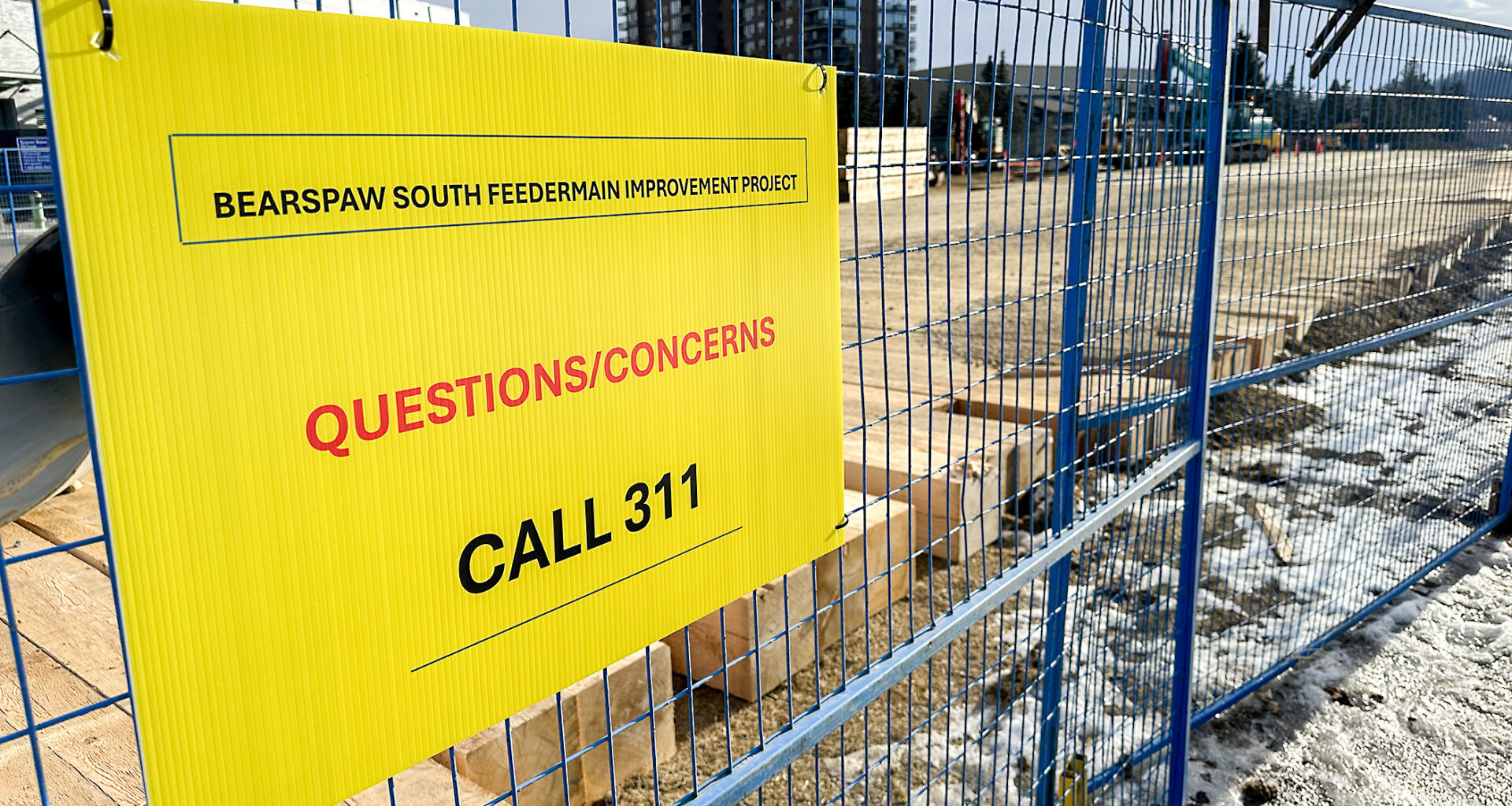
Calgary Mayor Jeromy Farkas has repeated the phrase “pay modestly now, or we can pay massively later,” and now it’s known roughly how much citizens will pay for the Bearspaw South replacement.
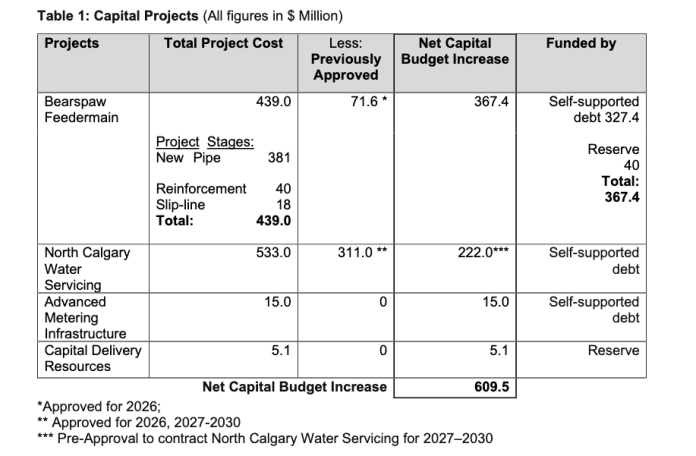
An urgent Notice of Motion was introduced at the March 3, 2026, Executive Committee meeting, recommending that Calgary city council approve an increase to the capital budget in Infrastructure Services Program 892 of $609.5 million for three water projects.
In the last budget, Calgary city councillors reaffirmed $1 billion in capital costs to upgrade Calgary’s water system.
The motions would allow the City of Calgary to increase the borrowing amount on prior resolutions by $515,200,000 – from $426,162,000 to $941,362,000 – to help pay for an expedited Bearspaw South feeder main.
Another borrowing bylaw would be increased by $49.2 million, and an additional $21.3 million in operating cash is being sought and funded through the Utility Sustainment Reserve. The latter is for additional operating cost demands to support the accelerated Bearspaw delivery.
“The proposed $609.5 million accelerated capital provides incremental funding to continue the design and construction to bring major water and wastewater infrastructure projects into service,” read the City of Calgary cover report.
“This includes continued reinforcement work on the Bearspaw South Feedermain, delivery of the new parallel steel feedermain, slip-lining of the Bearspaw South Feedermain, and the North Calgary Water Servicing Project.”
Because Calgary’s water infrastructure is generally self-supported (meaning it is recovered through water utility rates), City of Calgary administration has projected a possible increase of 14 per cent to water rates for 2027.
They said that utility rates for 2026 won’t be impacted, as they already increased by $5.29 per month to cover the previously approved capital costs. The projected 2027 increase could be up to $17 per month for a water customer using 19 cubic metres per month.
As a part of the capital request, there is also a request of $15 million to expedite the Advanced Metering Infrastructure Program.
“The upgraded technology facilitates near real time water consumption monitoring to support detecting potential leaks, which will support minimizing water loss,” the admin report read.
The cost of speed: Coun. Dhaliwal
Ward 5 Coun. Raj Dhaliwal said that no one should be surprised by the cost to repair and replace the Bearspaw South feeder main.
“There’s always a premium when you’re accelerating the projects,” Dhaliwal said.
He’s been assured that the City of Calgary is getting good rate for acceleration, but it’s put the City of Calgary between a rock and a hard place.
“This line, six kilometers, there is no option of not doing it later and pay more. There is no such option,” he told LWC.
“There is only one option, do it now and with speed, because this thing, like I always say, it’s a volcano, it’s going to erupt at any time. It’s not even a time bomb that has a time which it’s going to go off.”
As for the projected increase to water rates, and the impact on Calgary homeowners, Dhaliwal said that citizens elected a council that was committed to fixing infrastructure. In particular, the reassurance that the City of Calgary’s water system wouldn’t fail.
Dhaliwal said that roughly $327 million is self-supported debt, which is recovered through water rates. He said that council may have been able to lessen this blow by not using reserves to reduce the 2026 property tax increase.
“That was the wrong thing to do, because had we not done that, we would have had those extra dollars in our reserves to support this kind of infrastructure,” he said.
“Now Calgarians are paying. Whether it’s from the left pocket or right pocket, the taxpayer is one.”
The item, if approved at Executive Committee, will still need full approval at the upcoming Public Hearing meeting of council.
Liked it? Take a second to support Darren Krause on Patreon!