
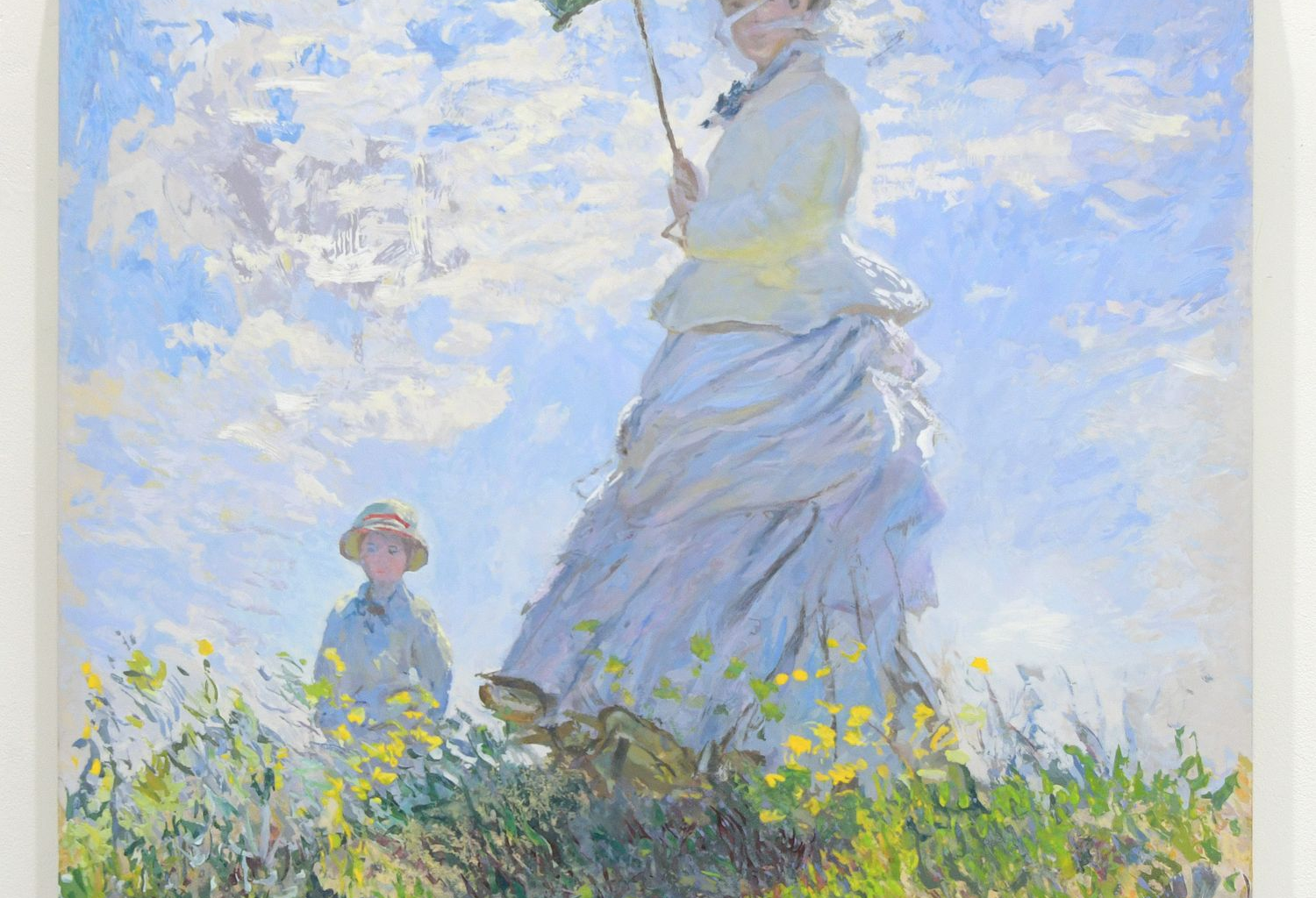
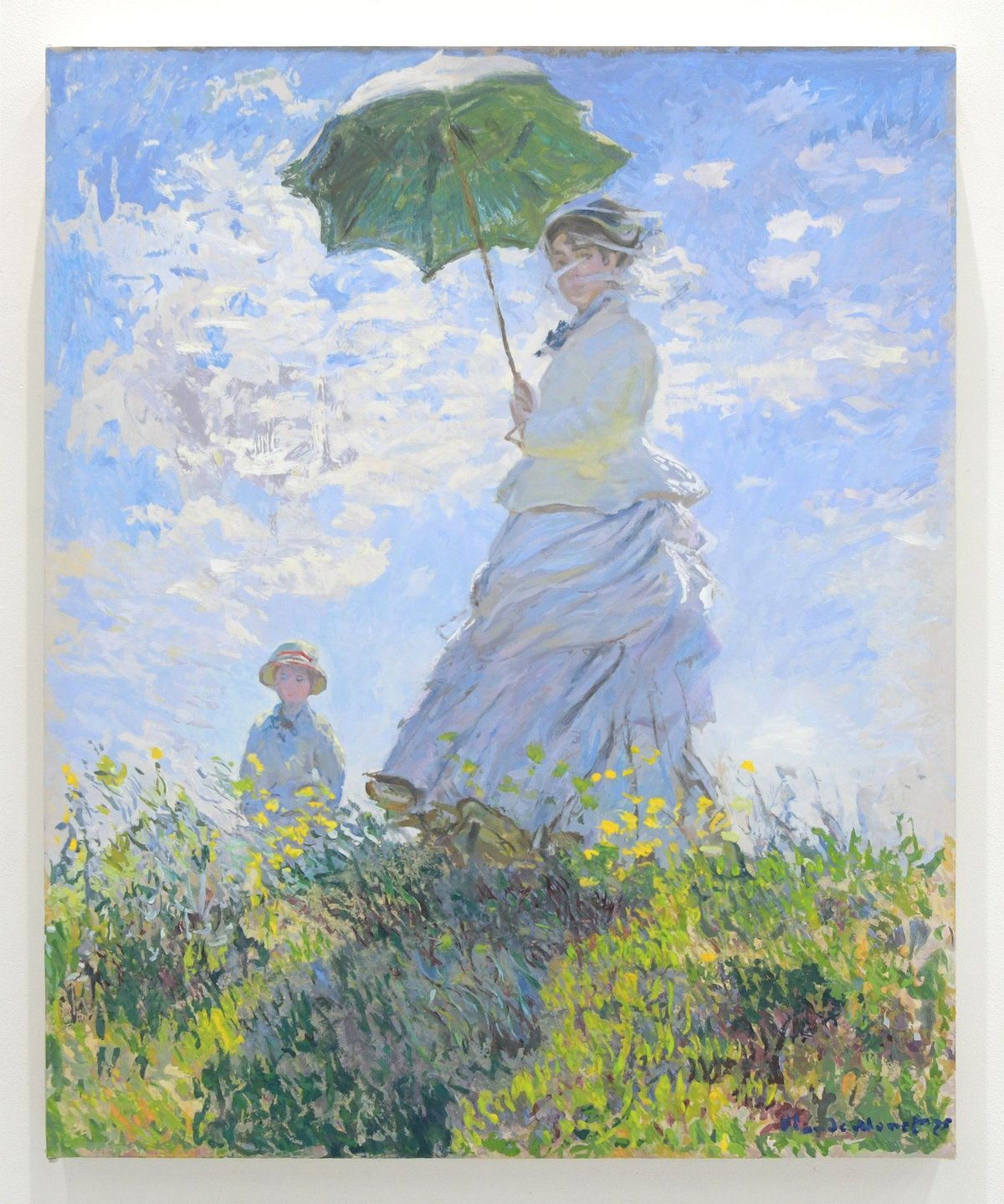
As part of his show called Hark Back to Ukiyo-e: Tracing Superflat to Japonisme’s Genesis, currently on display in LA, Takashi Murakami painted his own version of Claude Monet’s Woman with a Parasol – Madame Monet and Her Son. The painting is paired with Murakami’s copies of woodblock prints (ukiyo-e) that influenced the work of Monet and other abstract & impressionist artists.
Here Murakami pairs a copy of Monet’s portrait with twelve enlarged versions of ukiyo-e prints by Kikukawa Eizan and his teacher, Utamaro. Through these examples Murakami shapes a narrative of Monet’s encounter with bijinga. They suggest the elements that Monet absorbed in his study of prints: statuesque three-quarter figures; sensual outlines; parasols viewed from below; cloud-like masses of cherry blossoms; windswept skirts. Another selection, Utamaro’s Yamauba and Kintarō, is an example of a bijinga sub-genre in which women are shown with young children.
As noted by Greg Allen, Murakami used an unusual process for his reproductions:
Copying the originals, Murakami had his own intimate encounter with these features, recognizing in the process the meticulous care taken in pursuit of delicate effects. He interprets them in his signature style, composed of layer upon layer of silkscreened acrylic paint, applied with a special squeegee work application method and coated in a glossy finish.