

Listen to this article
Estimated 5 minutes
The audio version of this article is generated by AI-based technology. Mispronunciations can occur. We are working with our partners to continually review and improve the results.
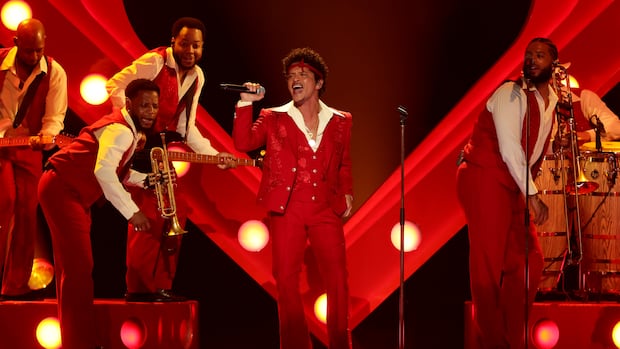
Bruno Mars just might be one of the most consistent hitmakers working in music today.
His signature smooth vocals have been dominating airwaves in recent years thanks to his notable features on award-winning songs like Rosé’s APT. and Lady Gaga’s Die with a Smile. But now, after nearly a decade, he’s finally back with his fourth solo album, The Romantic.
Today on Commotion, culture critic Pablo The Don and musician Romeo Candido join host Elamin Abdelmahmoud to discuss whether the nine-track album lives up to the hype, and whether it’s time for Bruno Mars to make a sonic change.
We’ve included some highlights below, edited for length and clarity. For the full discussion, listen and follow Commotion with Elamin Abdelmahmoud on your favourite podcast player.
LISTEN | Today’s episode on CBC Listen:
Commotion with Elamin Abdelmahmoud25:00A new Bruno Mars album, and F1’s Drive to Survive is back
Elamin: Romeo, The Romantic is the fourth solo album from Bruno Mars. He’s been a household name for … more than a decade at this point. You’re a musician yourself. So tell me, … what do you think it is about Bruno that, over the years, maybe, separates him from the other artists of his generation?
Romeo: Well, he’s not ever chasing trends, you know? He’s reaching back way far in the past, but he’s never chasing trends. I like a verse-chorus-bridge, key change. I like a high tenor. I like a multi-instrumentalist. I like a person who can dance. Like, we do not have showmen anymore. We have people who rap on tracks. We have people who sing AutoTuned. With Bruno, he has a real voice from God and he has real music musicianship.
Elamin: Can I push you a little bit on this? Because I love Bruno Mars as a musician. I think his first couple albums genuinely deliver something beautiful. And then it feels like there has been a track of his career where he’s kind of become an homagist, more than anything else — someone who’s kind of doing the thing where he is reaching far into the past. And I’m not so sure whether he’s creating something entirely new when he reaches into the past, or he’s trying to … recreate it in the present. What is the thing that you get out of Bruno reaching into the past?
Romeo: Well, it’s a vibration, remember? … We love the music from the past. And now, there’s just so much music that it’s going to be hard for the next generations to find everything. And so what I like is, his kind of homage becomes a bit of an entrance point to finding some of the older tunes.
Elamin: Pablo, we’ve just talked a little bit about that nostalgia thing…. It’s been a big part of the Bruno sound for years. But then, he also seems to be doubling down on the retro, sort of ’60s – ’70s soul style. Is it still working for you, Pablo?
Pablo: When it comes to Bruno, the thing is he’s never going to make bad music. So, you have to almost evaluate him in his own box, kind of like how you have to do Beyoncé…. I think the beginning of his career was so interesting because he was a chameleon when it came to music. He would go from the doo-wops to more rock on Unorthodox Jukebox, and then we get to 24K Magic and it’s a full tribute to Black music throughout the decades. And then we get Silk Sonic, which is pure ’70s, him and Anderson .Paak really emphasizing live instrumentation and then taking it cheeky and funny, and poking fun at some of the things that were said in that ’70s music.
When we get here, it’s like, it’s good, but Bruno, where else can we go? Do you want to go anywhere else? And it’s one of those things where because you can’t say it’s bad music, it almost feels bad to critique him about it. But it’s just me wondering, because you are such a creative force, what else do you have? Is there anything else you want to explore? Because you could be a needle-mover and an entry point into so many other genres for people, like Romeo said.
You can listen to the full discussion from today’s show on CBC Listen or on our podcast, Commotion with Elamin Abdelmahmoud, available wherever you get your podcasts.
Panel produced by Ty Callender.