
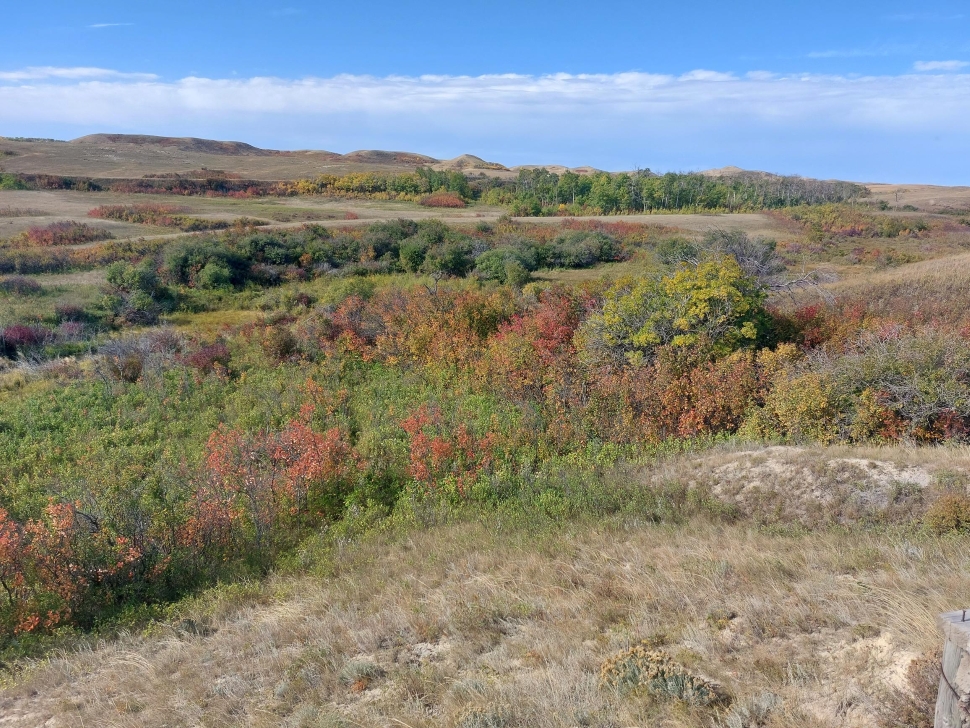
The Nature Conservancy of Canada (NCC) celebrated World Wildlife Day by announcing the protection of 426 hectares of crucial native grassland near Rockglen.
Working alongside a local landowner, the NCC formalized a conservation agreement to secure the Burning Hills property, an area that strengthens a vital wildlife corridor used for seasonal migration and genetic diversity.
Conserving these native grasslands is not only critical for the survival of local wildlife but also benefits surrounding communities. The landscape helps mitigate the impacts of floods and droughts while acting as a powerful carbon sink that stores billions of tonnes of carbon.
The property features a mix of native and tame grass, forested coulees, and riparian areas. It provides a haven for numerous rare species listed under Canada’s Species at Risk Act. Documented species in the region include the endangered burrowing owl and greater sage-grouse, the threatened swift fox, and the northern leopard frog, which is of special concern.
The area is also ecologically significant for its plant life. A recent discovery of the threatened soapweed yucca along a nearby roadway marks the only known location of this rare plant in Saskatchewan.
The project’s name, Burning Hills, pays tribute to a local legend with deep ties to Indigenous history. Following the Battle of Little Bighorn, members of the Lakota Sioux fled Montana and took refuge in the hills. The glow from their campfires illuminated the night sky, creating the illusion from a distance that the ridge was on fire.
Michael Burak, program director of southwest Saskatchewan for the NCC, said the project serves as a vital refuge.
“This collaboration not only safeguards rare species and supports biodiversity but also reinforces the role of grasslands in storing carbon and protecting communities from floods and droughts,” Burak stated in a news release. “Together with our partners and landowners, we are building a legacy of conservation that will benefit both nature and all Canadians.”
The acquisition was made possible through the generosity of the landowner, alongside funding from the National Fish and Wildlife Foundation, the Weston Family Foundation, and the Government of Canada. The federal funding comes from the Landscape Resiliency Program, a $26-million collaborative initiative running until May 2028 aimed at conserving up to 30,000 hectares of vital ecosystems across the country.
The Burning Hills project is part of the NCC’s broader Prairie Grasslands Action Plan, which aims to conserve more than 500,000 hectares of endangered prairie habitat by 2030.