
Breadcrumb Trail Links
Key is to lease the machine, not buy it, as the City of Greater Sudbury did, Ottawa councillor says
Published Mar 04, 2026 • Last updated 1 hour ago • 6 minute read
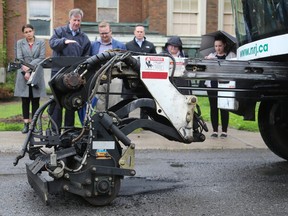 Ottawa city councillors look at the Python 5000, a unique pothole repair equipment, on June 03, 2019. Ottawa officials are happy with how the machine has performed. Photo by Jean Levac /Postmedia NewsArticle content
Leasing, not buying, Python 5000 pothole-patchers has been the “secret sauce” for the City of Ottawa, says councillor Tim Tierney.
Advertisement 2
This advertisement has not loaded yet, but your article continues below.
Article content
During an interview, Tierney, who is also chair of the public works and infrastructure committee, gave an enthusiastic two-thumbs-up review of the pothole-patching machine.
Article content
Recommended Videos
Article content
He said the key difference between Ottawa and Greater Sudbury is that they have chosen to lease their machines for about two months each year. The machines run 24/7 for 900 hours, from March until the beginning of May.
Tierney said the company that leases the machines handles all repairs and replacement work.
This year, the city has leased two machines at a cost of $400,000. Tierney said it is money well spent.
“When we get them, they come in up to standards,” he said. “Our experience has been pretty good, actually.”
In fact, Tierney said Ottawa’s experience has been “really good” over the past few years. To date, they have not encountered any notable challenges — and no breakdowns.
Advertisement 3
This advertisement has not loaded yet, but your article continues below.
Article content
“We’ve had a good experience, but it’s only because of the leasing,” he said. “We’re not in the business of owning a new piece of technology like that.”
On busy arterial roads, Tierney said the Python is invaluable.
“When you’re on a high-speed stretch of road, like, 80 km/hour, having crews in front and behind and all of this stuff — it’s more of a challenge with the hot box,” he noted. “It’s very dangerous. So we see the benefit — you get the hole blown out, you get the asphalt pumped into it and it has the roller, all in one machine. That’s great for those arterials where it’s not safe.”
Leased couple of months each year
While Ottawa only leases the machines for a couple of months each year, Tierney said staff “go very aggressive, right at the beginning.”
Sudbury Star Morning Briefing
Thanks for signing up!
Article content
Advertisement 4
This advertisement has not loaded yet, but your article continues below.
Article content
The city repairs the bulk of their potholes before the summer season has even begun.
“As soon as we get into the thaw season, that’s when we really target all the potholes. We get out immediately and patch as quick as we can,” Tierney said. “It still happens throughout the year, but a majority of them” are repaired in March, April and May.
“I think it goes a bit into May and then that’s pretty much it because then we start our next season — street-sweeping season,” he quipped.
When told about the challenges Greater Sudbury has faced with the Python 5000, Tierney said he and his colleagues voted to lease “just to avoid those kinds of situations.”
When it was purchased in September 2021, Greater Sudbury’s Python 5000 cost local taxpayers nearly $555,000, plus HST (the city previously reported it cost about $400,000, but clarified the actual price in February). The finance committee voted unanimously in favour of purchasing the machine.
Advertisement 5
This advertisement has not loaded yet, but your article continues below.
Article content
There was a lot of hype when the pothole-patcher was first purchased; however, Joe Rocca, director of linear infrastructure services, told the operations committee in January that the machine has faced significant challenges.
“Through 2025, we had very limited use of the Python,” Rocca elaborated. “We’ve had a lot of mechanical failures with it, a lot of parts breaking.”
In 2025, the Python 5000 was only on city streets for 15 business days. Last year, the city filled about 111,000 potholes. Of those, only 1,500 craters — approximately 1.35 per cent — were patched using the Python 5000.
Greater Sudbury not impressed
“Our experience with this piece of equipment is, it’s been super challenging to keep it on the road and using it,” Rocca said.
Advertisement 6
This advertisement has not loaded yet, but your article continues below.
Article content
He said one of the biggest problems with the machine has been the unavailability of parts.
“It’s been challenging to get stuff ordered in, and if we can’t find it, our city staff are turning to local suppliers and vendors to actually fabricate parts for it,” Rocca told the operations committee.
The Python 5000 went live on city streets in January 2022, but staff reported problems early, as they discovered it was not suitable for cold temperatures.
Several municipalities in Ontario have invested in the pothole-patchers, so we decided to reach out to some of our neighbours to learn about their Python-related experiences.
In Timmins, Shane Skinner, manager of public works, said it has been up and down with that city’s machine.
Advertisement 7
This advertisement has not loaded yet, but your article continues below.
Article content
“Public works has mixed reviews. When the machine works, it works well,” Skinner said. “The benefit is that one operator in the Python can do the work of a four-person traditional hot box crew. This frees up resources to perform other work and is much safer, as no staff are working near live traffic.”
Echoing Rocca’s sentiments, Skinner said while staff were optimistic at first, “issues with parts availability means the machine has been down more than available for work of late. We are experiencing the same issues with parts availability and this is reflected in the decline of potholes patched.”
Like Greater Sudbury, Timmins owns their Python 5000.
Timmins uses machine
In Timmins, the machine went into rotation in 2022. That year, it repaired a total of 26.1 per cent of potholes filled by the City of Timmins. Its output has declined steadily in the intervening years. In 2023, a total of 20.6 per cent of potholes were filled by the Python; in 2024, that dropped to 12.5 per cent; and last year, only 11.1 per cent of potholes got the Python 5000 treatment.
Advertisement 8
This advertisement has not loaded yet, but your article continues below.
Article content
Again mirroring the experience in Greater Sudbury, Skinner said they have learned the Python is not suited to cold weather.
“We have tried various tires but with the hydrostatic transmission, it presents challenges maneuvering in the snow and icy conditions,” he explained. “The unit also has issues at the throat of the feed to the belt — this area is not heated and when the hot asphalt or warm cold mix comes into contact with that tube, the material freezes and builds up over time to a solid mass that impedes the feed.”
He said Timmins uses their machine from late spring to late fall — typically from late April to late October. But it has not replaced entirely the need for multi-person crews. Skinner said the city still uses two to three traditional pothole-patching crews with hot boxes during the spring thaw season.
Advertisement 9
This advertisement has not loaded yet, but your article continues below.
Article content
In Thunder Bay, Ian Spoljarich, manager of the roads division, said that city’s experience with their Python 5000 has been “positive overall. The unit has performed as intended and has met the operational objectives for which it was purchased.”
But Lake Superior can be powerfully turbulent, and he said Thunder Bay does not use its machine during the harshest winter conditions, even though it is equipped with a heater that keeps the material warm while traveling to patch locations and helps to maintain product quality.
“We operate the unit throughout the winter when conditions permit; however, we avoid using it during extreme cold, as we have found it to be more susceptible to breakdowns in those conditions,” Spoljarich commented.
Advertisement 10
This advertisement has not loaded yet, but your article continues below.
Article content
Generally, the City of Thunder Bay puts its Python to use anywhere from 40 and 80 days per year.
“It places approximately 80 to 160 tonnes of material annually, representing a relatively small portion of our overall asphalt repair program,” Spoljarich said.
Although the city owns its machine, Spoljarich said they have not experienced the same concerns locating parts as have Timmins and Greater Sudbury; however, he also noted they have been challenged by the lack of tech support.
“As with any equipment in our fleet, the unit does require occasional repairs and maintenance. While it has experienced downtime from time to time, this is consistent with other equipment we own and operate,” he commented. “In some cases, parts are readily available; in others, sourcing can take longer. We do not receive technical support, which can present additional challenges when troubleshooting or co-ordinating repairs.”
The Star contacted Saskatchewan-based Superior Roads (superiorroads.com), manufacturer of the Python 5000. We asked for an interview regarding the availability of parts and the after-purchase services they provide. Initially, the company replied to our email; however, after more than a week, they had not identified a spokesperson or made arrangements for an interview.
BlueSky: @mkkeown.bsky.social
Facebook: @mkkeown
Article content
Share this article in your social network