

Listen to this article
Estimated 4 minutes
The audio version of this article is generated by AI-based technology. Mispronunciations can occur. We are working with our partners to continually review and improve the results.
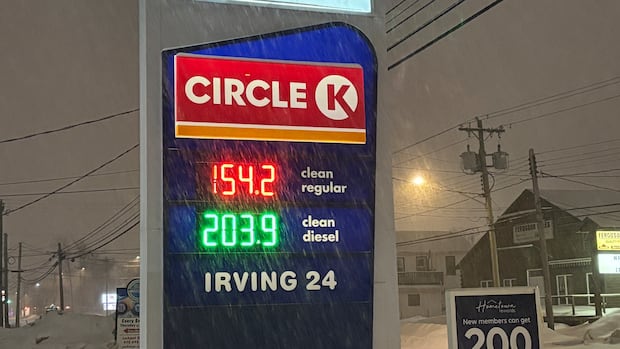
Fuel prices on Prince Edward Island rose overnight Wednesday, and energy experts say more increases could be on the way if tensions in the Middle East continue.
In an unscheduled adjustment, the Island Regulatory and Appeals Commission raised the minimum price for regular gasoline by 6 cents per litre to $1.54. Diesel increased by 9 cents to $2.04, while the maximum price for heating oil rose by 8 cents to $1.45.
IRAC said it made the unscheduled change in response to market conditions and help ensure petroleum prices remain fair for consumers, wholesalers and retailers.
“Global markets are currently experiencing high volatility in response to geopolitical tensions abroad,” the commission said.
The adjustment comes days after a sweeping U.S.-Israeli attack over the weekend that killed Iran’s supreme leader and pulled about a dozen other countries into the conflict.
Canadian energy and climate journalist Markham Hislop said fuel prices in Canada could continue rising depending on how long the conflict lasts. U.S. President Donald Trump has said he foresees a military campaign lasting four to five weeks.
“The longer it goes on, the higher prices will rise,” Hislop told CBC’s Island Morning on Wednesday. “Canadian prices are tied to global prices, and if they rise to the global level, then we’ll see them rise domestically.”
Strait of Hormuz standoff
Petroleum analyst Matt McLain of GasBuddy said one major concern is the Strait of Hormuz, the narrow mouth of the Persian Gulf and one of the world’s most important oil transit routes.
About 20 per cent of the global oil supply passes through the strait. However, military activity in the area has disrupted shipping, and Iran has warned vessels not to pass through the waterway, leaving many oil shipments in limbo.
“There are a lot of ships that have dropped anchor on either end of the strait and not moving at this point, and so that creates, potentially, in the coming days, a little bit of a hiccup,” McLain said.
“Anytime you have an issue that creates a hiccup like this, it ripples through the overall pricing market for crude oil.”
WATCH | The role of a critical shipping lane in the U.S.-Iran conflict: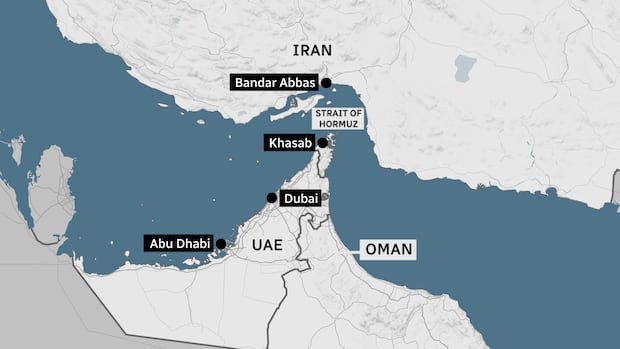
What’s happening around the Strait of Hormuz as conflict escalates?
CBC’s senior business correspondent Peter Armstrong explains what’s happening around the critical shipping lanes in the Strait of Hormuz on Monday as conflict escalates following U.S. and Israeli attacks on Iran.
McLain said if the Strait of Hormuz returns to normal operation, prices could eventually ease, although the likelihood of that happening in the next few days is uncertain.
Hislop added that higher gasoline and diesel prices are usually passed on to consumers.
“We’re probably going to see higher prices in the grocery store, we’ll start seeing higher prices for consumer goods,” he said.
“The longer it goes on, and the higher the oil prices go, the more you will see the impact of spread to other parts of the economy.”
Impact on Atlantic Canada
The shipping disruption could also affect regions that rely on imported oil, including Atlantic Canada.
According to a 2024 Statistics Canada report, Canada produces more crude oil than its refineries need.
Provinces with refineries located farther from Western Canadian production, such as Ontario, Quebec and New Brunswick, consistently import the most crude oil. New Brunswick imported the most crude oil among Canadian provinces in 2023.
Canada’s largest refinery, the Irving Oil refinery in Saint John, N.B., where much of P.E.I.’s fossil fuel supply is sourced, counts Saudi Arabia among its top crude oil suppliers, according to the report.
Hislop said higher and more volatile oil prices could accelerate the shift toward renewable energy and electric transportation.
“If there’s any kind of an impact on global energy markets, it would be the increase in the electrification of transportation,” he said.
“That will, over time, decrease global oil demand. We’ll see peak oil demand arrive sooner than 2030.”