
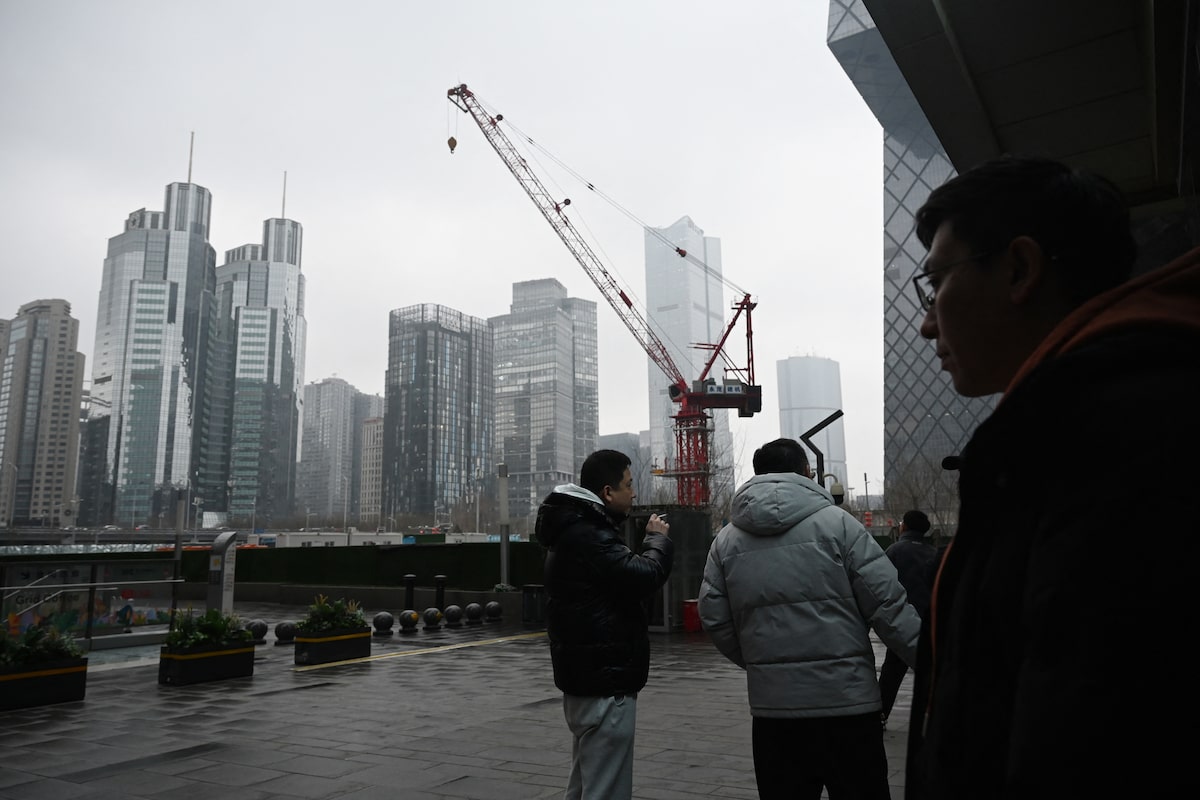
People walk outside office buildings in the central business district in Beijing, on Wednesday. China has set an economic growth target of 4.5% to 5% for 2026.GREG BAKER/AFP/Getty Images
China expects its economy to grow 4.5 to 5 per cent this year, the lowest rate in decades, with Beijing citing international volatility and a domestic economy that remains “in the midst of a profound transformation.”
Speaking to delegates Thursday at the opening of the annual meeting of the National People’s Congress, China’s rubber-stamp parliament, Premier Li Qiang said the Chinese economy had proven “remarkably resilient, forging ahead against headwinds” in 2025, but that severe challenges were on the horizon.
“Rarely in many years have we encountered such a grave and complex landscape, where external shocks and challenges were intertwined with domestic difficulties and tough policy choices,” Mr. Qiang said in a 47-page work report shared with reporters ahead of his speech.
“The international economic and trade environment underwent drastic changes. As unilateralism and protectionism abruptly escalated, market expectations were hit by frequent volatility, and China’s foreign trade came under considerable pressure.”
China warns of threat to ‘vital’ Hormuz shipping route as Iran war expands
Since the pandemic rattled the Chinese economy − with stringent lockdowns across the country and foreign partners seeking alternative suppliers − the annual growth target, a self-imposed measure of Beijing’s administrative success, has been set at “around 5 per cent.”
While analysts have long questioned the value of the target, given the fact it is based on a measure of gross domestic product that can be juiced by government spending and infrastructure investments that do not necessarily represent the actual health of the economy, it is a key political indicator of Beijing’s overall confidence.
Thursday’s work report is the first time China’s leaders have set a target below 5 per cent since 1991, when the country had yet to join the World Trade Organization, transforming it into the manufacturing powerhouse it would become.
In his work report, Mr. Li said the 4.5-per-cent target was a low estimate − that the country will strive “for better in practice.”
Yue Su, a China analyst at the Economist Intelligence Unit, said the lower growth target was “quite realistic.”
“It’s a further shift from a ‘number-first’ mindset toward a ‘quality-first’ one,” Ms. Su said. “Beijing doesn’t necessarily see high growth rates as a good thing, because they may incentivize local officials to exaggerate growth with white elephant projects and data manipulation.”
Mr. Li said particular attention will be given to expanding the domestic economy, long a priority − as China’s leaders have sought to rein in the country’s reliance on foreign trade − and an increasingly vital one amid U.S. President Donald Trump’s tariff war and the chaos it has wrought globally.
“Taking the expansion of domestic demand as our priority, we should make co-ordinated efforts to boost consumption and expand investment, tap into every potential for growth in domestic demand and better leverage the strengths of our enormous market,” Mr. Li said.
This includes efforts to “further develop a unified national market and eliminate local protectionism and market segmentation,” he added.
Former central bank adviser Liu Shinjin warned at a financial forum in January that China’s record US$1.2-trillion trade surplus last year − a key factor behind reaching the 2025 economic growth target − reflects rising manufacturing competitiveness but also weak domestic consumption.
How Trump’s tariffs have reshaped the global economy, in 11 charts
He said China must shift from its long-standing reliance on investment and exports toward a model primarily driven by innovation and consumption, adding that while manufacturing could be further upgraded, its share of the economy should fall.
“China’s current insufficient consumption is deeply tied to a series of institutional and structural factors, making it unrealistic to fully resolve these issues in the short term,” Mr. Liu said. “However, leaving them unaddressed is not an option either.”
Externally, China entered 2025 squarely in the crosshairs of Mr. Trump’s trade war. But Beijing has weathered that challenge better than most countries, matching Washington tariff for tariff until both countries came to the table and benefiting from the alienation of traditional U.S. allies to shore up partnerships elsewhere, including with Canada, South Korea and much of Europe.
Mr. Trump is due to travel to Beijing at the end of the month to meet with Mr. Li and Chinese President Xi Jinping.
“On the international front, we took a reasoned, robust and effective approach to addressing economic and trade issues and stood firm in safeguarding China’s national interests,” Mr. Li said Thursday.
“Positive outcomes were produced by the five rounds of China-U.S. trade talks, and important common understandings were reached by the two countries’ heads of state during their meeting in Busan, putting China-U.S. economic and trade co-operation on a more stable footing.”
With files from Reuters