
We live in a moment when long-range planning can feel almost naïve. Economic uncertainty, political volatility, shifting demographics, technological acceleration — the variables seem endless. Cultural and community institutions, in particular, operate in environments where funding models shift, audiences evolve, and expectations expand almost overnight.
And yet, more organizations than ever are turning toward intentional long-term thinking.
Through my consultancy work, I am regularly approached by executives and boards seeking clarity around governance, operational renewal, earned revenue development, and sustainable growth. Sometimes the request is explicitly for a “strategic plan.” Sometimes it’s framed as a reset, a refresh, or simply a conversation about the future. Whatever the label, the impulse is the same: a desire to pause, examine foundations, and ensure momentum is anchored in purpose.
Submitted/Stephen Borys
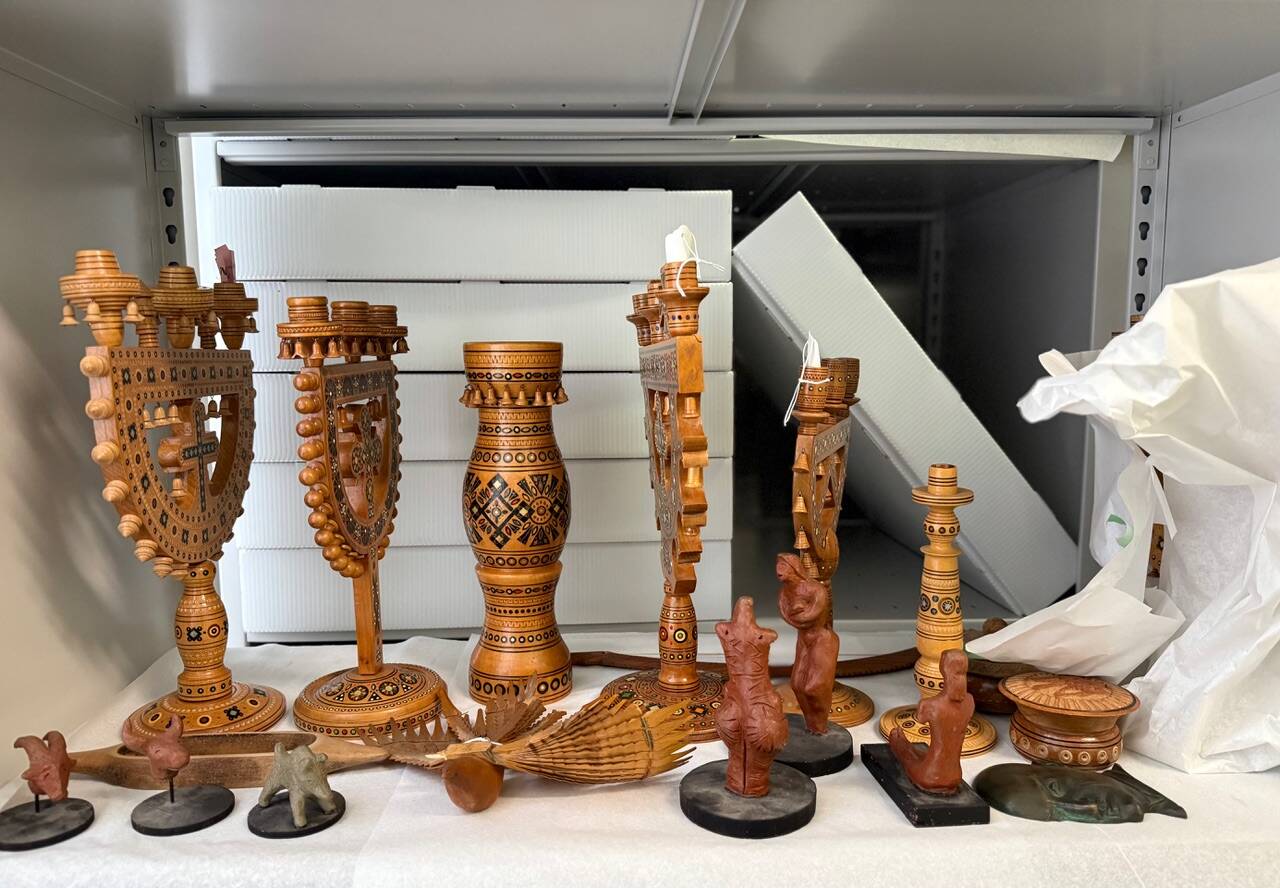
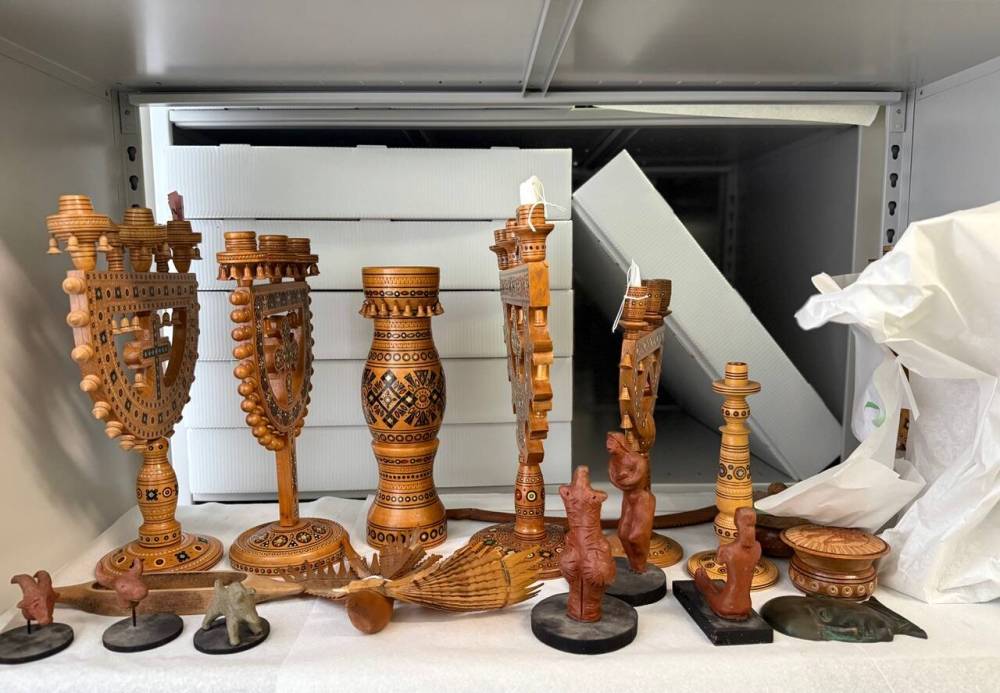
Carpathian candelabra and other wood and terracotta objects on an art storage shelf at the Oseredok Ukrainian Cultural and Educational Centre. Oseredok holds one of the most significant Ukrainian archives and art collections in Canada.
In recent months, I’ve had the privilege of working closely with two very different Winnipeg institutions: Oseredok Ukrainian Cultural and Educational Centre and the Winnipeg Architecture Foundation.
Oseredok, founded in 1944, holds one of the most significant Ukrainian archives and art collections in Canada. It is a place of memory, identity and scholarship — and like many centres of its kind, it is navigating generational transition, financial sustainability, and questions about how to animate and share its extraordinary collections for contemporary audiences.
The Winnipeg Architecture Foundation (WAF), by contrast, is younger and mission-driven in a different way. It advances public understanding of architecture and the built environment through its website, tours, research, publications, and annual film festival (and some great merchandise). As it approaches its 30th anniversary, WAF is asking how to strengthen earned revenue lines, build endowment funds, and remain indispensable to professionals and the broader public alike.
Different mandates. Different histories. Yet strikingly similar questions.
What does sustainability actually look like for us?
How do we remain credible across generations?
What must we protect at all costs — and what may need to evolve?
Those questions are less about documents and more about identity.
Earlier in my career, while leading successive strategic visioning exercises at the Winnipeg Art Gallery–Qaumajuq, one insight emerged clearly: institutions must be able to articulate why they exist before they can decide where they are going. In museum and gallery settings today, even the most carefully curated exhibition — thoughtfully installed, beautifully designed, and fully accessible — cannot rely on quality alone. If the public does not walk through the doors, organizations must pause and ask hard questions.
Cultural institutions are shaped not only by directors, curators and boards, but by audiences, donors, sponsors and communities. When these institutions listen well, they evolve without losing integrity.
That listening is not weakness. It’s maturity.
This is where the language of “impact” becomes useful.
In his book Making Museums Matter, the late museum thinker Stephen Weil drew attention to the assessment model used by the United Way. The focus is not simply on outputs — how many programs delivered, how many visitors counted — but on outcomes and impact. Are you making a meaningful difference in the community around you? And how do you know?
Outputs measure effort.
Outcomes measure effect.
For cultural organizations, this does not mean reducing art or architecture to statistics. It means asking whether exhibitions, programs and public conversations are strengthening civic life. Are we fostering understanding? Preserving memory? Encouraging thoughtful debate about the built environment? Supporting belonging? Are we making a positive difference?
In Winnipeg, the appointment last summer of Matthew Cutler as president and CEO of the United Way of Winnipeg adds a promising dimension to this conversation. Having worked previously at the Canadian Museum for Human Rights, Cutler understands how museums shape public dialogue. In announcing his appointment, United Way leadership described him as bringing “a rare combination of heart, strategy, and integrity,” grounded in “a deep respect for community, a belief in inclusive collaboration, and a passion for social change through vision, relationships, and strategic action.”
Those qualities are not confined to philanthropy. They are precisely what arts and heritage organizations require if they are to remain trusted and credible.
Both Oseredok and the Winnipeg Architecture Foundation are, in their own ways, leaning into that work. Oseredok is clarifying how archival stewardship, exhibitions, education and community engagement can be sustained within a viable business and facilities framework. WAF is aligning its research and publications, tours, digital platforms and fund development ambitions around a clear sense of public value and purpose.
In both cases, planning is less about predicting the next five years with precision and more about coherent alignment.
Are resources supporting what matters most?
Is governance structured to support growth?
Are programs reinforcing identity rather than diluting it?
Sometimes this means refining priorities. Sometimes it means letting go of cherished but unsustainable practices and taking a tighter hold on the non-negotiables. Sometimes it means strengthening financial foundations before expanding ambition.
The world may feel unplannable, but drift is not inevitable.
Organizations that pause — not because they are in crisis, but because they value coherence and impact — are better prepared to adapt without losing themselves. Strategic thinking does not eliminate uncertainty. It steadies response.
Winnipeg Free Press | Newsletter
And when that steadiness is anchored in community and measured by meaningful difference, planning becomes more than an administrative exercise.
It becomes stewardship.
In uncertain times, that is not naïve.
It is necessary.
Stephen Borys is president and CEO of Civic Muse, and former director and CEO of the Winnipeg Art Gallery–Qaumajuq.

Stephen Borys is president and CEO of Civic Muse, and former director and CEO of the Winnipeg Art Gallery–Qaumajuq.
Our newsroom depends on a growing audience of readers to power our journalism. If you are not a paid reader, please consider becoming a subscriber.
Our newsroom depends on its audience of readers to power our journalism. Thank you for your support.