

Released: 2026-03-05
Government earnings decline amid lower alcohol revenue
Federal and provincial governments earned $15.5 billion (-2.0%) from the control and sale of alcohol ($13.1 billion; -4.2%) and recreational cannabis ($2.5 billion; +11.5%) in the fiscal year ending March 31, 2025. This includes net income from provincial liquor and cannabis authorities, excise taxes, retail sales taxes, other specific taxes, and licences and permits.
The decline in alcohol earnings in 2024/2025 was the largest annual decrease since Statistics Canada began tracking this series in 2004/2005.
Canadians buying less alcohol
Overall, liquor authorities and other retail outlets sold $25.8 billion worth of alcoholic beverages in the fiscal year ending March 31, 2025, down 1.6% from fiscal year 2023/2024. The decrease in alcohol sales occurred despite a 1.6% increase in the price of alcoholic beverages in stores from March 2024 to March 2025.
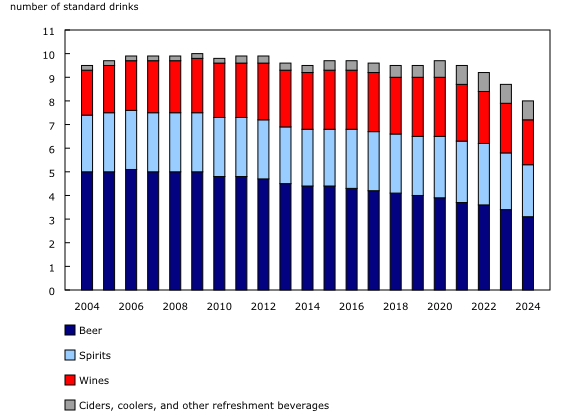
On a volume basis, sales of alcohol declined by 3.0% to 2,898 million litres in 2024/2025. This was the fourth consecutive year volume sales have declined. On average, Canadians of legal drinking age purchased the equivalent of 8.0 standard alcoholic beverages per week in 2024/2025, down from 8.7 the previous fiscal year and 9.7 a decade ago.
Chart 1

Sale of standard drinks per week per person of legal drinking age, 2004/2005 to 2024/2025
Share of domestic alcohol sales edges up
In 2024/2025, domestic products represented 60.6% of total alcohol sales in Canada, up from 59.0% the previous fiscal year.
By beverage type, 88.7% of beer sales and 90.7% of cider and cooler sales were from domestic products. In comparison, domestic products accounted for 46.7% of sales of spirits and 30.0% of wine sales.
The share of domestic alcohol sales increased across all beverage categories in 2024/2025.
Beer’s market share remains stable
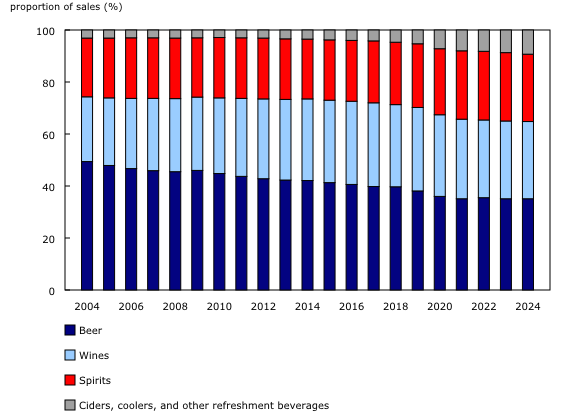
The total value of beer sales by liquor stores, agencies and other retail outlets dropped 1.6% to $9.1 billion in the 2024/2025 fiscal year. Beer maintained its position as the top selling beverage category in 2024/2025; its market share was unchanged from a year earlier at just over one-third (35.1%) of total sales.
Wine (-0.2 percentage points to 29.7%) and spirits (-0.4 percentage points to 25.8%) lost market share on lower sales in 2024/2025. Ciders and coolers was the lone beverage category to gain market share, up 0.6 percentage points, although they continued to represent the smallest share of total sales at 9.3%.
By volume, beer sales declined 3.8% to 1,876 million litres in 2024/2025, the ninth consecutive annual decline in beer sales by volume. Beer sales were equivalent to 3.1 standard bottles of beer per week, per person of legal drinking age.
Chart 2
Market share by type of beverage and year, 2004/2005 to 2024/2025
Imported wine sales decline for the first time
Wine sales fell 2.2% to $7.7 billion in 2024/2025, driven by a decline in imported wine sales (-3.9%). Imported wine accounted for 70.0% of total wine sales. This was the first time imported wine sales have decreased since Statistics Canada began tracking alcohol sales by origin in 1992/1993.
Ontario (-5.3%) and Quebec (-4.3%) had the largest declines in imported wine sales in 2024/2025.
Domestic wine sales were stable, increasing 1.9% to $2.3 billion.
Wine sales by volume totalled 460 million litres, marking the fourth consecutive year of decline. The total litres of wine sold in 2024/2025 was equivalent to approximately 1.9 standard glasses per week for each person of legal drinking age.
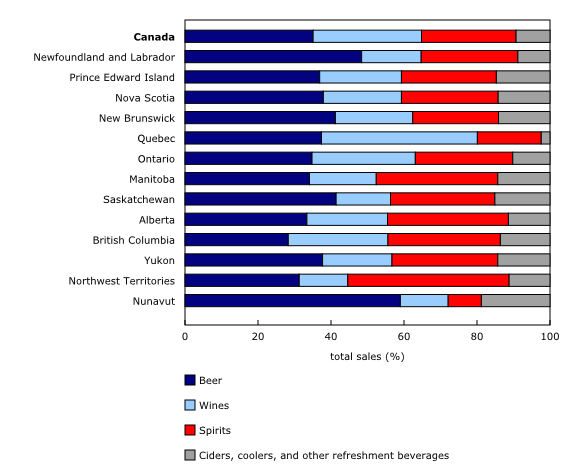
Chart 3
Market share by alcoholic beverage type, provinces and territories, 2024/2025
Sales of spirits decline
Total sales of spirits dropped 3.2% to $6.7 billion in 2024/2025. Whisky (29.6%), vodka (22.9%) and liqueurs (15.4%) were the top-selling spirits by share of total sales.
Overall, sales of spirits by volume decreased by 4.4% to 177 million litres in 2024/2025. The total amount of spirits sold was equivalent to 2.2 shots per week for each Canadian of legal drinking age.
Spirits were the top seller in the Northwest Territories (44.1%) and British Columbia (30.8%).
Ciders and coolers the lone beverage category to grow
Sales of ciders and coolers rose 4.8% from the previous fiscal year to $2.4 billion in 2024/2025. For the second consecutive year, ciders and coolers was the sole alcoholic beverage category with increased sales. Cider and cooler sales were up in nine provinces and two territories in 2024/2025, but down in British Columbia (-2.0%) and Yukon (-1.8%).
The volume of ciders and coolers sold increased by 2.2% to 385 million litres in 2024/2025. The total amount sold was equivalent to approximately 0.8 standard drinks per week for each person of legal drinking age.
Growth in recreational cannabis sales slows
Sales of recreational cannabis by provincial cannabis authorities and other retail outlets increased 6.1% or $0.3 billion from the previous fiscal year to $5.5 billion in 2024/2025. Nevertheless, this was a marked slowdown from the sales increases in 2023/2024 (+11.6%) and 2022/2023 (+15.8%). The price of recreational cannabis decreased 1.1% from March 2024 to March 2025.
Inhaled extracts the fastest growing type of recreational cannabis
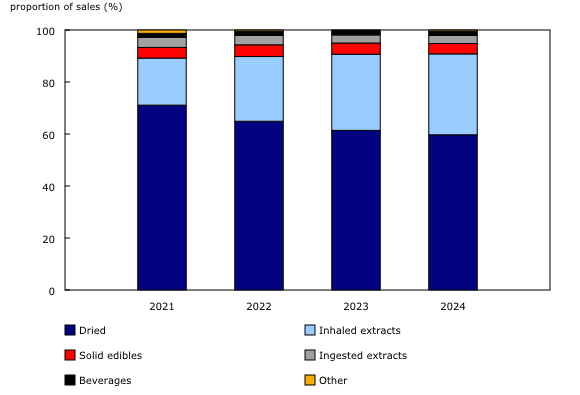
Inhaled extracts was the fastest growing recreational cannabis category in 2024/2025, up 12.8%. The market share of inhaled extracts continued to increase in 2024/2025, up to almost one-third of total sales (31.1%). Solid cannabis edibles (-2.2%) was the lone cannabis category with a sales decline in 2024/2025.
Cannabis sales in 2024/2025 were equivalent to $167 per person of legal age to consume cannabis. Yukon ($384) had the highest sales per person, while Quebec ($105) had the lowest. Quebec’s lower sales partly reflect restrictions in effect during the fiscal year, including a ban on cannabis vaping products and topicals, as well as limited edible offerings.
Chart 4
Market share by cannabis product and year, 2021/2022 to 2024/2025
Focus on Canada and the United States
In 2024/2025, Canada imported $1.0 billion of alcoholic beverages from the United States, down 5.4% from the previous fiscal year. During the same period, exports to the United States totalled $1.4 billion, up 4.1% year over year.
Imported and exported values do not necessarily reflect final sales to consumers.
For detailed and up-to-date figures on Canada-US trade by product type, please refer to the Canadian International Merchandise Trade Web Application.
For more data and insights on areas touched by the socio-economic relationship between Canada and the United States, see the Focus on Canada and the United States webpage.
Note to readers
Comparability and limitations of the data
Statistics on sales of alcoholic beverages by volume should not be equated with data on consumption. Sales volumes include only sales as reported by the liquor authorities and their agencies, including sales by wineries, breweries and other outlets that operate under licence from the liquor authorities.
Statistics on sales of alcoholic beverages by dollar value should not be equated with consumer expenditures on alcoholic beverages. The sales data refer to the revenues received by liquor authorities and their agents, and a portion of these revenues include sales to licenced establishments such as bars and restaurants, some of which would be considered as a business intermediate expense.
The value of sales of alcoholic beverages excludes all sales taxes, the value of returnable containers and deposits. Absolute volume of sales of alcoholic beverages is calculated by multiplying the sales volume by the percentage of alcohol content for each product category.
Statistics on sales of cannabis exclude illicit market transactions. Cannabis sales values include only legal, non-medical sales (excluding all sales taxes) as reported by the cannabis authorities and outlets that operate under licence from the cannabis authorities.
Differences in provincial and territorial legislation have an impact on the types of cannabis products each jurisdiction deems legal. As a result, each jurisdiction’s cannabis sales by product type reflect not only consumer preference but limitations placed on the availability of certain products.
The data collected for cannabis have been sourced from the Government Liquor Authority – Report of Operations survey and the Health Canada Cannabis Tracking System.
Per capita figures do not account for the impacts of international tourism or interprovincial labour mobility, including cases where individuals reside in one province or territory but are temporarily employed in another.
Standard drink
According to Health Canada guidelines, a standard drink is defined as a 341 mL (12 oz.) beer, cooler or cider with 5% alcohol content; a 142 mL (5 oz.) glass of wine with 12% alcohol content; or a 43 mL (1.5 oz.) spirit drink with 40% alcohol.
Legal drinking age versus per capita
Standard drinks per week per person are calculated for each person of legal drinking age in Canada. The legal drinking age is 19 years and older in every province and territory, except for Quebec, Manitoba and Alberta, where it is 18 years and older.
Per capita sales by value and volume for alcohol are based on the population of inhabitants aged 15 years and older. This allows comparability with other countries, the Organisation for Economic Co-operation and Development and the World Health Organization, as they also present alcohol per capita data using the population of inhabitants aged 15 years and older.
Cannabis sales per person
Cannabis sales per person are based on the population of inhabitants of legal age to buy, use, possess and grow recreational cannabis, which is 19 years of age and older across most of Canada, except for Alberta (18 years of age and older) and Quebec (21 years of age and older).
Inflation rates
Inflation rates are referenced from the Consumer Price Index, monthly, not seasonally adjusted.
Products
The infographic “Alcohol and cannabis sales in Canada, April 2024 to March 2025,” which is part of Statistics Canada – Infographics (Catalogue number11-627-M), is now available.
Contact information
For more information, or to enquire about the concepts, methods or data quality of this release, contact us (toll-free 1-800-263-1136; 514-283-8300; infostats@statcan.gc.ca) or Media Relations (statcan.mediahotline-ligneinfomedias.statcan@statcan.gc.ca).