
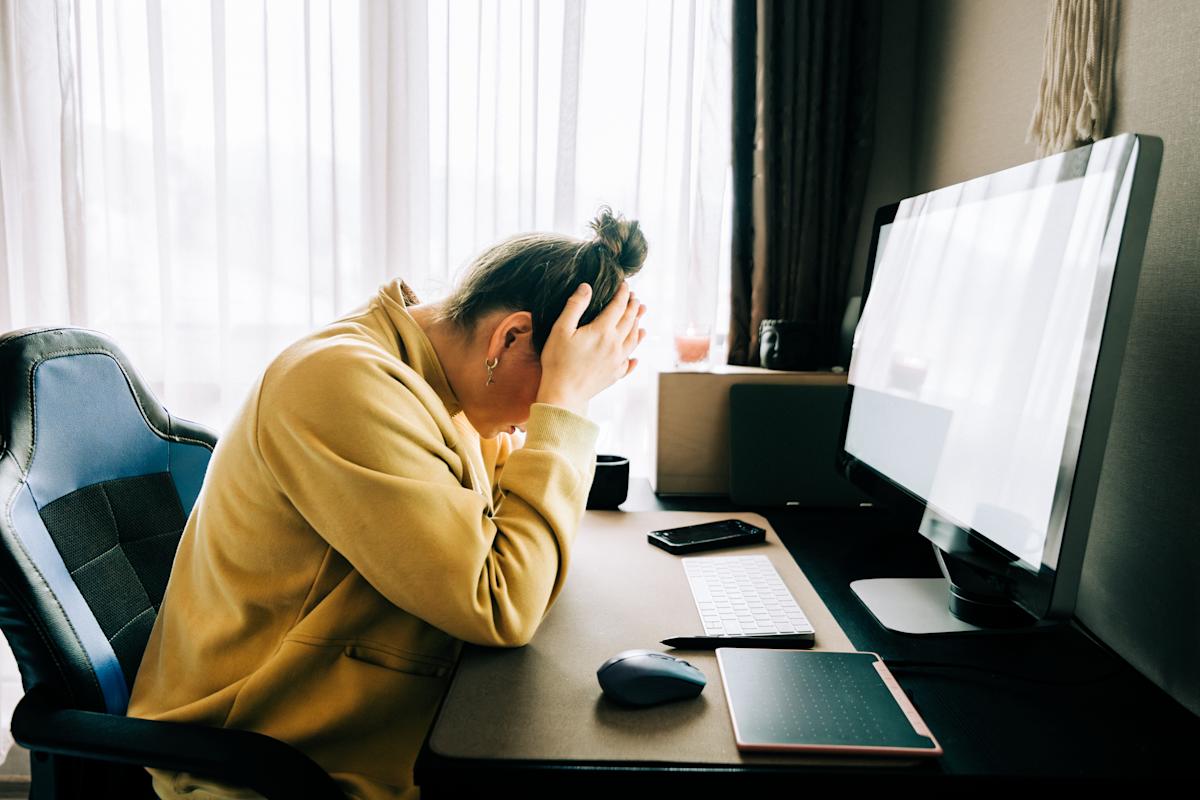
 Employees can also be affected by the stress of those around them, as well as their own. · Olga Pankova via Getty Images
Most of us experience stress at work, whether it’s triggered by a looming deadline, a big decision or a heavy workload. It isn’t just our own issues that cause us stress, however. A considerable proportion of workers experience ‘second-hand’ stress due to those around them exhibiting their own symptoms.
According to new research by RRC International, 964,000 workers in the UK say they are suffering from stress because of work. Of those, 7% say it is caused by those around them.
Like viruses, psychological states can spread from person to person. In 2008, a landmark longitudinal study that followed 4,739 people over 20 years found that happiness depends on the happiness of others with whom they are connected.
Just as someone’s good mood can rub off on you, though, stress can also spread. A 2023 study published in the Journal of Personality and Social Psychology found that perceiving stress among the people you spend time with can lead to experiencing stress yourself.
So what drives second-hand stress – and might working in an office, rather than remotely, make it worse?
“I tend to describe second-hand stress as absorbing tension that doesn’t belong to you, almost like your nervous system is picking up background radio static,” says Dr Elena Touroni, a consultant psychologist and co-founder of The Chelsea Psychology Clinic.
“Psychologically, it’s linked to how humans mirror the emotions of the people around them, often without realising,” she explains. “When someone nearby is rushed, anxious or under pressure, our bodies instinctively track those cues.”
Second-hand stress is rooted in evolution and serves to keep us safe. When we’re around someone who appears stressed, it can act as a signal that something may be wrong – and that we, too, should be on alert.
In response to perceiving stress in others, our bodies release the hormone cortisol, increasing our alertness and preparing us to react quickly to potential danger. In effect, our brains ‘mirror’ what we’re observing.
Our personalities may also determine whether or not we’re affected by other people’s stress. “People who are naturally empathetic, sensitive to others’ moods or perfectionistic are especially prone to it, because they’re continually scanning their environment and can end up carrying the emotional weight of the room,” adds Touroni.
With in-office work becoming more common as some employers shift away from remote work, being in shared spaces can increase exposure to other people’s stress.
Story continues
More than half of UK workers (53%) say they feel expected to spend more time in the workplace, while 14% of employers plan to introduce or increase mandatory office days.
“Offices can create a shared emotional temperature that’s hard to shield yourself from,” says Touroni.
 Workplace stress can rub off on colleagues. · PeopleImages via Getty Images
“Working in an office may increase the risk of second-hand stress because being physically close to others exposes you to their tone of voice, facial tension, frantic typing, sighs and rushed movements, all of which subtly activate your own stress response.”
Remote working usually gives people more control over their environment, which reduces exposure to those ambient stress cues. Stress can still transmit through emails and online meetings, just with less intensity than constant in-person contact.
A little stress isn’t always a bad thing. It can motivate us to finish a project on time, or prepare for a meeting.
But problems arise when workplaces allow chronic stress to go unaddressed for long periods. It’s costly for both employers and workers, leading to reduced productivity, burnout, high staff turnover, and mental and physical health problems such as anxiety and heart disease.
Professor Binna Kandola, a business psychologist and co-founder of Pearn Kandola, says the signs of second-hand stress look similar to normal stress because the same systems are activated.
“These include feeling tense or on edge, irritability, a reduced sense of control, difficulty concentrating and emotional fatigue. In more prolonged situations, people may withdraw, feel cynical or show dips in performance,” he says.
“In most office environments, second-hand stress is more likely to show up as rising tension, short tempers or gradual sense of mental exhaustion rather than serious trauma symptoms. But if exposure is constant, it can build up.”
So how can leaders reduce second-hand stress? The most helpful changes come from setting a calmer, more predictable emotional culture,’ says Touroni. “When leaders model steady pacing, realistic deadlines and clear communication, it reduces the sense of urgency that spreads through teams,” she says.
Practical steps include offering quiet spaces, supporting hybrid working, keeping workloads realistic, and helping managers recognise when tension is building instead of pushing staff through it. Research also shows that giving people more autonomy at work – for example, by being flexible over location or hours – also improves mental wellbeing.
“Encourage recovery, not constant urgency,” says Kandola. “Breaks, quieter spaces and protected time away from intense tasks help prevent stress from building. Where roles involve repeated high-pressure situations, rotation, debriefing and workload monitoring are important.”
Ultimately, second-hand stress is a byproduct of how we’re wired. Our ability to tune into the emotions of others helps us connect, collaborate and stay safe, but it also makes us vulnerable to absorbing tension that isn’t our own.
As workplaces evolve, particularly with a shift back to shared office environments, understanding this psychological spillover is crucial. By recognising how easily stress can spread and taking proactive steps to manage it, we can create healthier, more resilient working cultures.
Read more:
Download the Yahoo Finance app, available for Apple and Android.