
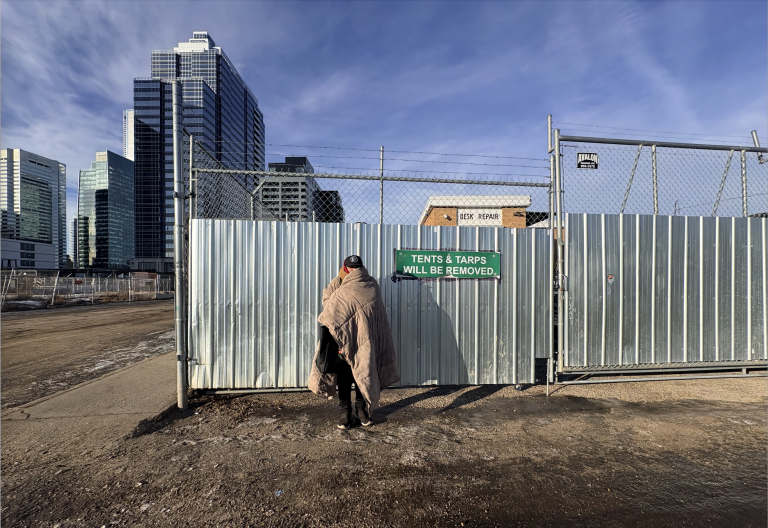
On a feeding night, Gale and her volunteers load vehicles with food and supplies and drive into the cold. Bear Claw sets up and word moves fast. People come. Some are coherent, some are not. Some are in the grinding misery of withdrawal, bodies shaking, eyes gone somewhere else.
Gale moves among them. She knows who needs what. She knows who to hold and who to give space to and who has not eaten since she was last here. She is fierce and tender in the same motion, which can be difficult to sustain.
“I’ve been in this life,” she says. “That’s how come my brothers and sisters — I understand them really well.”
She has a description of herself that she seems to have arrived at with some peace.
“I was a crackhead on the streets. I was sex trafficked here in Edmonton.”
She says it not with shame and not exactly with pride either, but with the particular authority of someone who knows that her history is the credential, the reason she is trusted, the reason people come to her in the cold and the dark rather than away from her.
“It’s a labour of love,” she says. “I go from moment to moment.”
Merrick lives moment to moment too.
“I had a sergeant tell me, ‘Judy, just let us play out our plan.’ To me it’s a genocide.”
He is back at the Maskokamik Lodge now, until he finds out if he can go back to the transitional housing apartment he was living at. A week ago, he yelled at a staff member during an altercation after he had been drinking alcohol — a vice he vows not to continue allowing to hold a grip on him. The apartment offers cheaper rent, three meals a day, and a roof over his head-it’s paid for by a social assistance cheque until he finds a job, but he wants to finish school first. It is more stability than he has had in years.
He has a lot of time to think here. Long nights in a room that is his, technically, but feels like a way station between one uncertain thing and the next. He fills the time reading, drawing, writing lyrics and playing guitar when he can get his hands on one.
Creating art is his outlet.
“Some people describe it as morbid,” he says of his art. “I describe it as honest.”
Merrick was born into a family already fracturing under the weight of things that had happened long before him. His parents separated when he was young. Both struggled with addiction. His father, a man who spent his childhood in foster care, carried wounds that had never been treated.
“He had no mom or father to teach him,” Merrick says. “He was in foster care all his life. So he got abused and abandoned. His attachment issues, he’s emotionally scarred. Mentally scarred.”
His mother was a different kind of absence. He does not call her his mom. “She never loved me. She never treated me like a son. I was more of a slave.” She would look at him and see his father’s face and punish him for it, he says. “You look like your dad. You sound like your dad. You’re gonna be just like your dad.” He heard it enough times that for a while he believed it. They convinced him his dad didn’t want him. They convinced him no one else did either.
What he learned instead was how to sit in a room and read it.
“When you have no friends, you got nobody to talk to, you just sit there and watch people growing up. You recognize patterns. You see how they act, how they react to certain things.”
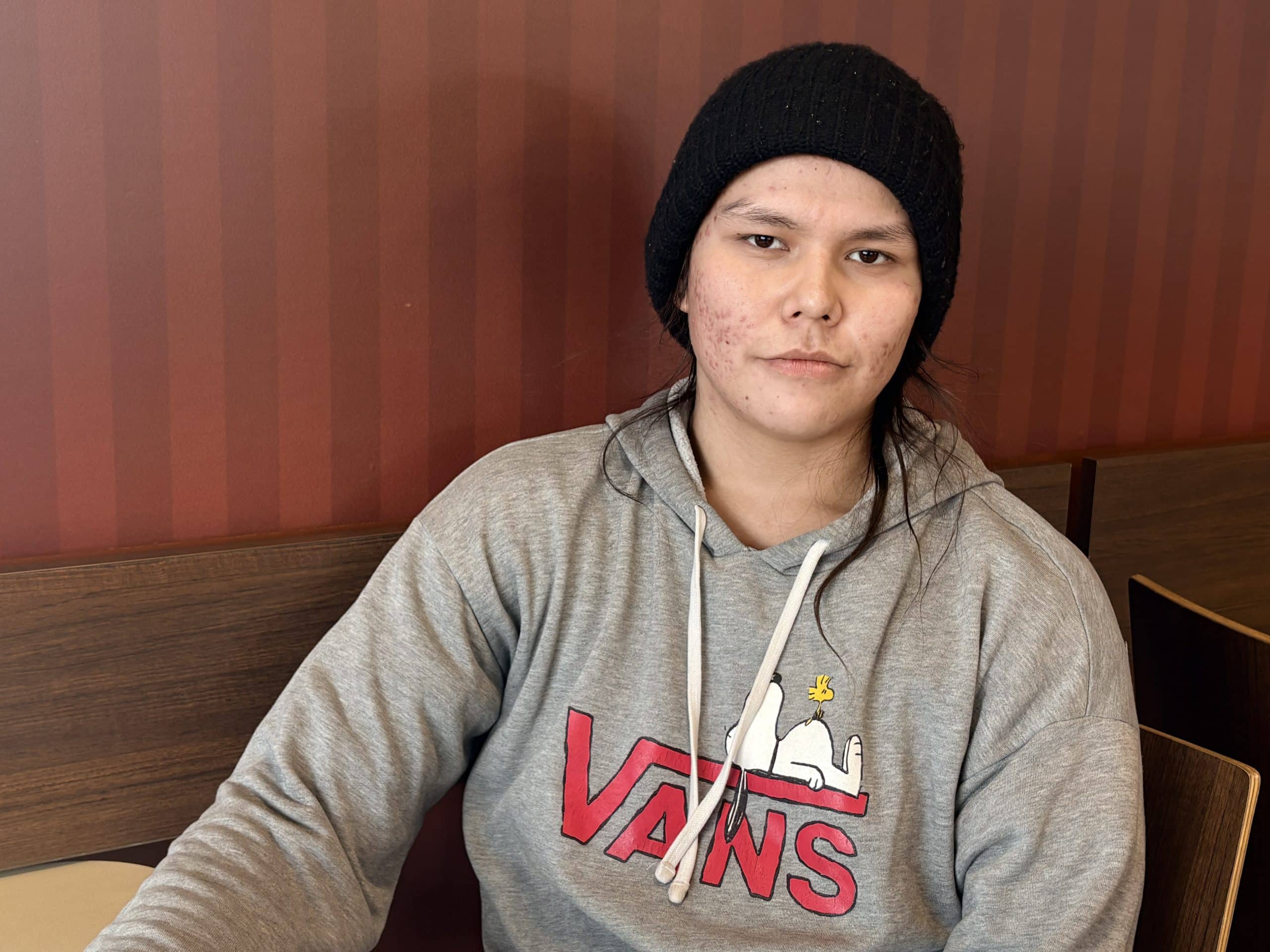 Merrick, 19, from Saddle Lake Cree Nation has experienced homelessness since he was 16 when he lived in a tent with his father in Edmonton. Merrick is currently working to finish high school and hopes to one day have secure housing. Photo by Brandi Morin
The losses in his family came in clusters. His paternal grandmother was found dead in her apartment. She had been sick — cancer — and the landlord had refused to let anyone in. By the time they reached her, she had been alone for three or four days.
“She had no food or water,” Merrick says. “She was starving, dying of thirst. Dying in her own filth.” He pauses. “The landlord went in. Found her body.”
His father’s sister took her own life. And then his maternal grandmother — drunk, in the middle of a fight with his mother, also took her life.
“‘I’m gonna go home and hang myself now.’ And that’s what she did. Went to the garage, grabbed an extension cord.”
He was ten years old when someone else in the family died, his cousin. He remembers standing there when they told him.
“I stopped crying.” He looks at the table. “I don’t feel much emotion sometimes. When I feel it, I feel it hard. But sometimes I just… don’t.”
This is what intergenerational trauma looks like from the inside.
“It’s never just one thing,” he says. “It always piles up and adds onto each other. They’re all interconnected somehow.”
Merrick smiles brightly and gushes that he loved school when he went. He wants to finish Grade 12. He wants, eventually, to study botany.
“I want to get to the point where I’m able to play with the genetics and breed herbal plants, medicinal herbs we can grow at home. So, we don’t have to go to pharmaceuticals and get all those chemicals they feed us.”
He has already mapped out the family he wants to have someday, his dream is simply to become a good father.
But right now, he is nineteen and alone and the two people he is closest to in the world are somewhere in this city and he can’t find them. Finding his dad and sister is what keeps him up at night.
Merrick says he talks to God sometimes. Gets into arguments. And has good discussions, he says.
Outside the Maskokamik Lodge, Edmonton is doing what Edmonton does in February — pressing down cold and dark and indifferent on the thousands of people trying to survive it. The homeless people are getting younger, Merrick has noticed. He saw a girl recently who looked about fifteen, out on the street.
He shifts in his seat. Outside, the cold waits.
“Hope for the best,” he says. “Prepared for the worst. That’s all I got.”