
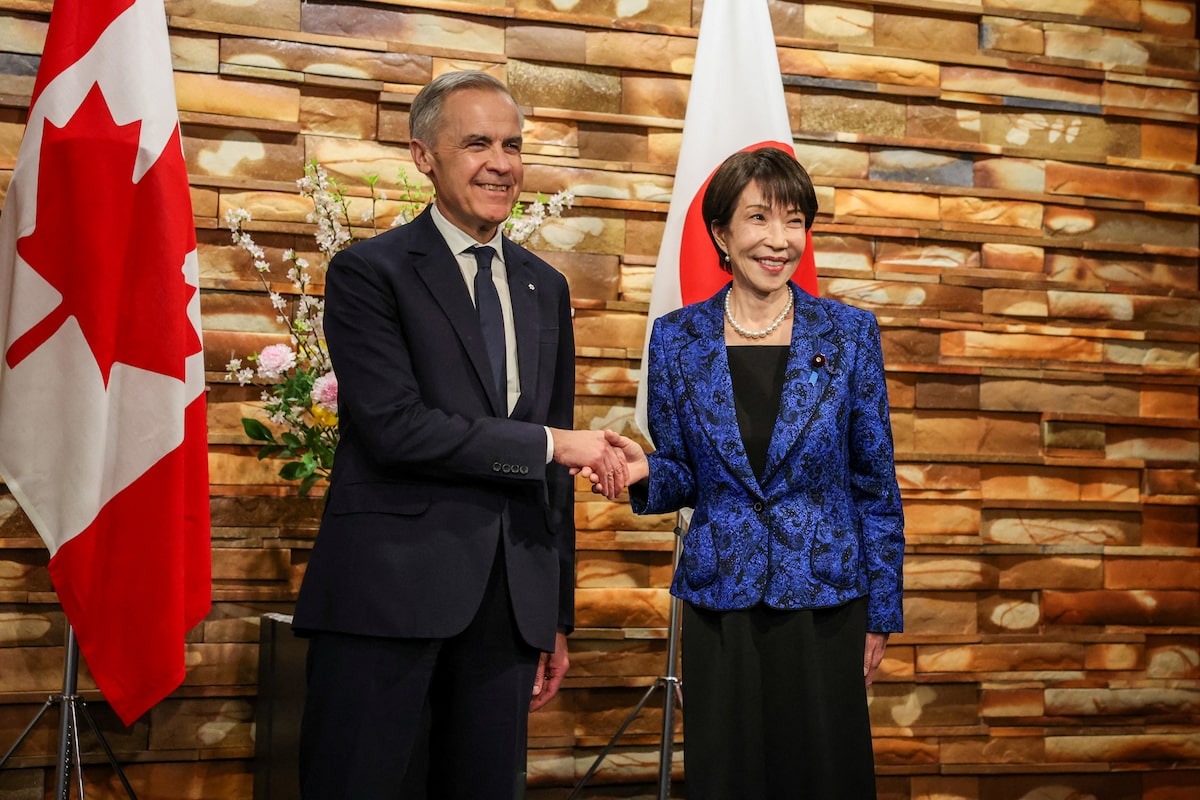
Prime Minister Mark Carney meets Japan’s Prime Minister Sanae Takaichi in Tokyo on Friday.Takashi Aoyama/Reuters
The Royal Canadian Navy will step up joint exercises with Japanese warships and Tokyo is looking at conducting military training with Canada in the Arctic under a new strategic partnership signed by Mark Carney.
The Prime Minister arrived Friday in Japan, arguably Canada’s most important ally in Asia, as part of his drive to boost non-U.S. trade in the face of increased protectionism in the United States under President Donald Trump. It’s the final stop in a 10-day trip that started in India and continued to Australia and Japan.
In Tokyo, Mr. Carney met with Japanese Prime Minister Sanae Takaichi, fresh from a landslide election victory that secured her immediate political future.
The leaders emerged from the Kantei, or prime minister’s office, to announce the partnership that will forge deeper co-operation in defence, energy, critical minerals and advanced technology such as artificial intelligence.
In turbulent times, Canada and Japan must remain reliable allies
Mr. Carney congratulated Ms. Takaichi on her Feb. 8 election victory, which won her a strong mandate from voters for her conservative agenda and tough stance on China.
He called it a “grand-slam worthy of the Hanshin Tigers,” referring to the Japanese leader’s favourite baseball team.
“We in Canada are hoping for similar results from our newest Toronto Blue Jay, Kazuma Okamoto,” he said.
Ms. Takaichi, who repeatedly referred to the Prime Minister as “Mark” in remarks to journalists, said the strategic partnership takes Japan and Canada to a new level.
Mr. Carney was the guest at an official dinner with Ms. Takaichi on Friday evening, where the Prime Minister presented her with a Canadian-themed cake to mark her birthday, which falls on Saturday.
The two leaders signed three memorandums of co-operation on defence and security for joint Coast Guard exercises, international emergency response and action against illegal fishing in the North Pacific. Both Canada and Japan are significantly boosting military spending, which, in Tokyo’s case, is to deter future aggression from China, among other countries.
Canada and Japan announced a new strategic partnership on Friday in Japan.Takashi Aoyama/Reuters
Canada and Japan also pledged to increase joint operations and training with each other’s naval forces, and the PMO in its statement said Tokyo may join Canada’s Operation NANOOK exercises that take place in the Canadian Arctic on a near-year-round basis. NANOOK is Canada’s premier Arctic training and sovereignty operation in the North.
Japan has been an observer in past NANOOK exercises but is now considering full participation, the PMO said.
Mr. Carney, who is grappling with threats from Mr. Trump to limit Canadian-made vehicle shipments to the United States, pitched Ms. Takaichi on maintaining and growing Japanese auto investment in Canada.
“Nearly 75 per cent of the cars manufactured in Canada are made by Japanese companies, supporting thousands of high-quality careers for Canadian workers,” he said. “We are ready to do more.”
Mr. Carney was scheduled to meet Saturday with business leaders in Japan, including major auto makers.
However, Tokyo’s envoy to Ottawa recently said that existing and future Japanese auto investment in Canada will depend on whether export access to the U.S. market is still secure after the 2026 renegotiation of the United States-Mexico-Canada Agreement.
Japanese carmakers retain Canadian footprint as U.S. scales back Ontario operations
At these Saturday meetings, Mr. Carney will present Canada “as a reliable trade partner and competitive destination for new investments,” his office said in a statement.
Mr. Carney and Ms. Takaichi also established a new channel of co-operation called the Canada Japan Cyber Policy Dialogue to jointly fight cyber threats.
In a joint statement, the two leaders said they back “a free and open Indo-Pacific” and “strongly oppose any unilateral attempts” in the region “to change the status quo by force or coercion” – a statement that’s normally understood to include rejecting an attack on Taiwan by China.
Japan is ramping up nuclear power generation after reducing it following the Fukushima nuclear accident in 2011, and Canada could benefit from increased demand for uranium. Companies from Japan are participating in Canada’s efforts to build a commercial, or revenue-generating, small modular nuclear reactor.
Canada has boosted its military presence in the Indo-Pacific in recent years to three warship visits annually. This includes working with Japan as part of the Canadian Armed Forces’ Operation NEON to monitor and disrupt maritime sanctions evasion by North Korea.
Foreign direct investment (FDI) in Canada from Japan amounted to $48.2-billion in 2024, making Japan the fourth-largest source of FDI for the Canadian economy.
The Prime Minister’s Office (PMO) said the Canadian government will lead a Team Canada trade mission to Japan this year.
As part of this new strategic partnership, both countries have instructed government officials to identify immediate investment opportunities, including through pension funds, the PMO said.
Mr. Carney and Ms. Takaichi committed to expanding trade and co-operation on energy products, including liquefied natural gas. Japan’s Mitsubishi Corp. is a 15-per-cent joint-venture partner in the LNG Canada project that began shipping liquefied natural gas to Asia in June, 2025.
Canada is now a significant supplier of liquid petroleum gas (LPG), mainly propane, to Japan. Direct LPG exports from Prince Rupert, B.C., began around 2019.
In 2024, shipments from Calgary’s AltaGas Ltd. hit 24 per cent of the Japanese propane market – all of which is imported. Its market share there dipped to 11 per cent in 2025 after a China-U.S. trade war sparked by Mr. Trump boosted Chinese demand for non-U.S. propane and AltaGas product was diverted there instead.
Japan and Canada also pledged to deepen co-operation on critical minerals, including efforts to secure reliable supplies.
Two-way trade between the two countries is nearly $40-billion annually.