March 6, 2026
Between February 20 and 25, 2026, Abacus Data surveyed 1,000 Alberta adults aged 18 and over as part of our Alberta Omnibus study. This is the second release from that survey. The first examined attitudes toward Alberta independence. In this report, we turn to the broader provincial political landscape, including mood, priorities, leadership evaluations, and vote intention.
The survey was conducted online with a random sample of panelists. The margin of error for a comparable probability-based random sample of this size is plus or minus 3.1 percentage points, 19 times out of 20.
Alberta Politics Survey – Abacus Data
Mood: Alberta and Canada Viewed Similarly
Albertans today express a cautious and somewhat negative assessment of both the direction of the province and the country.
Thirty percent say Alberta is headed in the right direction while 56% believe it is off on the wrong track. Views of Canada are almost identical, with 31% saying the country is headed in the right direction and 54% saying it is off on the wrong track. The broader world is viewed far more pessimistically, with just 9% saying it is on the right track and 78% saying it is off course.
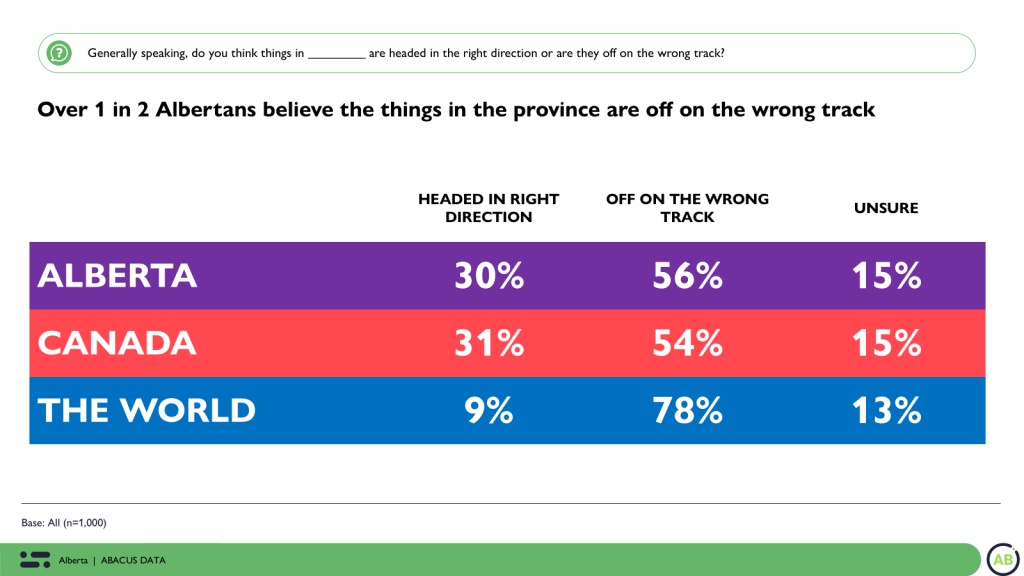
The similarity between provincial and national mood is notable. There is no clear evidence that Albertans are significantly more dissatisfied with Canada’s direction than with their provinces’.
There are important demographic differences. Women are more negative about Alberta’s direction than men, with 62% saying the province is on the wrong track compared with 49% of men. Albertans aged 30 to 44 are the most negative cohort, with 65% saying things are off on the wrong track. Those aged 60 and over are somewhat more positive, with 35% saying the province is headed in the right direction.
Regionally, pessimism is highest in Edmonton, where 59% say Alberta is on the wrong track. In rural areas, views are more divided, with 36% saying things are headed in the right direction and 44% saying wrong track.
Political identity shapes mood strongly. Among 2023 UCP voters, 46% say Alberta is headed in the right direction. Among 2023 NDP voters, just 14% agree while 76% say the province is on the wrong track.
Top Issues: Healthcare a Clear Pressure Point
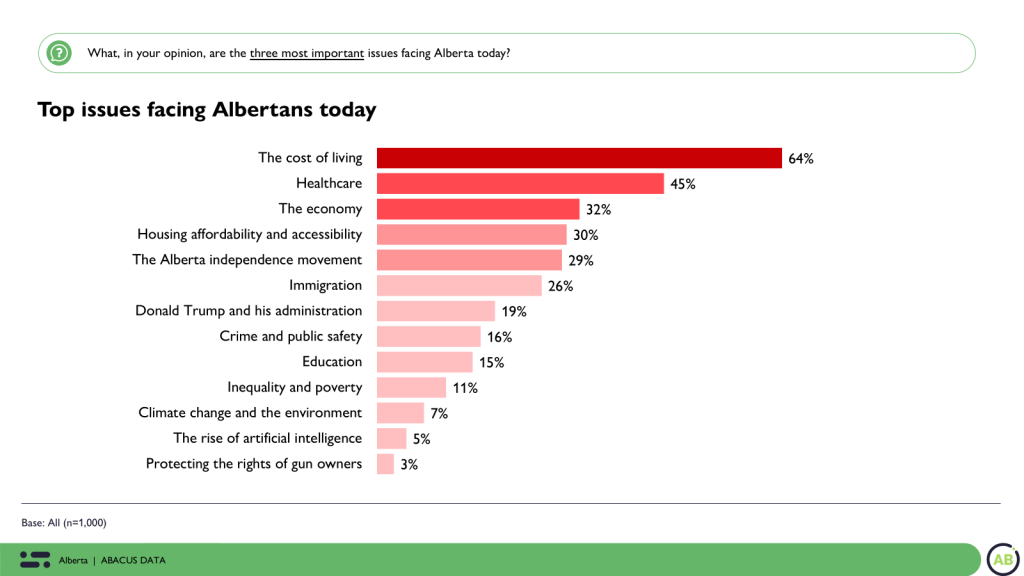
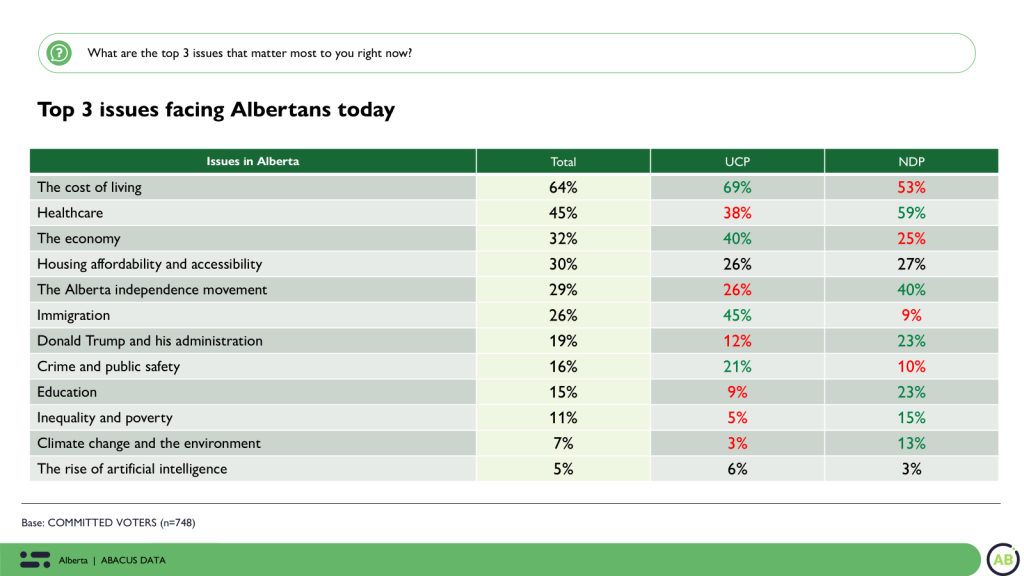
As we reported in our first release, affordability dominates the public agenda. Sixty four percent rank the cost of living as one of the top three issues facing Alberta today.
Healthcare follows at 45%, making it the second most cited issue in the province. The economy registers at 32%, housing affordability at 30%, and the Alberta independence movement at 29%.
Healthcare stands out as a potential vulnerability for the provincial government. While 45% overall identify it as a top issue, concern is especially high among those aged 60 and over, where 64% rank it among their top priorities. A majority of women, 51%, identify healthcare as a top issue compared with 40% of men.
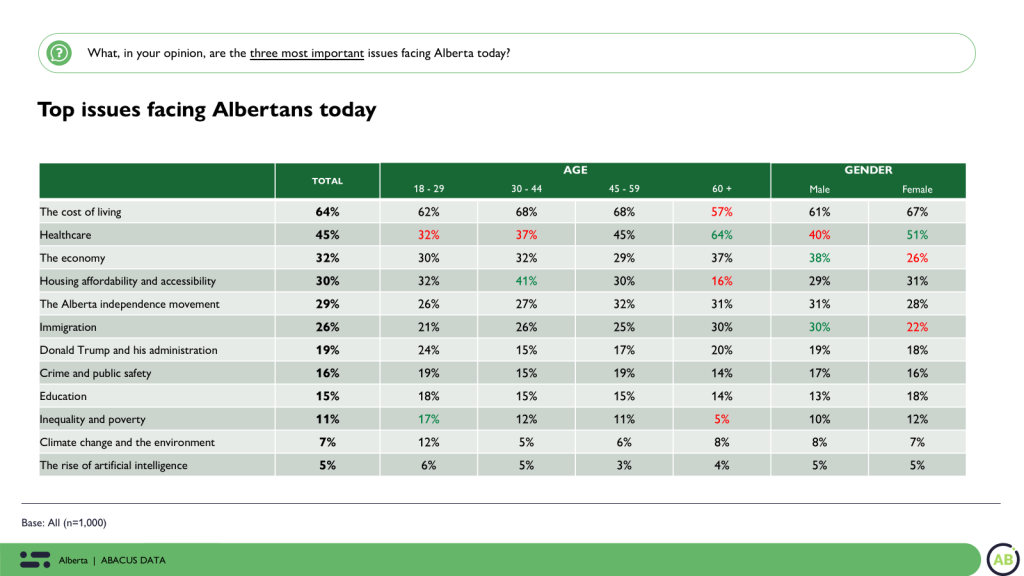
Among 2023 Alberta NDP voters, 56% cite healthcare as a top issue compared with 45% of 2023 UCP voters.
Among committed voters, the issue divide sharpens further. Fifty nine percent of NDP voters rank healthcare as a top issue compared with 38% of UCP voters.
When we examine evaluations of the government’s performance by issue area, healthcare emerges as one of the weakest points for the Smith government. Just 27% approve of how the government is managing healthcare while 53% disapprove. That net negative rating is among the worst across the policy areas tested.
By contrast, 44% approve of how the government is representing Alberta to the federal government and 39% approve of its handling of the economy. On healthcare, education, housing, and helping Albertans cope with inflation, approval remains in the mid to high 20s.
Government and Opposition Approval
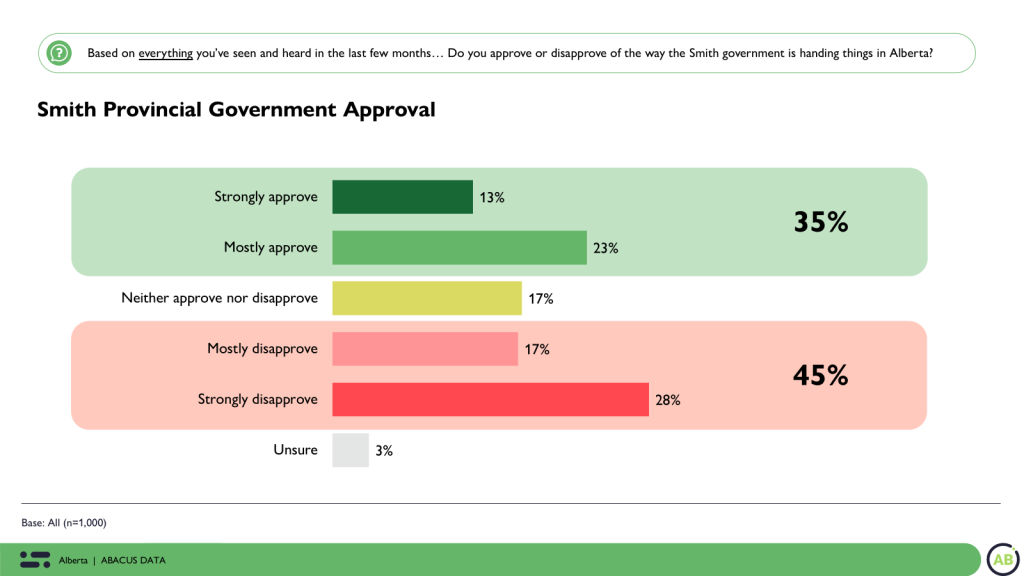
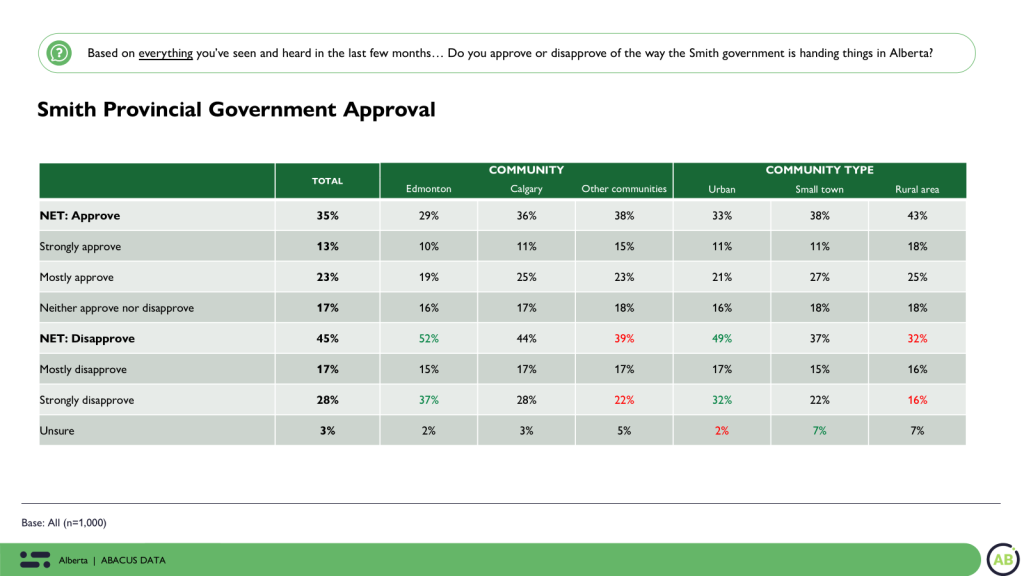
Overall approval of the Smith government stands at 35%, while 45% disapprove and 17% are neutral.
Approval is higher among men at 41% than women at 29%. It rises to 42% among those aged 60 and over but drops to 27% among those aged 18 to 29.
Regionally, approval is strongest in rural Alberta at 43% and weakest in Edmonton at 29%, where 52% disapprove.
The Alberta NDP Official Opposition under Naheed Nenshi receives 28% approval and 38% disapproval, with 22% neutral and 11% unsure. Approval is higher in Edmonton at 35% and Calgary at 29%, but drops to 23% in other communities and 17% in rural areas.
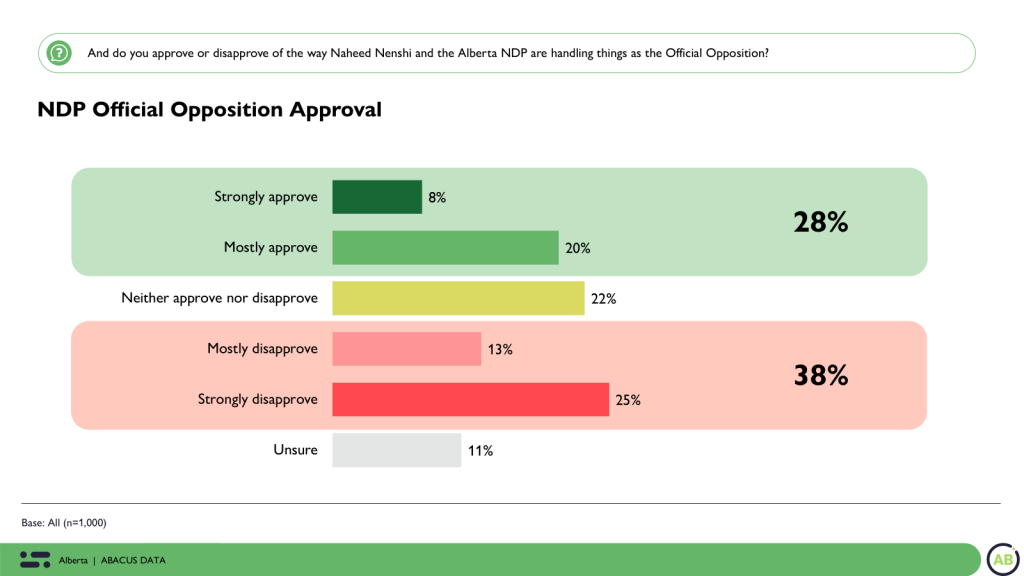
The opposition performs best among younger Albertans aged 18 to 29, where 30% approve and only 21% disapprove. Disapproval rises sharply among those aged 60 and over at 46%.
Leader Impressions: Smith and Nenshi in Similar Territory
Impressions of the two main leaders are remarkably similar.
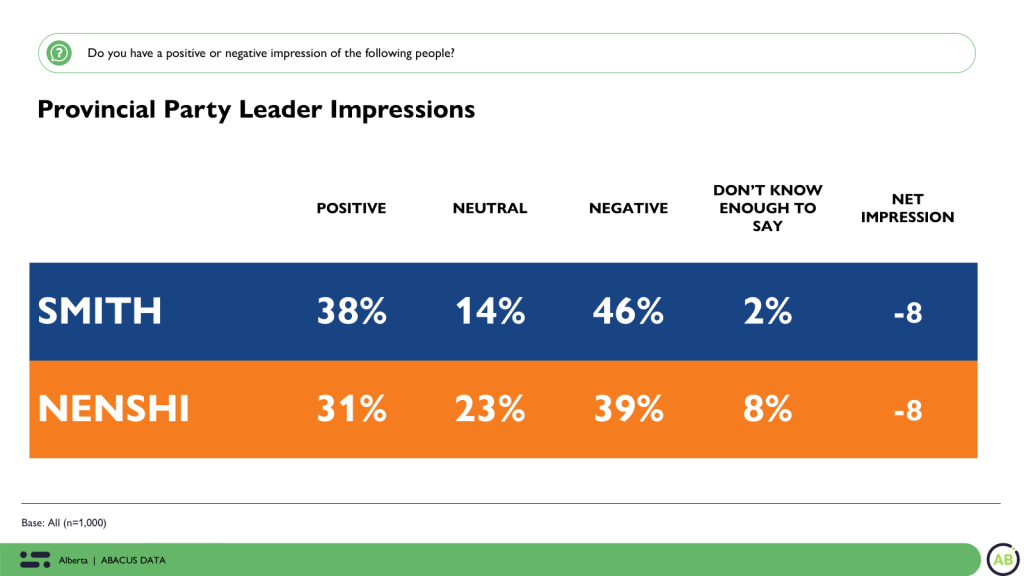
Premier Danielle Smith is viewed positively by 38% and negatively by 46%, for a net impression of negative eight. Naheed Nenshi is viewed positively by 31% and negatively by 39%, also for a net impression of negative eight.
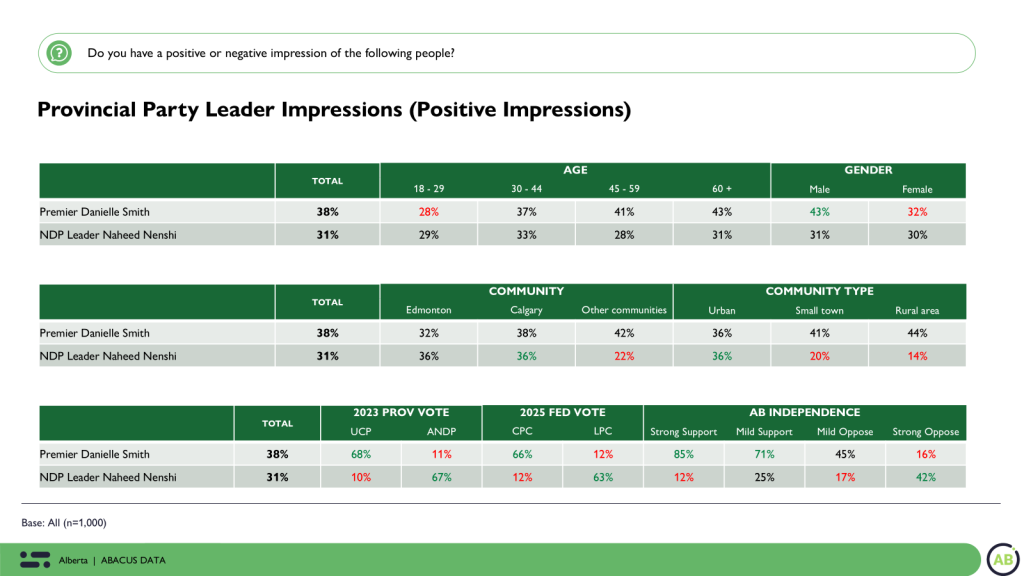
Smith’s positive ratings are highest among those aged 60 and over at 43% and among men at 43%. Nenshi’s positive ratings are strongest in Edmonton and Calgary at 36% each, and among younger voters.
Among 2023 UCP voters, 68% have a positive impression of Smith while just 10% view Nenshi positively. Among 2023 NDP voters, 67% view Nenshi positively while 11% view Smith positively.
The similarity in overall net scores suggests neither leader has yet broken through decisively beyond their partisan base.
Vote Intention: UCP Lead Driven by Strength Outside Major Cities
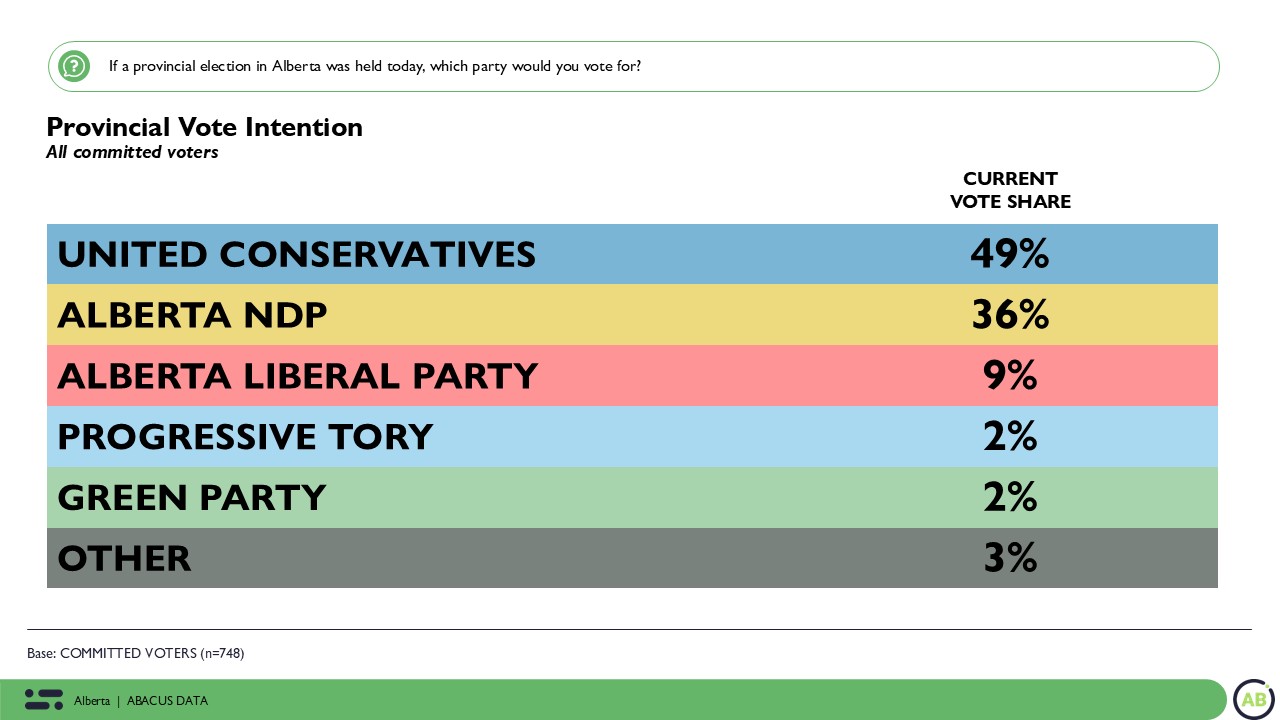
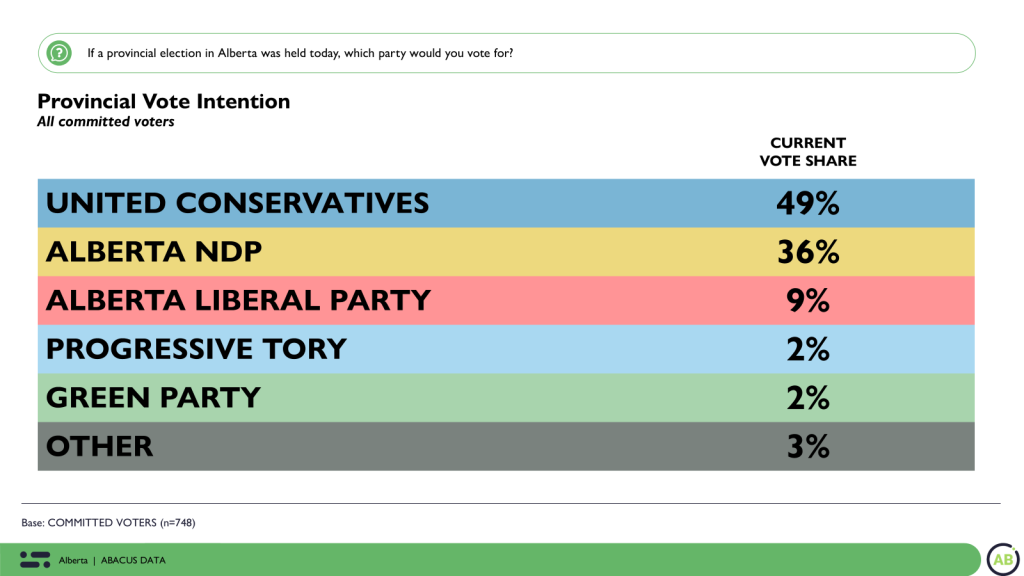
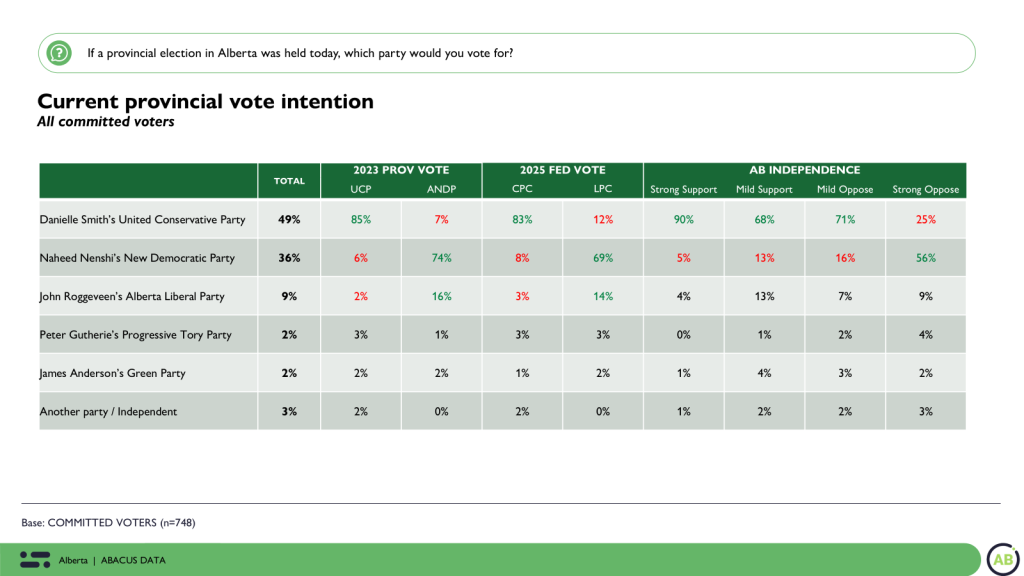
If a provincial election were held today, the United Conservative Party would receive 49% of the vote among committed voters, compared with 36% for the Alberta NDP. The Alberta Liberal Party registers 9%, with smaller shares for other parties.
The UCP’s lead is driven heavily by performance outside the two major cities. In Edmonton, the NDP leads 44% to 38%. In Calgary, the race is closer, with the UCP at 46% and the NDP at 38%.
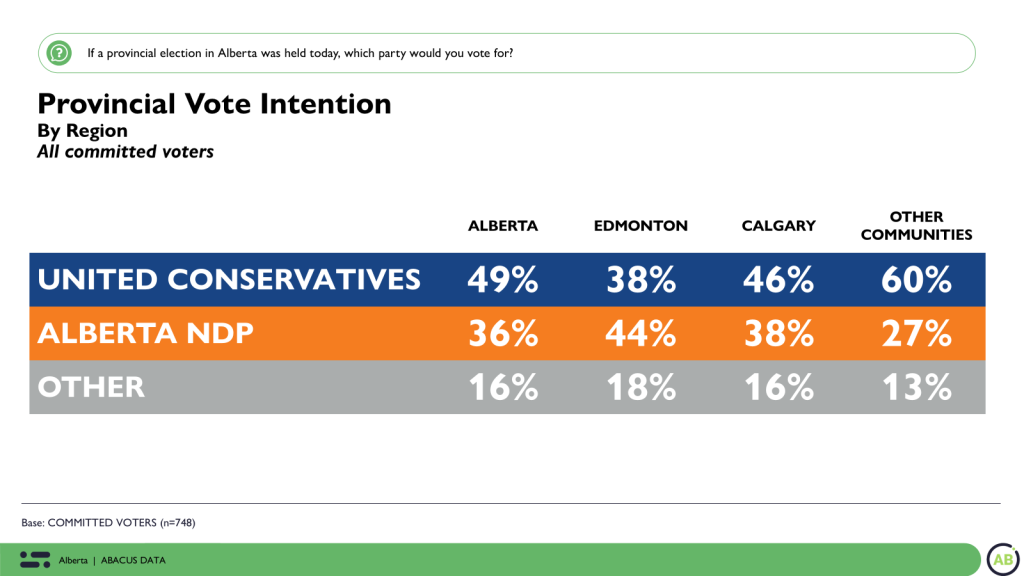
In other communities, however, the UCP leads 60% to 27%. In rural Alberta, the UCP dominates with 70% compared with just 15% for the NDP.
Age also shapes the vote. The UCP leads among voters aged 45 to 59 at 55% and among those 60 and over at 54%. Among voters aged 18 to 29, the race is much tighter, with the UCP at 34% and the NDP at 35%. The Alberta Liberal Party’s 9% overall includes 20% among those aged 18 to 29, a notable overperformance in that cohort.
The Alberta Liberal Party’s 9% province wide vote share likely reflects a halo effect from federal politics, particularly among federal Liberal voters, 14% of whom say they would support the Alberta Liberals provincially. This is notable given the party’s limited presence and candidate slate in the last provincial election.
Provincial vote intention aligns strongly with past vote. Eighty five percent of 2023 UCP voters would vote UCP again, while 74% of 2023 NDP voters would stick with the NDP.
Importantly, views toward Alberta independence do not appear to be driving provincial vote intention in a decisive way. Among those who strongly oppose independence, 56% would vote NDP and 25% UCP. Among those who strongly support independence, 90% would vote UCP. However, as we reported in our first release, independence remains a minority issue and ranks behind cost of living and healthcare. The overall structure of the provincial race appears largely unchanged.
The Upshot
According to Abacus Data CEO David Coletto: “This survey shows a province that is cautious, somewhat dissatisfied, but politically stable.
Albertans view the direction of the province and the country almost identically. There is no dramatic divergence in mood. Roughly three in ten think things are headed in the right direction and just over half think things are on the wrong track.
Affordability remains the dominant issue. But healthcare stands out as a significant vulnerability for the provincial government. It is the second most cited issue overall, the top issue for seniors, and an area where government approval is deeply negative. Just 27% approve of the government’s handling of healthcare while a majority disapprove. That is a pressure point that cannot be ignored.
At the leadership level, Danielle Smith and Naheed Nenshi are in similar territory. Both have net negative eight impression scores. Neither has yet expanded decisively beyond their base.
On vote intention, the UCP hold a sizeable lead at 49% to 36%. That lead is built on overwhelming support outside Edmonton and Calgary. In rural Alberta, the UCP are dominant. In Edmonton, the NDP lead. Calgary remains competitive.
The Alberta Liberal Party’s 9% is likely more about federal brand spillover than provincial organization. It reflects a halo effect rather than a structural breakthrough.
When we connect this to our first release on Alberta independence, the broader picture becomes clearer. Independence is a minority position. It ranks behind cost of living and healthcare as a priority. And attitudes toward independence do not appear to be fundamentally reshaping the provincial ballot at this stage.
Even the Premier’s announcement of several referendum questions to be put to voters in October has not meaningfully altered vote intention in the short term.
The political environment is not static. Healthcare pressures and affordability concerns remain real. But at this moment, the structure of the race is stable. The UCP benefit from geography and consolidation outside the major cities. The NDP remain competitive in urban Alberta. And the defining issues of the day are practical and economic rather than constitutional.
That is the terrain as we head into the next phase of Alberta’s political cycle.”
Methodology
The survey was conducted online with 1,000 adults aged 18 and over living in Alberta from February 20 to 25, 2026.
A random sample of panelists was invited to complete the survey from a set of partner panels managed through the PureSpectrum platform. These panels are typically double opt-in and blended to manage out potential skews that can occur when relying on a single source.
The margin of error for a comparable probability-based random sample of the same size is plus or minus 3.1 percentage points, 19 times out of 20.
The data were weighted according to the latest Census data to ensure the sample matched Alberta’s population by age, gender, educational attainment, and region. Totals may not add to 100 due to rounding.
This research was conducted and paid for by Abacus Data.
Abacus Data follows the CRIC Public Opinion Research Standards and Disclosure Requirements.
For media interviews about this poll, please contact us at [email protected].
About Abacus Data
We are Canada’s most sought-after, influential, and impactful polling and market research firm. We are hired by many of North America’s most respected and influential brands and organizations.
We use the latest technology, sound science, and deep experience to generate top-flight research-based advice to our clients. We offer global research capacity with a strong focus on customer service, attention to detail, and exceptional value.
And we are growing throughout all parts of Canada and the United States and have capacity for new clients who want high quality research insights with enlightened hospitality.
Our record speaks for itself: we were one of the most accurate pollsters conducting research during the 2025 Canadian election following up on our outstanding record in the 2021, 2019, 2015, and 2011 federal elections.
Contact us with any questions.
Find out more about how we can help your organization by downloading our corporate profile and service offering.