
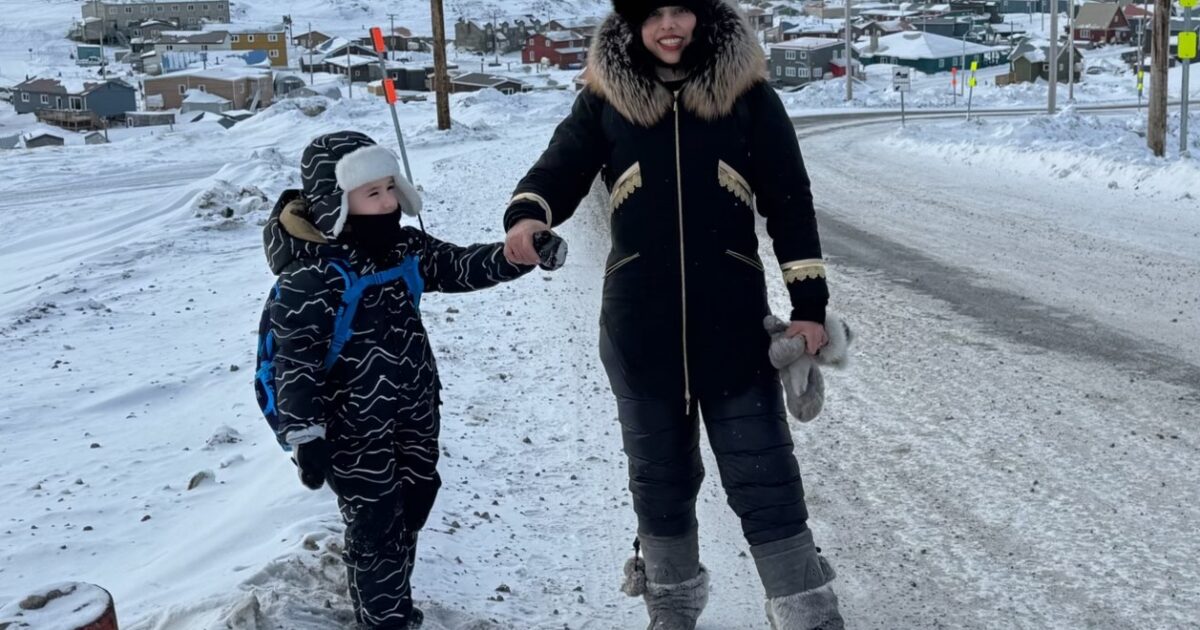
War not the path to peace, says Sima Sahar Zerehi, who was born in the country’s southern region
Watching her family’s homeland from nearly 8,000 kilometres away, Sima Sahar Zerehi says she’s hopeful Iranians will soon find independence and security, but that hope doesn’t come easy.
Zerehi was born in Ahvaz, about 800 kilometres southwest of Iran’s capital city of Tehran. She has lived in Iqaluit for the past 10 years, but her job requires her to split her time between Nunavut’s capital and the south.
Zerehi’s family fled Iran in 1984, stopping in Turkey before landing in Canada in 1989. Her parents, who were activists, were targeted by former supreme leader Ruhollah Khomeini’s regime. Her mom spent time in jail as a political prisoner.
“Their hope was for a better country. Their hope was for greater democracy,” she said.
After more than 40 years of Islamist authoritarian rule, the United States and Israel attacked the Middle Eastern country last Saturday. The initial strikes killed Supreme Leader Ali Hosseini Khamenei. A girls’ school was also hit, killing 165 people, most of them children.
“All I know is that when bombs fall, people die,” Zerehi said.
“A lot of those people are innocent, and obviously the worst and most horrific moments are when children are caught in the crossfire.”

Zerehi has cousins living in Iran. Everybody in her family seems safe so far but communication is spotty, she said.
The military conflict is ever-widening with Iranian attacks on Bahrain, Iraq, Jordan, Kuwait, Qatar, Saudi Arabia and the United Arab Emirates. Israel has also turned its aggression on Beirut, Lebanon.
The number of civilian deaths in Iran was estimated at 1,114 as of Thursday — including 183 children, most of them under the age of 10 — according to data shared by the Virginia-based Human Rights Activists in Iran organization.
It’s not clear who will emerge as Iran’s leader with the death of Supreme Leader Khamenei, but U.S. President Donald Trump has indicated he wants a say in that.
“I am not hopeful that liberation can be achieved through war,” Zerehi said of Iran’s uncertain future. “However, I do put my hope on the resistance on the ground, carried out by Iranians to overthrow their own government.”
There are nine other people of Iranian descent living in Nunavut, according to the 2021 census.

“I know there are mixed reactions to the bombing among the Iranian-Canadian community,” Zerehi said. “The one unifying sentiment is everybody wants a free and democratic Iran.”
Prime Minister Mark Carney and Foreign Affairs Minister Anita Anand expressed solidarity with the U.S. and Israel in a statement following the initial bombing on Saturday.
While Canada’s military is so far not participating in the war, Carney has acknowledged that the conflict is spreading and Canada will stand by its allies “when it makes sense,” according to reporting Thursday by CBC News.
“I think the Canadian government should support the people of Iran,” Zerehi said.
“What people have wanted and have asked for is a very simple thing — turn on the internet, put the pressure on the global community to ensure that everyone from Iran can have their voices amplified.”

United Nations Secretary-General António Guterres has condemned both the joint military attacks and Iran’s response.