

Listen to this article
Estimated 4 minutes
The audio version of this article is generated by AI-based technology. Mispronunciations can occur. We are working with our partners to continually review and improve the results.
Some women on Prince Edward Island are not getting equitable access to early breast cancer detection, says a non-profit group that raises awareness about screening practices.
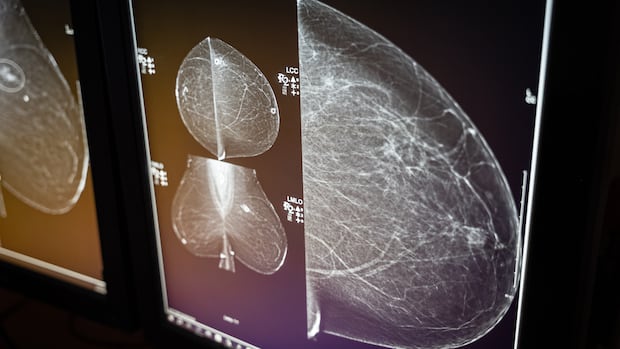
Mammograms are often less effective for those with dense breasts — or breasts with a higher proportion of fibroglandular tissue compared to fat — said Jennie Dale, the founder and executive director of Dense Breasts Canada.
“Dense tissue and cancer both appear white on a mammogram, making it very hard for the cancer to be detected,” Dale said, noting that the effectiveness of mammograms for those who fall under the highest category of density is only about 60 per cent.
“Women with dense breasts need additional screening.… The province is aware of that, and yet has left these women without an equitable chance to find cancer early.”
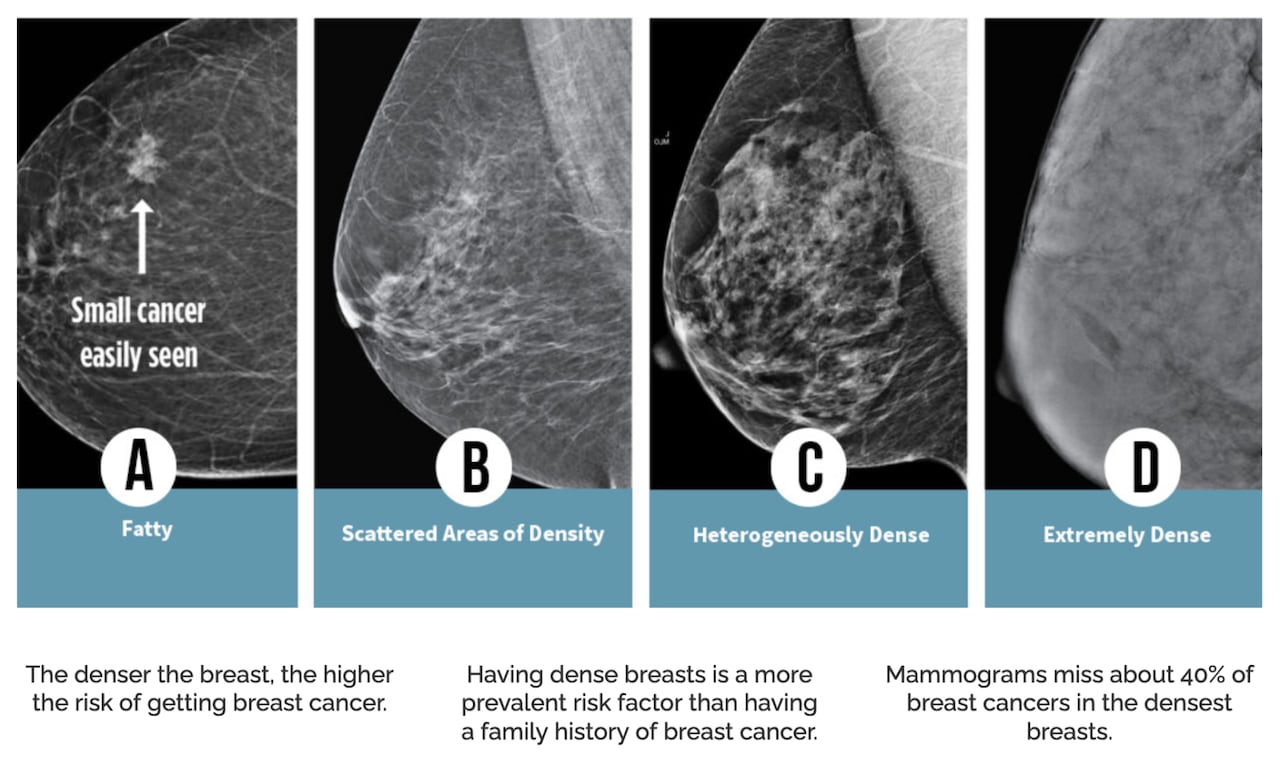 Dense breasts are divided into four categories, ranging from mainly fatty tissue to mostly glandular and fibrous. (Submitted by Dense Breasts Canada)
In 2019, then-premier Dennis King’s government promised to begin notifying all Islanders who have a mammogram of their breast density. The province also promised to look into the potential of adding ultrasound screening for those with the highest density.
Health P.E.I. said in 2022 that ultrasounds were not being used in the provincial breast screening program, and there were no plans to begin doing so any time soon.
Supplemental screening — either by way of ultrasound, MRI or contrast-enhanced mammography — is what advocates like Dale are pushing for now.
“Early detection can be achieved through additional screening for women with dense breasts. Give them an equal chance,” she said.
A representative from Health P.E.I. was not made available for an interview on the topic by the time of publication.
‘There’s no action’
The lack of screening options for those with dense breasts is frustrating, said Pam Hall, a breast cancer survivor and advocate.
“Provinces are responsible for providing access to a family doctor.… But they’re also responsible for getting accurate testing with supplemental ultrasound and MRI for early detection because everyone deserves early detection — not just ones without dense breasts,” she said.
“I don’t get supplemental screening, even as a breast cancer survivor with dense breasts.”
Hall said she’s heard the topic discussed in the P.E.I. Legislature and has met with MLAs to get some answers, but there has been little movement on the issue.
“We need action. There’s a cancer strategy and there’s the breast cancer action plan, but there’s no action,” she said.
“The evidence is there, and other provinces recognize it and they’re finding ways to be able to do more ultrasounds and MRIs.”
‘Early detection is everything’
Inadequeate screening methods for those with dense breasts “puts the women of P.E.I. at risk and puts them at a disadvantage,” Dale said, noting that “early detection is everything.”
The five-year survival rate for those whose cancer was found at Stage 1 is almost 100 per cent, while those whose cancer was found at Stage 4 have a five-year survival rate of about 23 per cent, according to the Canadian Cancer Society’s 2025 cancer statistics report.
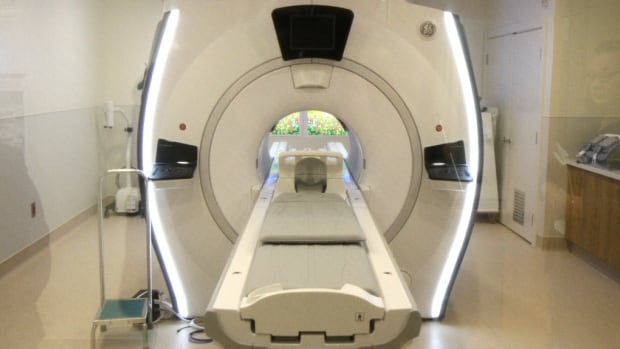 Supplemental screening — either by way of ultrasound, MRI or contrast-enhanced mammography — is what advocates like Dale are pushing for in P.E.I. (CBC)
Early detection also has psychological benefits, like reducing the amount of time needed for treatment.
“It’s not just about survival,” Dale said. “It’s also about quality of life and the impact on one’s life.”
By making changes like adding supplemental screening and offering women 75 and older the chance to self-refer for breast examinations, she said, P.E.I. could be on track to be a leader in breast health.
But for now, the province is trailing behind others that already offer these kinds of screening and prevention tools, she said.
“If you live in P.E.I., you don’t have the same chance at finding cancer early as a woman who lives in Alberta,” Dale said. “We have the technology to find cancer early and we need to use it.”