
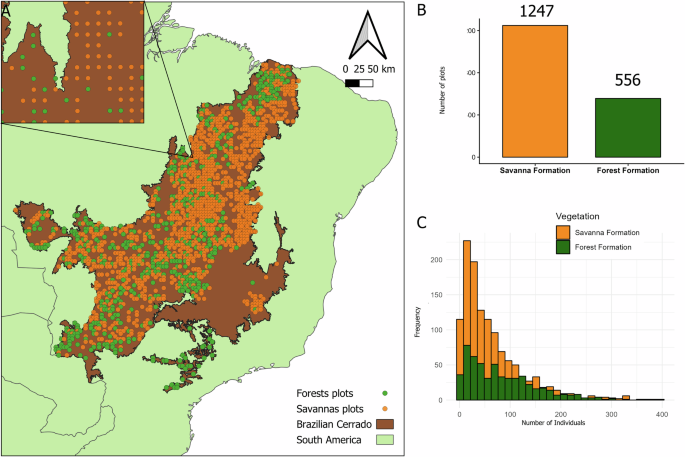
Díaz, S., Fargione, J., Iii, F. S. C. & Tilman, D. Biodiversity loss threatens human well-being. PLOS Biol. 4, e277 (2006).
Zhang, R., Tian, D., Wang, J. & Niu, S. Critical role of multidimensional biodiversity in contributing to ecosystem sustainability under global change. Geogr. Sustainability 4, 232–243 (2023).
Cardinale, B. J. et al. Biodiversity loss and its impact on humanity. Nature 486, 59–67 (2012).
Díaz, S. et al. Pervasive human-driven decline of life on Earth points to the need for transformative change. Science 366, eaax3100 (2019).
Keck, F. et al. The global human impact on biodiversity. Nature 641, 395–400 (2025).
Scheffers, B. R. et al. The broad footprint of climate change from genes to biomes to people. Science 354, aaf7671 (2016).
Ribeiro, R. et al. Advances in Brazil’s National Forest Inventory. Res. Ideas Outcomes 10, e138413 (2024).
Johnson, C. N. et al. Biodiversity losses and conservation responses in the Anthropocene. Science 356, 270–275 (2017).
Proença, V. et al. Global biodiversity monitoring: From data sources to Essential Biodiversity Variables. Biol. Conserv. 213, 256–263 (2017).
Brummitt, N., Araújo, A. C. & Harris, T. Areas of plant diversity—What do we know? PLANTS, PEOPLE. PLANET 3, 33–44 (2021).
Daniel, V., Munhoz, C., Proença, C. & CAMPOS, Y. Sabanas Del Cerrado En Bolivia: Delimitación, Síntesis Terminológica Y Sus Caracteristicas Fisionómicas Cerrado Grasslands And Savanna In Bolivia: Delimitation, Terminology And Physiognomies. Kempffiana 12, 47–80 (2016).
Vourlitis, G. L. et al. Tree growth responses to climate variation in upland and seasonally flooded forests and woodlands of the Cerrado-Pantanal transition of Brazil. Ecol. Manag. 505, 119917 (2022).
Alvarez, F. et al. Tree species hyperdominance and rarity in the South American Cerrado. Commun. Biol. 8, 695 (2025).
Ratter, J. A., Bridgewater, S. & Ribeiro, J. F. Biodiversity Patterns of the Woody Vegetation of the Brazilian Cerrado. in Neotropical Savannas and Seasonally Dry Forests (CRC Press, 2006).
Strassburg, B. B. N. et al. Moment of truth for the Cerrado hotspot. Nat. Ecol. Evol. 1, 1–3 (2017).
Françoso, R. D. et al. Habitat loss and the effectiveness of protected areas in the Cerrado Biodiversity Hotspot. Nat. Conserv. ção 13, 35–40 (2015).
ter Steege, H. et al. Mapping density, diversity and species-richness of the Amazon tree flora. Commun. Biol. 6, 1–14 (2023).
Ter Steege, H. et al. A spatial model of tree α-diversity and tree density for the Amazon. Biodivers. Conserv. 12, 2255–2277 (2003).
Ribeiro, J. & Walter, B. As principais fitofisionomias do bioma Cerrado. in 151–212 (2008).
Françoso, R. D. et al. Delimiting floristic biogeographic districts in the Cerrado and assessing their conservation status. Biodivers. Conserv 29, 1477–1500 (2020).
Bueno, M. L. et al. The environmental triangle of the Cerrado Domain: Ecological factors driving shifts in tree species composition between forests and savannas. J. Ecol. 106, 2109–2120 (2018).
Cordeiro, N. G. et al. The role of environmental filters in Brazilian savanna vegetation dynamics. Ecol. Manag. 500, 119645 (2021).
Bridgewater, S., Ratter, J. A. & Felipe Ribeiro, J. Biogeographic patterns, β-diversity and dominance in the cerrado biome of Brazil. Biodivers. Conserv. 13, 2295–2317 (2004).
Hortal, J. et al. Seven shortfalls that beset large-scale knowledge of biodiversity. Annu. Rev. Ecol. Evolut. Syst. 46, 523–549 (2015).
Guilherme, F. A. G., Júnior, A. F., Pereira, F. C., Silva, G. E. & Maciel, E. A. Disturbances and environmental gradients influence the dynamics of individuals and basal area in the Cerrado complex. Trees People 9, 100298 (2022).
Oliveira-Filho, A. T. & Ratter, J. A. 6. Vegetation Physiognomies and Woody Flora of the Cerrado Biome. in The Cerrados of Brazil: Ecology and Natural History of a Neotropical Savanna (eds Oliveira, P. S. & Marquis, R. J.) 91–120 (Columbia University Press, 2002).
de Miranda, S. doC. et al. Regional variations in biomass distribution in Brazilian Savanna Woodland. Biotropica 46, 125–138 (2014).
Morandi, P. S. et al. Tree diversity and above-ground biomass in the South America Cerrado biome and their conservation implications. Biodivers. Conserv 29, 1519–1536 (2020).
Felfili, J. M. et al. Análise comparativa da florística e fitossociologia da vegetação arbórea do cerrado sensu stricto na Chapada Pratinha, DF – Brasil. Acta Bot. Bras. 6, 27–46 (1992).
Moro, M. & Martins, F. Métodos de levantamento do componente arbóreo-arbustivo. in 174–212 (2011).
Killeen, T. J., Jardim, A., Mamani, F. & Rojas, N. Diversity, composition and structure of a tropical semideciduous forest in the Chiquitanía region of Santa Cruz, Bolivia. J. Trop. Ecol. 14, 803–827 (1998).
An Overview of the Plant Diversity, Biogeography and Conservation of Neotropical Savannas and Seasonally Dry Forests. in Neotropical Savannas and Seasonally Dry Forests (eds Pennington, R. T., Lewis, G. P. & Ratter, J. A.) (CRC Press, 2006).
Killeen, T. J. et al. The Chiquitano Dry Forest, the Transition between Humid and Dry Forest in Eastern Lowland Bolivia. in Neotropical Savannas and Seasonally Dry Forests (CRC Press, 2006).
Marimon, B. S. et al. Disequilibrium and hyperdynamic tree turnover at the forest–cerrado transition zone in southern Amazonia. Plant Ecol. Diversity 7, 281–292 (2014).
Marimon Junior, B. H. & Haridasan, M. Comparação da vegetação arbórea e características edáficas de um cerradão e um cerrado sensu stricto em áreas adjacentes sobre solo distrófico no leste de Mato Grosso, Brasil. Acta Bot. Bras. 19, 913–926 (2005).
Kunz, S. H., Ivanauskas, N. M. & Martins, S. V. Estrutura fitossociológica de uma área de cerradão em Canarana, Estado do Mato Grosso, Brasil – https://doi.org/10.4025/actascibiolsci.v31i3.1625. Acta Scientiarum. Biological Sciences 31, 255–261 (2009).
Castro, A. A. J. F., Martins, F. R., Tamashiro, J. Y. & Shepherd, G. J. How Rich is the Flora of Brazilian Cerrados? Ann. Mo. Botanical Gard. 86, 192–224 (1999).
Maracahipes Santos, L. et al. Diversity, floristic composition, and structure of the woody vegetation of the Cerrado in the Cerrado–Amazon transition zone in Mato Grosso, Brazil. Braz. J. Bot. 38, 877–887 (2015).
Méio, B. B. et al. Influência da flora das florestas Amazônica e Atlântica na vegetação do cerrado sensu stricto. Braz. J. Bot. 26, 437–444 (2003).
Maciel, E. A., Oliveira-Filho, A. T. & Eisenlohr, P. V. Prioritizing rare tree species of the Cerrado-Amazon ecotone: warnings and insights emerging from a comprehensive transitional zone of South America. Nat. Conserv. ção 14, 74–82 (2016).
de Lima, R. B. et al. Giants of the Amazon: How does environmental variation drive the diversity patterns of large trees? Glob. Change Biol. 29, 4861–4879 (2023).
Olivares, I., Svenning, J.-C., van Bodegom, P. M. & Balslev, H. Effects of warming and drought on the vegetation and plant diversity in the amazon basin. Bot. Rev. 81, 42–69 (2015).
Hofmann, G. S. et al. The Brazilian Cerrado is becoming hotter and drier. Glob. Chang Biol. 27, 4060–4073 (2021).
das Graças Costa, A. et al. Influence of fire on woody vegetation of savanna and forest formations in the Cerrado biome. J. Res. 34, 1207–1216 (2023).
Hoffmann, W. A. Fire and population dynamics of woody plants in a neotropical savanna: Matrix model projections. Ecology 80, 1354–1369 (1999).
Hoffmann, W. A. et al. Tree topkill, not mortality, governs the dynamics of savanna–forest boundaries under frequent fire in central Brazil. Ecology 90, 1326–1337 (2009).
Dantas, V., de, L., Batalha, M. A., França, H. & Pausas, J. G. Resource availability shapes fire-filtered savannas. J. Vegetation Sci. 26, 395–403 (2015).
Hoffmann, W. A. et al. Ecological thresholds at the savanna-forest boundary: how plant traits, resources and fire govern the distribution of tropical biomes. Ecol. Lett. 15, 759–768 (2012).
Simon, M. F. & Pennington, T. Evidence for Adaptation to Fire Regimes in the Tropical Savannas of the Brazilian Cerrado. Int. J. Plant Sci. 173, 711–723 (2012).
Maracahipes, L. et al. How to live in contrasting habitats? Acquisitive and conservative strategies emerge at inter- and intraspecific levels in savanna and forest woody plants. Perspect. Plant Ecol., Evolut. Syst. 34, 17–25 (2018).
Giles, A. L. et al. Simple ecological indicators benchmark regeneration success of Amazonian forests. Commun. Earth Environ. 5, 780 (2024).
Emilio, T. et al. Soil physical conditions limit palm and tree basal area in Amazonian forests. Plant Ecol. Diversity 7, 215–229 (2014).
Lira-Martins, D. et al. Soil properties and geomorphic processes influence vegetation composition, structure, and function in the Cerrado Domain. Plant Soil 476, 549–588 (2022).
Abrahão, A. et al. Soil types select for plants with matching nutrient-acquisition and -use traits in hyperdiverse and severely nutrient-impoverished campos rupestres and cerrado in Central Brazil. J. Ecol. 107, 1302–1316 (2019).
Haridasan, M. Nutritional adaptations of native plants of the cerrado biome in acid soils. Braz. J. Plant Physiol. 20, 183–195 (2008).
Laurance, S. G. W. et al. Influence of soils and topography on Amazonian tree diversity: a landscape-scale study. J. Vegetation Sci. 21, 96–106 (2010).
Quesada, C. A. et al. Variations in chemical and physical properties of Amazon forest soils in relation to their genesis. Biogeosciences 7, 1515–1541 (2010).
Costa, F. R. C., Schietti, J., Stark, S. C. & Smith, M. N. The other side of tropical forest drought: do shallow water table regions of Amazonia act as large-scale hydrological refugia from drought? N. Phytologist 237, 714–733 (2023).
Inventário Florestal Nacional. Serviço Florestal Brasileiro https://www.gov.br/florestal/pt-br/assuntos/ifn/ifn.
Fisher, R. A., Corbet, A. S. & Williams, C. B. The Relation Between the Number of Species and the Number of Individuals in a Random Sample of an Animal Population. J. Anim. Ecol. 12, 42–58 (1943).
Chao, A. et al. Rarefaction and extrapolation with Hill numbers: a framework for sampling and estimation in species diversity studies. Ecol. Monogr. 84, 45–67 (2014).
Hsieh, T. C., Ma, K. H. & Chao, A. iNEXT: an R package for rarefaction and extrapolation of species diversity (Hill numbers). Methods Ecol. Evolut. 7, 1451–1456 (2016).
Oksanen, J., Kindt, R. & Legendre, P. The Vegan Package: Community Ecology Package 2007. (2013).
Downloads – Terrabrasilis. https://terrabrasilis.dpi.inpe.br/downloads/.
Hersbach, H. et al. The ERA5 global reanalysis. Q. J. R. Meteorol. Soc. 146, 1999–2049 (2020).
Funk, C. et al. The climate hazards infrared precipitation with stations—a new environmental record for monitoring extremes. Sci. Data 2, 150066 (2015).
Poggio, L. et al. SoilGrids 2.0: producing soil information for the globe with quantified spatial uncertainty. SOIL 7, 217–240 (2021).
Arruda, D. M., Fernandes-Filho, E. I., Solar, R. R. C. & Schaefer, C. E. G. R. Combining climatic and soil properties better predicts covers of Brazilian biomes. Sci. Nat. 104, 32 (2017).
PRODES — Coordenação-Geral de Observação da Terra. http://www.obt.inpe.br/OBT/assuntos/programas/amazonia/prodes.
Souza, C. M. et al. Reconstructing three decades of land use and land cover changes in Brazilian biomes with landsat archive and earth engine. Remote Sens. 12, 2735 (2020).
Giglio, L., Randerson, J. T. & van der Werf, G. R. Analysis of daily, monthly, and annual burned area using the fourth-generation global fire emissions database (GFED4). J. Geophys. Res. Biogeosci. 118, 317–328 (2013).
Paradis, E., Claude, J. & Strimmer, K. A. P. E. Analyses of phylogenetics and evolution in R language. Bioinformatics 20, 289–290 (2004).
Gaspard, G., Kim, D. & Chun, Y. Residual spatial autocorrelation in macroecological and biogeographical modeling: A review. J. Ecol. Environ. 43, 19 (2019).
R: The R Project for Statistical Computing. https://www.r-project.org/.