
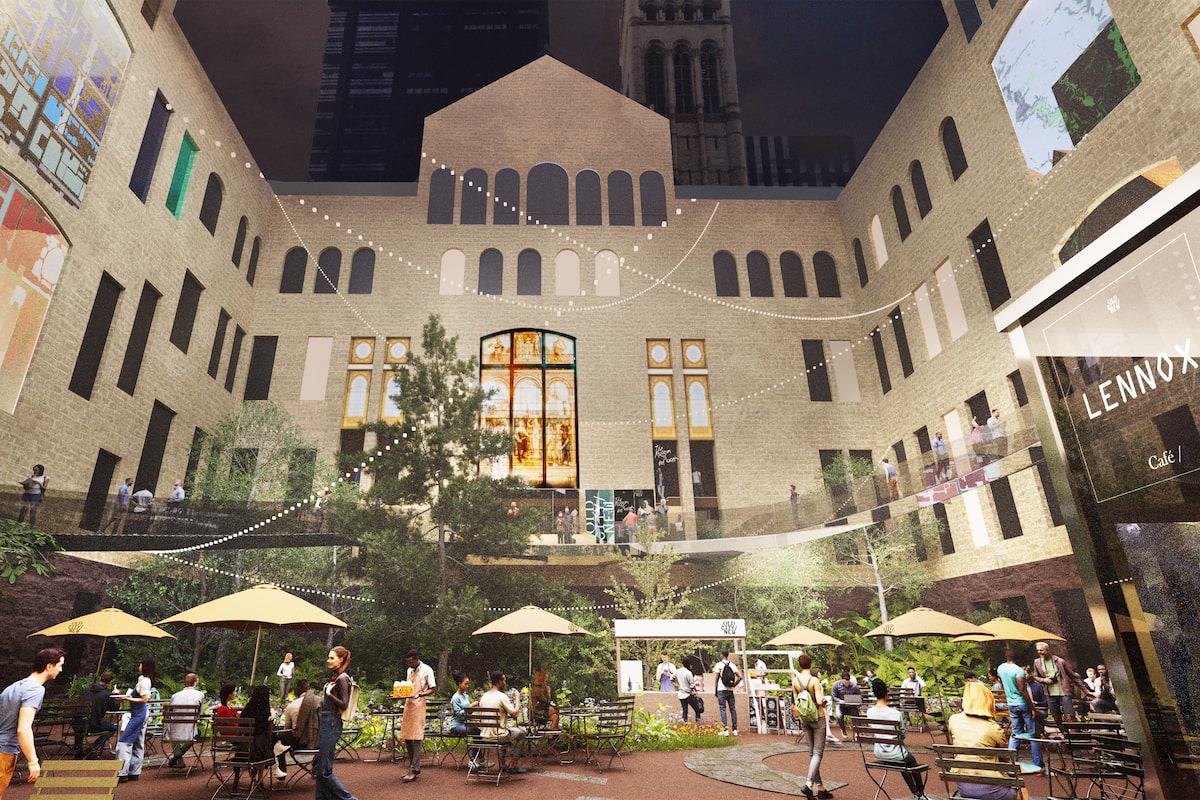
Rendering of Toronto’s old city hall renovation plans.Supplied
Imagine a lively, coffee-scented agora tucked inside a 19th-century sandstone monolith, humming with conversation and stray notes from a concert rehearsal upstairs. String lights arc above a copse of serviceberry trees and a bar stirring Toronto-themed cocktails against a backdrop of Romanesque arches.
That is the promise of Toronto’s Old City Hall at Queen and Bay streets: a place for gathering and the arts. The landscape architects PUBLIC WORK have imagined how to crack open its courtyard and then the whole building, starting this summer.
E.J. Lennox’s Richardsonian-Romanesque pile is 400,000 square feet of untapped civic energy. Its rusticated sandstone walls give it the air of a Victorian patriarch presiding over downtown. After 60 years in which it served as a courthouse, its judges and jailers have decamped, leaving a cavernous opportunity to fill this vacancy with the brisk Technicolor life of the metropolis.
E.J. Lennox’s Richardsonian-Romanesque pile is 400,000 square feet of untapped civic energy, writes Alex Bozikovic.Supplied
How? By treating the building as a living performance rather than a static relic. This winter a few advocates, led by prominent heritage architect Michael McClelland, have been pitching this vision to the city. “Culture needs a home,” says Mr. McClelland, a founder of ERA Architects. “While we tout Toronto as a great place for the arts, artists are leaving the city to find space. This, even as a temporary solution, would be an exemplar.”
Mr. McClelland envisions a mix of art and commerce, much like the Distillery District or the complex at 401 Richmond. In each case, old industrial bones were given new, creative blood.
He sees Old City Hall the same way. Imagine the cavernous front foyer reimagined as a restaurant and co-working space; upstairs, courtrooms and chambers house a messy, vibrant ecosystem of printmakers, tech startups and rehearsal spaces. A museum of Toronto, which the city hopes to launch in this building, could emerge through a series of tactical displays and grow from there.
Advocates led by prominent heritage architect Michael McClelland have been pitching a new vision to the city of Toronto.Supplied
What would this look like? I asked the landscape architects PUBLIC WORK, who designed the Bentway, to reimagine Old City Hall starting with the outdoor space. The firm’s Marc Ryan and colleagues responded with a vision they call Old City New. The building “is a fortress that we see from a distance,” Mr. Ryan said. “But we never really get to feel what’s inside. There’s a whole world inside this building, and it’s beautiful.”
Their design is first of all a manual for quick and easy interventions. It begins with the courtyard, “the biggest room of all,” as Mr. Ryan puts it. They take the “sallyport,” the arched and barred passageway into the courtyard, and line it with glowing green light and new signage. Visitors would walk in from the adjacent side street to the courtyard, transformed with soil and plants, patio tables and seating, and a kiosk or food truck. This is practical and – if the city can summon the political will – easy and cheap.
Look more closely and PUBLIC WORK’s drawings also show more provocative ideas. They imagine ramps, echoing the swooping concrete curves on Viljo Revell’s City Hall across the street, that link the courtyard to the building’s upper levels.
Mr. McClelland, a founder of ERA Architects, envisions a mix of art and commerce like the Distillery District or the complex at 401 Richmond.Supplied
They propose another intervention that is refreshingly sacrilegious: The stained-glass window in the front foyer, an allegory of the city’s history, swings wide on new hinges. With a new door underneath, Mr. Ryan and team invite visitors to take a ramp down from the halls of power, out into the grit and grace of the city.
This is a poetic stroke that delivers a new place from an old one – what Carleton University professor Federica Goffi identifies, in a recent book, as “architecture in conversion.” Architecture, as she puts it, requires the “activation of the imagination to allow the past to speak to the present.”
PUBLIC WORK’s vision delivers three crucial insights: that outdoor public space is the city’s lifeblood; that we should be less precious about our old places; and that the city can move fast if it chooses to.
Toronto Mayor Olivia Chow should bypass the glacial municipal machine and establish a separate body, writes Alex Bozikovic.Supplied
But this demands some nerve. Mayor Olivia Chow should bypass the glacial municipal machine and establish a separate body, a non-profit sitting outside the bureaucratic walls, to run the site as a 10-year urban laboratory.
For the moment, two city agencies are working on a long-term plan that relies on a huge, expensive and ill-advised renovation. The city has neither the money nor the capacity to move this forward. But it has already allotted millions over the coming decade to maintain the status quo.
Those funds are enough – perhaps supplemented modestly from the culture budget, or by philanthropy – to launch Old City New. This is a culture project, a tourism project and one that could transform the city’s brand for the world. Forget the heavy machinery of construction. Focus on the choreography of programming and leasing. Open the doors and see what works. Let the city’s artists and designers and makers show the way.
A museum of Toronto could emerge through a series of tactical displays.Supplied