
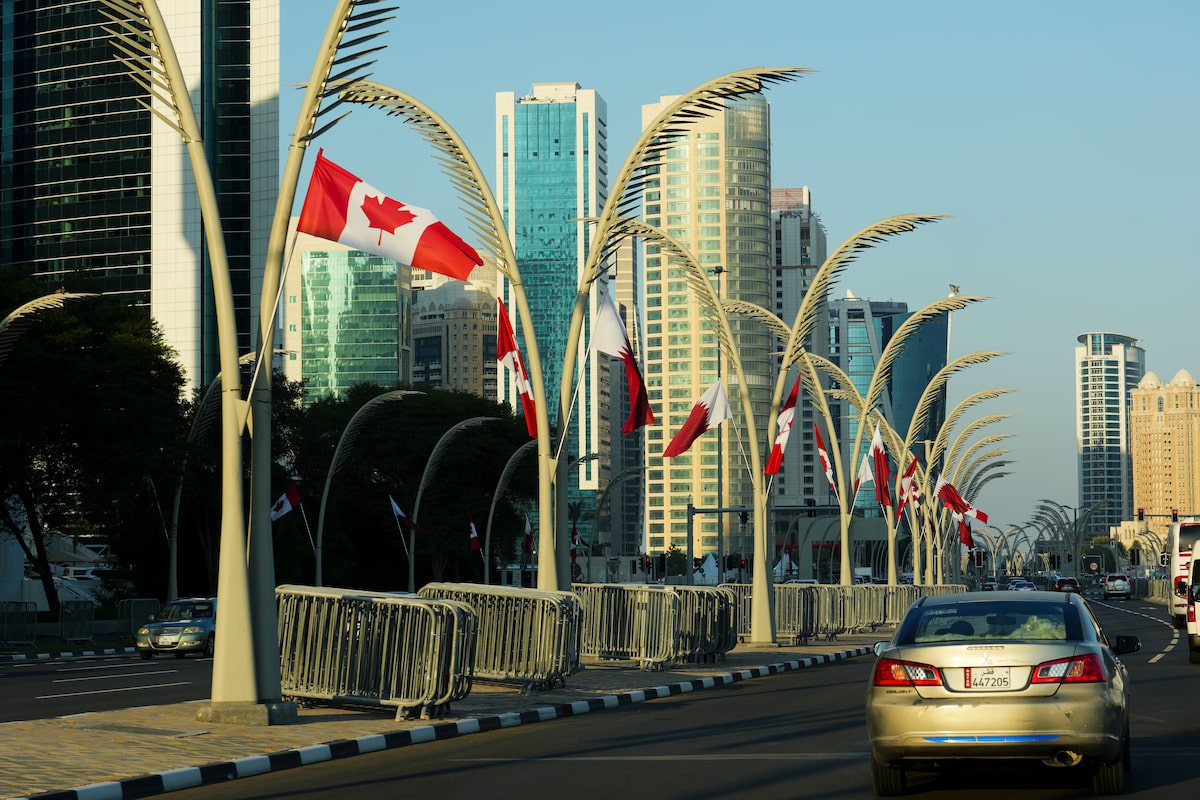
Canadian flags line a main boulevard during Prime Minister Mark Carney’s visit to Doha, Qatar, in January.Sean Kilpatrick/The Canadian Press
The widening fallout from the Iran war is complicating Canada’s push to tap into investment pools in the Middle East, threatening to disrupt the flow of capital and people in a region where Canadian investors are just starting to put down deeper roots.
One week into a conflict that has spilled over into neighbouring countries, emerging financial capitals are on edge as the war jeopardizes oil and gas supplies coming out of the Gulf.
However, executives from influential sovereign wealth funds in the United Arab Emirates, Qatar and Saudi Arabia have been trying to reassure foreign investors that business is carrying on as usual.
On phone calls with Canadian-based investors, their Gulf counterparts have relayed the sense of uneasy calm that has settled over cities such as Dubai, where business professionals are still taking their families to the beach in between shelter-in-place alerts that ping on their mobile phones when inbound missiles or drones are detected.
Eric Reguly: The Iran war is propelling Germany into another energy crisis
But those conversations, so far, have focused on making sure employees are safe and businesses are operating and undamaged. For now, with some meetings postponed and safety concerns still curbing travel, the deep relationship-building needed to unlock access to the region’s troves of investment capital is on pause. This could slow progress on new deals as investors assess how long the hostilities could last.
The Globe and Mail spoke to multiple sources spanning institutional investing, business, professional services and the civil service who have contacts in the Middle East. The Globe is not identifying the individuals to allow them to speak freely about sensitive business relations.
The region presents a growing financial hub flush with trillions of dollars of capital, and where Canada has typically been underrepresented – both in assets and people – in capitals such as Dubai and Abu Dhabi. But more importantly, Canada has missed out on the country’s share of Gulf investment dollars flowing abroad.
The federal government, led by Prime Minister Mark Carney and the contacts he built in the region as a central banker and asset-management executive, is in the early stages of a campaign to try to change that.
Analysis: When it comes to the Iran war, Trump has no clear goal or answers
A November trip to the UAE by Mr. Carney secured a pledge from the Emirates to invest $70-billion in Canada, including an anticipated $1-billion deal to expand critical-minerals processing. And a January trip to Qatar to deepen ties on trade, investment and defence co-operation opened the door to the US$550-billion Qatar Investment Authority doing more deals in Canada after recent transactions in wealth management and mining.
Gulf states are reviewing overseas investments in anticipation of economic strain caused by the conflict, an unnamed official told the Financial Times.
But many investors expect sovereign wealth funds in the region will still have huge amounts of capital they need to put to work, especially if oil prices stay high, which would create a windfall for some. If the worst of the regional attacks coming out of Iran are short-lived, Canadian investors don’t expect the commitments to investing in Canada to be disrupted.
The momentum that Canada has built with Gulf investors, seeking to move past historical stumbling blocks over stability risks and human-rights abuses in the region, could even get a further boost if Canada is viewed as a stable, orderly and reliable investment partner that is separate from the U.S.
Though many of the largest funds in the Middle East have tended to view Canada as a junior member of the North American market, some investors see a window of opportunity to reframe Canadian companies and projects as distinct opportunities to add diversity to portfolios that are heavy on U.S. investments.
Global law firm DLA Piper said in a January outlook report that “Canada-Gulf investment decisions are increasingly turning into completed deals,” and future transactions should flock toward artificial intelligence and digital infrastructure, as well as advanced manufacturing, battery storage and energy-transition technologies.
But the barrage of attacks that Iran has launched over the past week, and the uncertainty about how long the conflict might drag on, have made investors nervous and served as a reminder that the region’s hard-won reputation for stability doesn’t mask continuing risks.
Opinion: In the Middle East and Gulf region, the Iran war will change everything
Increasingly, to build the necessary relationships to secure investment from sovereign wealth funds, part of the price of admission has been to open an office in one of the region’s financial capitals, putting permanent employees on the ground.
Brookfield Asset Management Ltd., which has been one of the most active investors in the Middle East, has had an office in Dubai since 2015 and added an outpost in Riyadh a few months ago. National Bank of Canada opened a Dubai office in January, joining Canadian insurers Manulife Financial Corp. and Sun Life Financial Inc. in the city. Venture-capital investor Inovia Capital also opened an office in Abu Dhabi late last year.
In the near term, the business case for launching new offices in the region could be much harder to make, especially if employees are deemed to be in harm’s way.
As long as safety concerns persist, it will also be much harder for Canadian investors and business leaders to make the regular trips required to build trust with sovereign wealth funds and political leaders in face-to-face meetings.
There were an estimated 97,000 Canadians in the Middle East when the conflict with Iran erupted. That included some employees at major sovereign wealth funds in the UAE and Qatar. Many expats in the region have stayed put, but some have left, finding ways out even as air traffic slowed to a crawl at most major airports.
Most of the direct investment that large Canadian asset managers have made in the Middle East is clustered in the UAE, with lesser commitments in Qatar and Oman. But those investments are relatively modest, as most of the focus has been on attracting foreign capital to Canada.
Explainer: How the Iran war is affecting countries in the Middle East and wider world
Brookfield and Montreal-based Caisse de dépôt et placement du Québec, the $517-billion pension-fund manager, have stakes in some physical assets in the region that could be at risk of damage if Iran continues to lash out with strikes on surrounding countries.
The Caisse has a $5-billion joint venture with DP World Ltd., a state-owned global logistics player based in the UAE, which includes part ownership of Dubai’s Jebel Ali Port and free zone, as well as an industrial park. Last weekend, DP World briefly suspended operations at the port after debris from the aerial interception of a missile or drone caused a fire.
Brookfield owns stakes in an array of assets in the region: They include the ICD Brookfield Place office tower in Dubai; regional payments processors Network International and Magnati Payments Solutions; membership in a consortium that owns a minority stake in natural-gas pipelines in the UAE operated by Abu Dhabi National Oil Co. (ADNOC); and ownership of private-school operator GEMS Education. Brookfield also has a partial interest in Oman Tower Co., which operates telecommunications towers.
So far, none of those assets have been affected. Brookfield Asset Management CEO Connor Teskey said in a television interview that the conflict hasn’t lessened the asset manager’s appetite to invest in the region. He added that the company plans to press ahead with a US$20-billion joint venture with Qatar’s leading investment fund to build AI infrastructure in the country.
John Rapley: An Iran oil shock darkens prospects for all the money in the world
Mr. Teskey told Bloomberg News that the Middle East has “an increasing presence on the world scene, and those are the types of opportunities that Brookfield wants to pursue over the long term.”
Spokespeople for Brookfield and the Caisse declined to comment, but both companies have been in contact with partners and local authorities to monitor the situation.
Canada’s eight largest pension-fund managers do not have offices in the region, and most do not directly own assets in the countries affected by Iran’s attacks. Some funds have limited exposure through emerging-markets index funds that own shares of publicly traded companies in the region.
The greatest risk to foreign investment would be a protracted war in Iran that continues to draw in other countries, potentially leading to strikes on strategic assets such as oil and gas infrastructure that would further destabilize prices and energy supply around the world.
With that prospect looming, the pressure to find a way to bring the conflict to a quick end is mounting.