
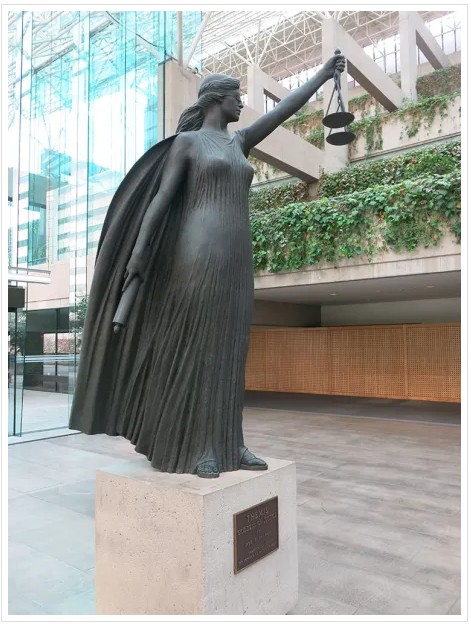
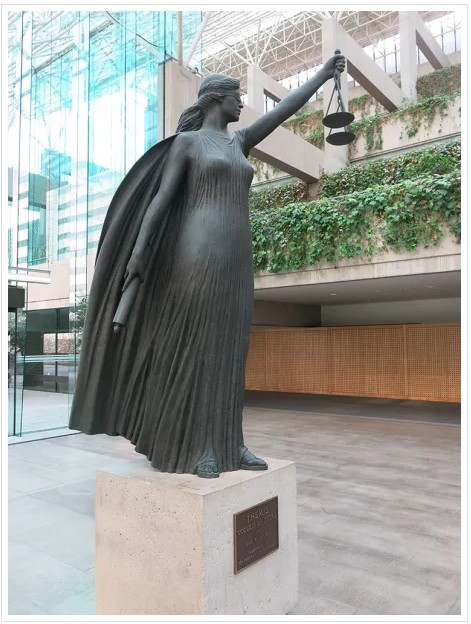
 Photo: Themis by Jack Harman (Vancouver Law Courts). The Greek goddess of justice.
Since 2022, the B.C. legislature has passed a wave of consequential laws with remarkably little scrutiny. While these moves may follow the technical “letter of the law,” they raise a profound question in political science and constitutional theory: Can a law be legal, yet illegitimate?
Legality refers to adhering to the technical rules of the legislative process. Legitimacy refers to the moral and democratic standing of a law in the eyes of the public.
The Speed of “Service”
The provincial shift began almost immediately after David Eby was sworn in as B.C.’s 37th Premier on November 18, 2022. Just three days later, the government introduced Bill 43 (the Housing Supply Act). Its passage was near-record-breaking: the main debate lasted only 55 minutes on November 24, followed by a five-minute Third Reading and Royal Assent that same day.
This rushed process became the foundation for further sweeping changes in 2023, including Bills 44, 46, and 47 (the Housing Statutes Amendment Act), covering residential density, development finance, and transit-oriented areas. By 2024, the Vancouver Charter was amended via Bill 18 after a mere 30 minutes of committee debate. (See our Legislation Tracker for a full summary).
A Deficit of Democracy
These laws were not the product of broad public consensus. Instead, they were largely the result of development industry lobbying, a marked lack of public consultation, and the use of non-disclosure agreements to mute municipal concerns. The results have been:
Generational consequences for B.C. communities.
Concentrated power in the hands of a single individual: the Minister of Housing and Municipal Affairs.
Planning disarray for municipalities across the province.
Some citizens groups have fought back. Some local governments are finally fighting back, seeking judicial reviews in the courts to challenge this centralization of power.
Vancouver’s ODP: The Next Battleground
In mainstream media and formal City of Vancouver discussions, these underlying laws are usually treated as an unchangeable “given.” The questions of legality and legitimacy are rarely whispered, let alone debated.
This silence is critical as Vancouver faces a single Public Hearing on March 10, 2026, for its first-ever Official Development Plan (ODP). This is a highly consequential matter. While the City may be complying with the “absolute bare minimum” legal notification requirements, the ODP’s legitimacy is at risk. By consciously choosing not to notify the owners of the 100,000 affected properties in Vancouver, the City invites future challenges based on a lack of democratic mandate. (For more on the ODP, see “Urgent!”) But right now, before the ODP passes, it’s important for the electorate and citizens to go on record, in writing or by speaking (in person or by phone) to make their views know.
The Power of the Electorate
Ultimately, power should reside with the electorate. For a law to be truly legitimate, it requires the informed consent of the governed. It is up to the people to remain engaged and hold elected officials—at the municipal, provincial, and federal levels—to account.
More reading
The legal perspective
If the legislature followed the Standing Orders (the internal rules of the House), the law is legally valid.
Parliamentary sovereignty: In the Westminster system, legislatures generally have the power to set their own schedules and “guarantee” or limit debate through tools like closure or time allocation.
Judicial review: Courts rarely strike down a law based on the duration of the debate. They focus on whether the law itself violates the Constitution or the Charter of Rights, not the speed of the assembly’s deliberations.
The legitimacy perspective
Legitimacy is often undermined when “deliberative democracy” is bypassed. Arguments for why a 50-minute debate might be seen as illegitimate include:
Lack of scrutiny: Major legislation usually requires committee hearings and multiple readings to identify flaws or unintended consequences.
Democratic deficit: If the public and stakeholders are not given time to provide input, the law may lack the “consent of the governed.”
Abuse of power: Using a majority to stifle opposition debate can be viewed as an affront to parliamentary tradition, even if it is technically permitted.
This tension is exactly why “procedural legitimacy” is a major topic in law; a law can be a valid command from the state but still be considered a failure of democratic norms.
Here are some historical examples where “fast-tracked” legislation was later challenged in court.
In British Columbia and elsewhere, the question of being “legal but illegitimate” often comes up. In this province it mentioned by critics to describe the BC NDP government’s recent use of closure or time allocation to pass major bills with minimal debate.
While technically legal under the Standing Orders of the Legislative Assembly, this practice is frequently criticized as a “democratic deficit.”
Recent examples in B.C.
Bill 21 (Legal Professions Act, 2024): This “seismic” change to the legal profession was passed after the government invoked closure to end debate. The Law Society of BC is currently challenging it in court, arguing that while the process was legal, it violated the constitutional principle of an independent bar.
Bill 15 (Infrastructure Projects Act, 2025): This controversial bill, which allows the province to fast-track major projects by overriding certain permits, passed with a razor-thin 47-46 tie-break vote in May 2025. Opponents, including several First Nations and the BC Greens, argued the lack of consultation and rushed debate made the law illegitimate.
Bill 31 (Energy Statutes Amendment Act, 2025): Critics labeled this “government by decree” because it grants cabinet sweeping powers over BC Hydro and electricity allocation with very limited legislative oversight or debate.
Bills 44, 46, 47 (Housing Supply Act, 2023 and more). Reference: Q&A interview with mayor Sid Tobias on judicial review initiative on B.C.’s housing laws, and next steps (link)
Why it’s called “illegitimate”
Minimal scrutiny: Major legislation often has hundreds of clauses; a 50-minute debate means most sections are never even read aloud or questioned.
Bypassing stakeholders: Fast-tracking prevents First Nations, local governments, and the public from mounting a meaningful response before the law is enacted.
Concentration of power: Critics argue that “ruling by Order-in-Council” (cabinet decisions) rather than through the full Assembly turns the legislature into a “rubber stamp.”
Legally, a law is binding the moment it receives Royal Assent.
Politically, the label of “illegitimacy” is used to build a case for future repeal or to challenge the law’s validity in the court of public opinion.
In this regard, recommended reading: “The Trifecta of Control: Stealth. Speed. Complexity. How BC’s Planning Reforms Are Undermining Local Democracy — Quietly, and Fast.” By Erick Villagomez in Spacing Vancouver – https://spacing.ca/vancouver/2025/06/16/the-trifecta-of-control-stealth-speed-complexity/
The next municipal elections in British Columbia are on October 17 , 2026. That’s another opportunity to hold elected officials to account, at the municipal level.