
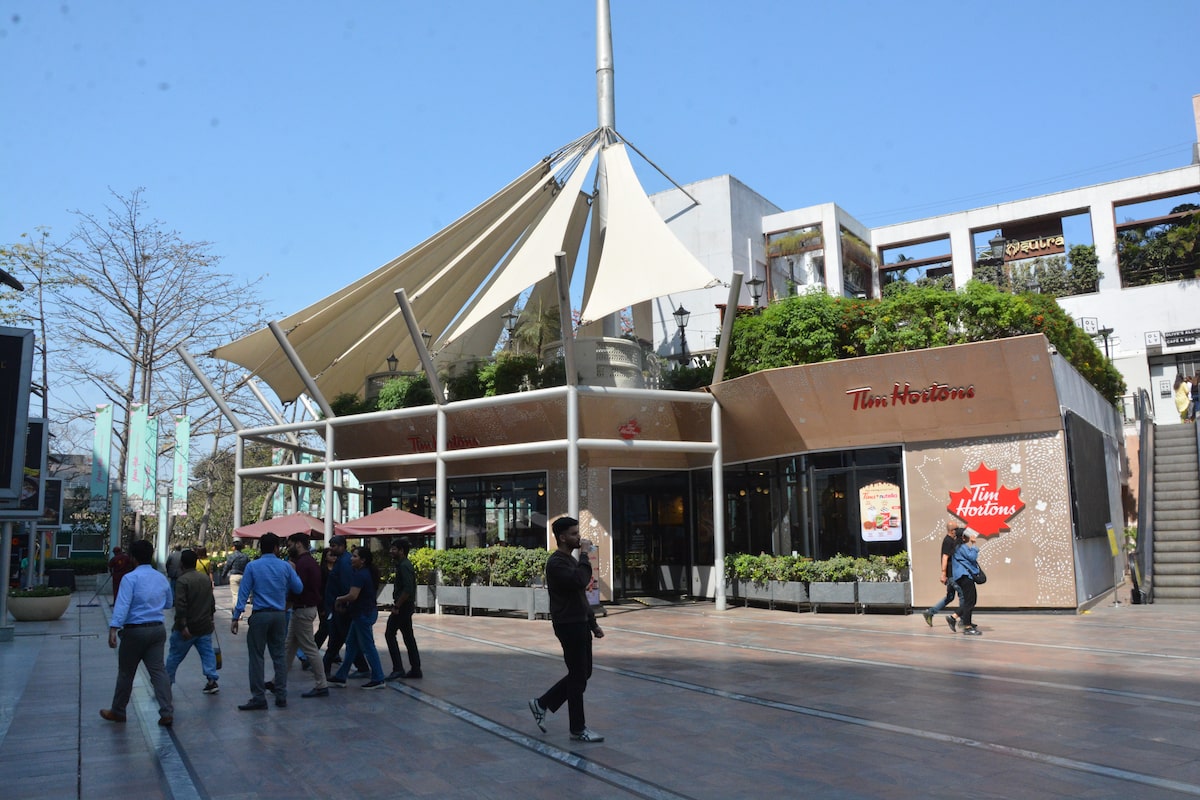
Tim Hortons in Gurugram, a business district on the outskirts of Delhi, is one 44 locations in India.The Globe and Mail
On a Tuesday afternoon in a business district on the outskirts of Delhi, Shweta Magar is serving a double-double latte with a paneer puff on the side.
This isn’t your garden-variety Tim Hortons. It’s spacious and upscale, geared toward the engineers who work for multinational companies in the surrounding glass tower buildings.
The lamp shades are maple leaves. There’s a mural featuring a canoe paddle, a tent and a moose. Ms. Magar and her colleagues sport red lumberjack shirts. In short, the Gurugram Tim Hortons – one of 44 locations across India – is about the most Canadian thing you can find this side of Hong Kong.
It’s also something relatively rare: A Canadian brand with a presence on the ground in the world’s fastest growing economy.
Opinion: Carney’s India strategy promises many benefits
With some notable exceptions, Canadian companies have limited traction in the Indian market. Prime Minister Mark Carney’s trip to the country this week was an effort to change that.
He met the leaders of some of India’s great business houses in Mumbai last weekend, then travelled to New Delhi on Monday to patch things up with Prime Minister Narendra Modi after several years of diplomatic strife.
The goal: Get more Canadian uranium into Indian nuclear reactors, more Canadian code into Indian software systems and more Canadian-branded coffee into India’s rapidly growing middle class.
A poster of Prime Minister Mark Carney and Indian Prime Minister Narendra Modi in New Delhi during Mr. Carney’s visit.The Globe and Mail
Mr. Carney has been touring the globe over the past year, trying to gin up demand for Canadian businesses, in an effort to diversify trade away from President Donald Trump’s unreliable and protectionist United States.
India, which recently overtook Japan as the world’s fourth largest economy, represents a huge opportunity. The economy is projected to grow at an annual rate north of 7 per cent this year, hoovering up the kind of commodities Canada produces.
It’s opening up previously closed sectors to foreign investment. And in recent years, the famously protectionist country has begun to sign trade deals in an effort to boost its manufacturing sector through exports, and attract investments from multinational companies looking to shift parts of their supply chain away from China.
In one way, Canada is already a big player in India. Canadian pension funds and large asset managers – notably Brookfield Asset Management and Fairfax Financial Holdings – are among the most significant foreign investors in the country and have played an important part in the Modi government’s push to privatize infrastructure.
Carney says he raised foreign interference concerns in ‘frank’ talk with Modi
If you’re driving on a toll road in India, chances are it’s owned by a Canadian pension fund.
But when it comes to trade, the numbers are underwhelming.
Canadian companies shipped only $3.9-billion worth of goods to India in 2025 – mostly commodities like lentils, potash and coal – compared with $565-billion to the United States and $34-billion to China. India sent $9.7-billion worth of goods the other way to Canada, led by pharmaceuticals, diamonds and jewellery.
And while services exports have grown rapidly in recent years, that was almost entirely owing to Indian students studying in Canada – a pipeline Ottawa has severely restricted over the past year and a half.
“It wasn’t clear for a long time in India what exactly you could do with the Canadians. We had a trade relationship with Saskatchewan, but that’s limited to just basic commodities,” said Pramit Pal Chaudhuri, head of South Asia for the Eurasia Group.
Mr. Carney is trying to flip that script by promising Canada will be a secure supplier of energy, critical minerals and digital technology to India, in a more dangerous and divided world. And the warm reception he received in New Delhi this week, as global markets and supply chains were upended by the U.S.-Iran war, suggests that India is casting around for just such partners.
But as Ottawa re-engages with New Delhi and aims to sign a comprehensive economic partnership agreement by the end of the year, it remains at the back of the pack.
Australia, New Zealand, Britain and the European Union have all signed trade deals with India.
“That puts our companies at a disadvantage and that’s the energy that drives me to move this as fast as possible, because [other countries] have an early mover advantage,” Maninder Sidhu, Canada’s Minister of International Trade, said in an interview, referring to the Canada-India trade talks.
Ultimately, the Canadian government can help open the door. But Canadian businesses will need to buy into India’s growth story – the same way the country’s big asset managers have – to achieve Mr. Carney’s goal of doubling two-way trade with India to $70-billion by 2030.
Maninder Sidhu, Canada’s minister of international trade in Canada House, in New Delhi on Monday.The Globe and Mail
Twenty-six-year old Prathamesh Shirole is out for his Saturday morning jog along the Mumbai seawall wearing black Lululemon running shorts. Most of his fellow runners are decked out in the usual Nike and Adidas apparel.
“It’s more one of those, ‘If you know, you know,’ kind of brands,” Mr. Shirole says.
There are no Lululemon stores in India, although the Vancouver-based sportswear company has plans to launch a retail footprint in the country later this year. Right now, Mr. Shirole gets his gear from his sister who lives in Mississauga.
If you want to understand the Indian market opportunity, the joggers on the Mumbai seawall are a good place to start.
The country’s population is young and growing fast. Indians are still poor on a per capita basis, earning on average around $3,700 a year. But out of a population of nearly 1.5 billion, there are around 300 million people in the urban middle class with some level of disposable income.
Opinion: No time for truth in this reset with India
“The elevator pitch is very simple,” said Prem Watsa, chief executive of Fairfax and one of Canada’s biggest bulls on India.
“You have an economy that’s plus-or-minus US$4-trillion. However you define it, say the middle class is 300 million people,” Mr. Watsa said in an interview.
“Just think that goes to 600 million people. That’s 300 million more middle-class people who want houses, who want automobiles, who want insurance, who want Mastercards,” he said. “You’re creating a United States every five to 10 years.”
The India arm of Mr. Watsa’s business empire, Fairfax India Holdings, owns insurance providers, industrial companies, a shipping line and the Bangalore airport.
Other Canadian companies are likewise making a bet on the Indian consumer. Restaurant Brands International, which owns Tim Hortons, plans to increase the number of locations to 300.
Vivek Kanyal and Shweta Magar, employees at Tim Hortons in Gurugram.The Globe and Mail
John Hunter, the founder of Burlington, Ont.-based Hunter Amenities, which makes shampoos and lotions for the hospitality industry, acquired a factory in India in 2017, to produce for export and to sell into the domestic market. With his Indian revenue growing quickly, he’s looking to add a second factory in the country.
“It’s a very untapped market compared to hospitality in China, which would be probably 10 times that of India. But India will grow to be that. So we’re really kind of on the ground floor as the market matures,” Mr. Hunter said in an interview.
Export Development Canada, the Crown corporation that provides financial services to exporters, estimates around 400 Canadian companies have some presence in India. That includes big names like McCain Foods Ltd., Magna International Inc. and Sun Life Financial Inc.
Many, however, are small and medium-sized enterprises.
“What we really struggle with, as compared to other nations, is we have a lot of lower, mid-market companies, who are quietly doing things in places and often quite localized,” Alison Nankivell, EDC’s chief executive, said in an interview in Mumbai.
“But we don’t have these large anchor companies who build an entire value chain around their ambition and then can organize and pull in their suppliers like the Apples of the world,” she said.
In recent years, India’s electronics manufacturing sector has been transformed by major companies such as Apple-supplier Foxconn and Samsung building factories in the country as an alternative to China and Southeast Asia.
For many international businesses, the key India play remains setting up remote operations in cities like Bangalore and Hyderabad to service customers around the world.
But these are not the call centres of the 1990s. Companies now use India as a font of high-quality engineering and management talent, leading to a boom in what management consultants refer to as global capability centres.
OpenText Corp., one of Canada’s biggest software companies, has around 6,500 employees in Bangalore and Hyderabad. That’s roughly a third of the company’s global work force and more than half of the company’s engineering staff.
Opinion: India has an oil problem. The Iran war makes it worse. Canada is the solution
Muhi Majzoub, OpenText’s executive vice-president of product and engineering, said he has teams of engineers placed in different time zones who pass code from one to another following the daylight.
“When we get a call from a customer in North America, we’re not waking up an engineer in the middle of the night in Hyderabad or Bangalore. We serve them from the U.S. or Canada,” Mr. Majzoub said in an interview.
“If the call is from an Asia-Pacific country, or Australia, New Zealand, then our colleagues in India step in and provide coverage so we’re not waking up an engineer in North America at 2 a.m.”
While Canadian products have yet to make a big splash in India, Canadian money certainly has.
Canada’s pension funds, including the Canada Pension Plan Investment Board, the Caisse de dépot et placement du Québec, and Ontario Teachers’ Pension Plan (OTPP), have become major investors in Indian infrastructure, as have Fairfax and Brookfield.
To date, Canadian asset managers have put roughly $110-billion into the country. And that number continues to grow rapidly.
Brookfield CEO Connor Teskey said last year that there was no limit to the amount of capital the company would deploy in India. And he set a target of $100-billion in assets under management in the country by 2030, up from around $30-billion today.
“You compare it with other geographies, other economies, the first thing that hits you is scale,” Aditya Joshi, Brookfield’s country head for India, said in an interview in the company’s Mumbai office.
“There’s not many countries around the world where you can deploy dollars at scale and get returns which are globally competitive.”
Aditya Joshi, head of India for Brookfield Asset Management, in Mumbai on Wednesday.The Globe and Mail
Brookfield made its first investment in India in 2014. Twelve years on, it owns more than 55 million square feet of office and retail space in seven cities including Mumbai, Delhi and Bangalore. It owns more than 250,000 telecom towers in India, a cross-country natural gas pipeline and around 45 gigawatts of wind and solar power projects, either under development or in operation.
This increase in investment is tied to the liberalization efforts pursued by the Modi government since it first came to power in 2014.
New Delhi has pushed through a series of reforms making it easier to start a business and move money in and out of the country. Sectors like insurance, telecommunications and, most recently, nuclear energy, have been opened up to additional foreign direct investment, while many roads and airports have been privatized. Meanwhile, the country’s national digital ID system has revolutionized digital payments and financial services.
“To grow India at 10 per cent nominal GDP, you need external capital, you need external debt, external equity. How do you bring that in? You make the ease of doing business in India better. You open up certain sectors for investments. You go and create strong bilateral ties with global countries,” Mr. Joshi said.
Deepak Dara, senior managing director and head of India at the Ontario Teachers’ Pension Plan in Mumbai on Wednesday.The Globe and Mail
Deepak Dara, OTPP’s India country head, oversees roughly $6-billion worth of investments in the country. That includes investments in Indian toll roads, renewable energy projects and some private equity.
He said the development of Indian capital markets in recent years, with far more domestic savings flowing into mutual funds and other financial products, has made it much easier for foreign investors to deploy capital.
“Like any emerging market, the first question people would ask five, six, seven years back was if you invest, how would you get out?” Mr. Dara said. Now it has become easier to exit investments by taking them public within India.
And the Modi government has been keen to work with foreign investors, Mr. Dara said.
Even at the height of the diplomatic breakdown between Ottawa and New Delhi, after Canada accused India of having a role in the killing of Canadian Sikh activist Hardeep Singh Nijjar in Surrey, B.C., in 2023, business continued as usual, Mr. Dara said.
“We didn’t feel it at all really from a government-to-business perspective, on either side of the equation,” he said. “In fact they leaned in and we got all the positive messages from them saying that the capital here is welcome.“
Tim Gitzel, CEO of Cameco Corp, was in New Delhi to sign a $2.6-billion Uranium supply deal with the Indian government on Monday.The Globe and Mail
The story over the past few years was very different for Cameco Corp. CEO Tim Gitzel.
The Saskatoon-based uranium miner had supplied fuel to Indian nuclear reactors from 2015 to 2020. But this agreement was not renewed as relations between Ottawa and New Delhi hit the skids.
Diplomatic ties had become strained over the course of former prime minister Justin Trudeau’s time in office, with Indian officials believing the Liberal government was too permissive of the Khalistan movement in Canada – a Sikh separatist group that aims to carve out an independent country in the northwest of India.
Then came the killing of Mr. Nijjar. Ottawa alleged that Indian government agents were involved in the murder, and both sides broke off diplomatic ties, expelling each other’s high commissioners.
“We do the business-to-business, but obviously we didn’t get an agreement between 2020 and 2025 because the relations between the countries didn’t allow it,” Mr. Gitzel said in an interview in New Delhi.
On Monday, he signed a new $2.6-billion uranium supply contract with the government of India in the palatial Hyderabad House, with Mr. Carney and Mr. Modi looking on. It was the most significant deal announced during the visit.
Cameco CEO sees major growth in India after inking uranium supply deal
The reconciliation began with a change at the top in Ottawa last year. But what really accelerated the rapprochement between Canada and India has been their mutual challenges with Mr. Trump.
After initially giving India preferential treatment, the U.S. President slapped a 50-per-cent tariff on Indian goods last summer, reportedly because Mr. Modi disputed Mr. Trump’s claim that he was responsible for ending the brief military conflict between India and Pakistan last year.
That shocked New Delhi out of complacency, said Mr. Chaudhuri of the Eurasia Group.
Trade talks between India and the European Union, which had been stuck in limbo for 16 years, were suddenly back on. Things progressed rapidly, with both sides making concessions. And last month the EU and India signed what European Commission President Ursula von der Leyen dubbed the “mother of all deals.”
In the fall, Mr. Carney and Mr. Modi met at the G20 meeting in South Africa and agreed to resume stalled trade negotiations, which were first launched back in 2010.
“I think the game for that is for both sides to recognize that there’s something more than just lentils and potash in that relationship,” Mr. Chaudhuri said.
“One is the investment side, definitely. Second is technology … [New Delhi has] actually taken Canada’s technological capacity seriously. And India is basically cherry-picking its way around the world looking for technologies they can work with which are not American or Chinese.”
In a speech to Indian business leaders in Mumbai last weekend, Mr. Carney pitched Canada as a secure supplier of energy and critical minerals. With the expansion of the LNG Canada project in Kitimat, B.C., a lot more Canadian liquefied natural gas will be hitting Asian markets in the coming years, he said.
The Bombay Stock Exchange on Sunday.The Globe and Mail
Canada already sends several million barrels of crude oil to India each month, although this tends to be shipped via the U.S. gulf coast, using massive tankers called Very Large Crude Carriers, which are too big for the existing port infrastructure in British Columbia.
“To be honest, it’s deja vu. I’ve heard the same things again and again: We can make this relationship grow, we have what you want,” said Sriram Hariharan Iyer, an Indian banker who spent more than a decade in Toronto as the country head for India’s ICICI Bank.
“But somehow I think this time could be different,” he said.
The U.S. is putting pressure on India to stop buying oil from Russia as part of an agreement to lower tariffs, and the conflict between the U.S. and Iran has disrupted shipping in the Strait of Hormuz through which almost half of Indian oil imports typically travel.
“That’s where Canada can differentiate itself: While I’m selling a commodity, I’m a stable country that will ensure that the supplies are there,” he said.