
INDIAN WELLS, Calif. — For a tournament that bills itself as a tennis paradise, Indian Wells has a tendency to bring some Old Testament elements to the sport in the California desert.
The sun that blazes down in the day is replaced with temperatures that can turn frigid at night. In a part of the world that sees rain around 14 days out of 365, a few always seem to land in the first fortnight of March, interrupting play. In 2024, bees swarmed the main stadium.
This year, just as last year, the sworn enemy of tennis players at all levels that rarely stops play, but defines its rhythm more than any other weather condition, is puppeting the small yellow ball they try to hit inside the white lines and driving them to distraction.
“Bloody windy out there,” said Rinky Hijikata, the 24-year-old Australian who credited his childhood in a windy suburb of Sydney for getting through his first-round match with Alexander Shevchenko of Kazakhstan in 2025. Across the complex that day, 40mph gusts buffeted palm trees, sending serve tosses askew and wobbling balls through the air like a swerving soccer free kick.
One year on, one of the most reliable elements of a tournament whose conditions tend toward the unpredictable is back with a vengeance.
“The conditions are impossible,” Venus Williams said during her news conference after a tight three-set loss to Diane Parry of France on the second day of the 2026 edition.
“You should get out there and play in that wind and you’ll tell me too if you can create some magic or if you can be perfect or not,” Williams said.
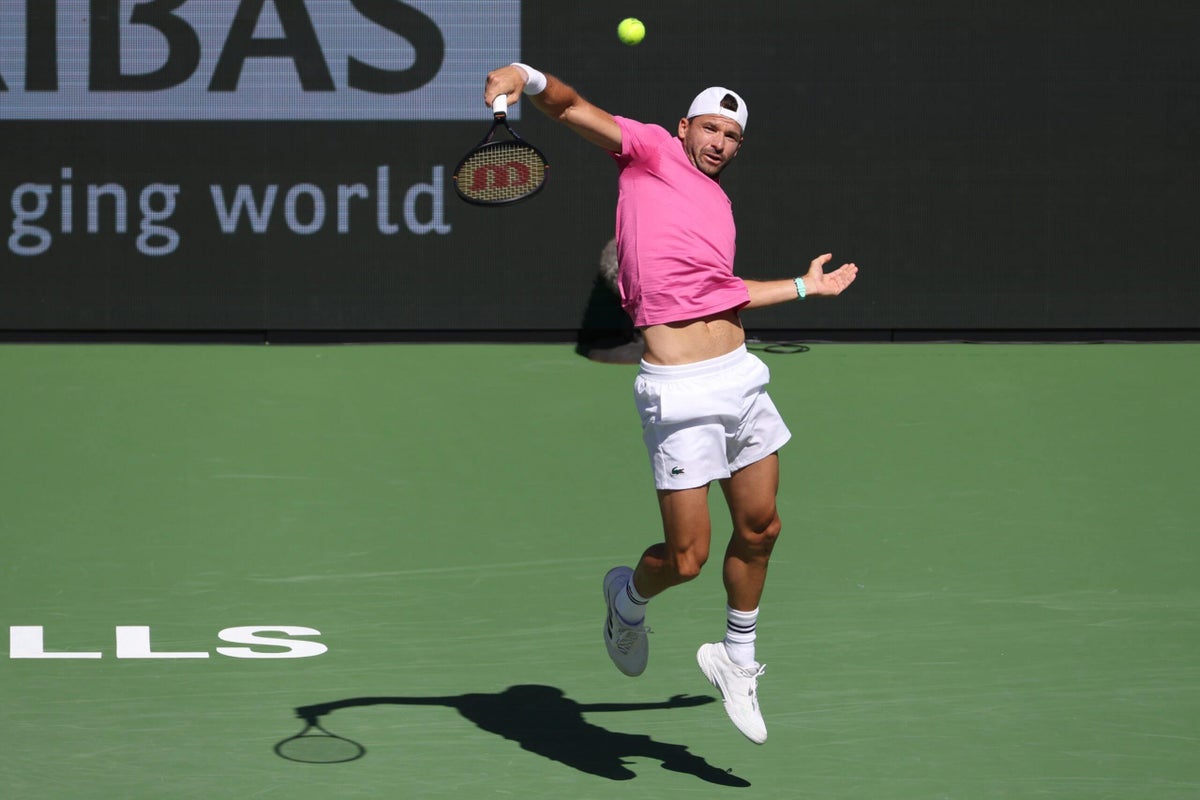
Earlier that day, Bulgaria’s Grigor Dimitrov described conditions as “horrible for tennis,” on a day that a takeaway food bag swirled up and over Stadium 1 at the Indian Wells Tennis Garden and briefly became the main character.
“The playing conditions here are terrible. The stadium is magnificent, everything is well organized, the crowd is incredible, but I can’t lie: the wind causes a ton of errors and makes the game much more difficult,” he said during his on-court interview after beating Terence Atmane for the right to face Carlos Alcaraz, one of few players who thrives in every version of Indian Wells’ conditions: The cold, slow nights and the hot, high-bouncing days, wind or no wind.
For most players, the underlying mantra dates back to a quote from last year, and comes from Switzerland’s Belinda Bencic.
“Respect the wind,” she warned.
Heat can be exhausting and rain can delay play, but wind is the most capricious. Much like a powerful first serve or groundstroke, its power over tennis means little without knowing its direction. If it’s blowing up and down a court, parallel with the sidelines, the effects are more predictable.
At one end, players have to be wary of overhitting with the breeze at their back. At the other, they have to be mindful of how much it will hold up their shots. The player receiving a ball with wind behind it needs to react quicker; if it’s slowing a ball down, their footwork needs to take them to it and adjust to any sudden changes of direction.
It doesn’t usually work that cleanly. The breeze can howl off Flushing Bay some days at the U.S. Open in New York; Arthur Ashe Stadium, the main arena, was known for its vortexes before the installation of a partial roof in 2015. At the ATP Tour event held in Estoril, Portugal, just north of Lisbon, the wind off the Atlantic could make a mess of matches.
The winds in Indian Wells are of another sort, something that somehow slips most players’ minds as they wax poetic about what is for many their favorite stop on the tennis calendar. The place is basically a wind machine thanks to its location between two sets of mountains, the San Jacintos and the San Bernardinos, in the Coachella Valley about 120 miles east of Los Angeles.
The mountains act like a funnel; the hot air from the desert ground rises, and the cool air from above rushes in to take its place. On the outside courts, it will go in whatever direction it has chosen for the day. On the main arena, Stadium 1, the bowl structure and its doors and openings create currents and vortexes to which players have to adapt on the fly.
In 2025, even practice sessions fell victim to the swirl, with the open outside courts completely exposed.
You can literally see the wind just take the ball over mid-air pic.twitter.com/0uMjtaVD8K
— Owen (@kostekcanu) March 6, 2025
For 2026, the buffeting on Stadium 1 has been higher profile. There was the brown bag during Williams’ match; shots wobbled and hesitated over their paths after leaving players’ rackets throughout. Some players were better equipped than others. Parry, who defeated Williams 6-3, 6-7(4), 6-1, used her slice backhand to skid the ball flat and low through the air, while Australia’s Kimberly Birrell stayed low and reduced her topspin the next day to worry No. 10 seed Victoria Mboko in a tight two-set loss.
The early stages of the tournament also underscored how, at Indian Wells, contradictory conditions interact closely with each other. The second day of the tournament was significantly sunnier and hotter than the third; on hot, dry days, the balls are livelier than cooler ones. Day 2 saw players ballooning shots long as well as having them stick in the wind; Day 3 saw less of that.
For world No. 3 Alexander Zverev, the wind has in fact become an obstacle to understanding if the courts are different or not.
The German last year helped to set off a court-speed conspiracy regarding tournament directors slowing down courts because, he said, they “want Jannik (Sinner) and Carlos (Alcaraz) to do well every tournament.”
“Last couple days was quite windy, so it’s tough to get a feel of the courts or the balls, but yeah, maybe it’s a bit quicker than last year,” he said in his news conference after beating Italy’s Matteo Berrettini in straight sets.
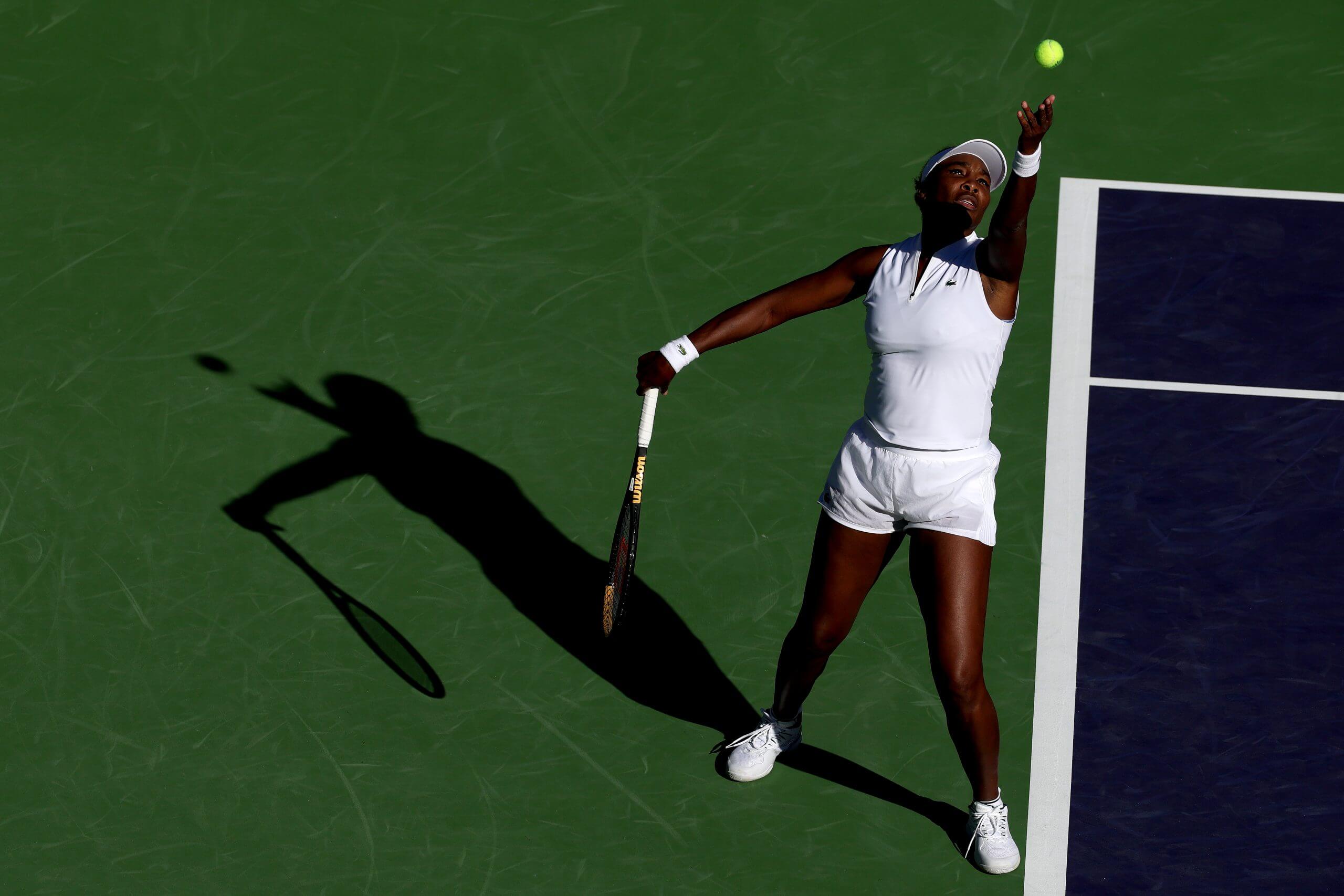
Venus Williams, like many players, found windy conditions at Indian Wells challenging. (Matthew Stockman / Getty Images)
As night falls and the temperature drops in Palm Desert, the wind tends to die down, though it can whip up when it wants to do so. Sometimes of course, rain arrives — often in a cold steady drizzle.
Prior to this year’s tournament, the BNP Paribas Open’s decision to make a change to a fundamental part of its furniture dominated discussion among the players, as it did last year. In 2025, it was the switch in surface manufacturer from Plexipave to Laykold, but the surface stayed bouncy, with the desert sand and grit in its paint sending balls spinning out of strike zones and roughing up the felt. Some players, Zverev included, felt that the new courts — which were supposedly going to create quicker conditions — in fact made things even slower.
This year, the ball is in the spotlight. The tournament has switched from Penn to Dunlop, as part of the ATP Tour’s ongoing bid to have more consistency in which balls are used from tournament to tournament and surface change to surface change. In an extensive disquisition on the move streamed on Twitch, 2022 champion Indian Wells predicted that the Dunlop balls would make rallies more interminable because of how easily they fluff.
So far, that has not really come to pass, with first-serve points won significantly up on previous years — but that appears to be largely because of the high daytime temperatures. Players have adjusted to the wind by using bigger targets down the middle of the court, so that any gusts are less likely to cause a dangerous flirtation with the lines.
“I think it’s more so difficult when it’s, like, slower and windy, because I feel like you have more time to think, so you’re just overthinking everything,” Coco Gauff said in her news conference after defeating Kamilla Rakhimova.
“I felt very comfortable when the new balls were in play, and then once it slowed down, it was just different, which usually is the opposite for me.”
Overall, it’s the swings in sun and cloud, hot and cold, and most of all, windy and calm that define conditions that Russia’s Andrey Rublev once likened to playing four tournaments in one. For players arriving for their first visit, especially those looking to carry a seeding, it can be an odd experience.
“It was my first time playing a match here, and it was a bit weird for me,” Mboko said in her news conference after her win.
“It was a bit windy.”
If the forecast is right — always a big if in the desert — the gusts will be lighter in the coming days, making life on the tennis courts easier to handle. Unless the bees of 2024 swarm again.