
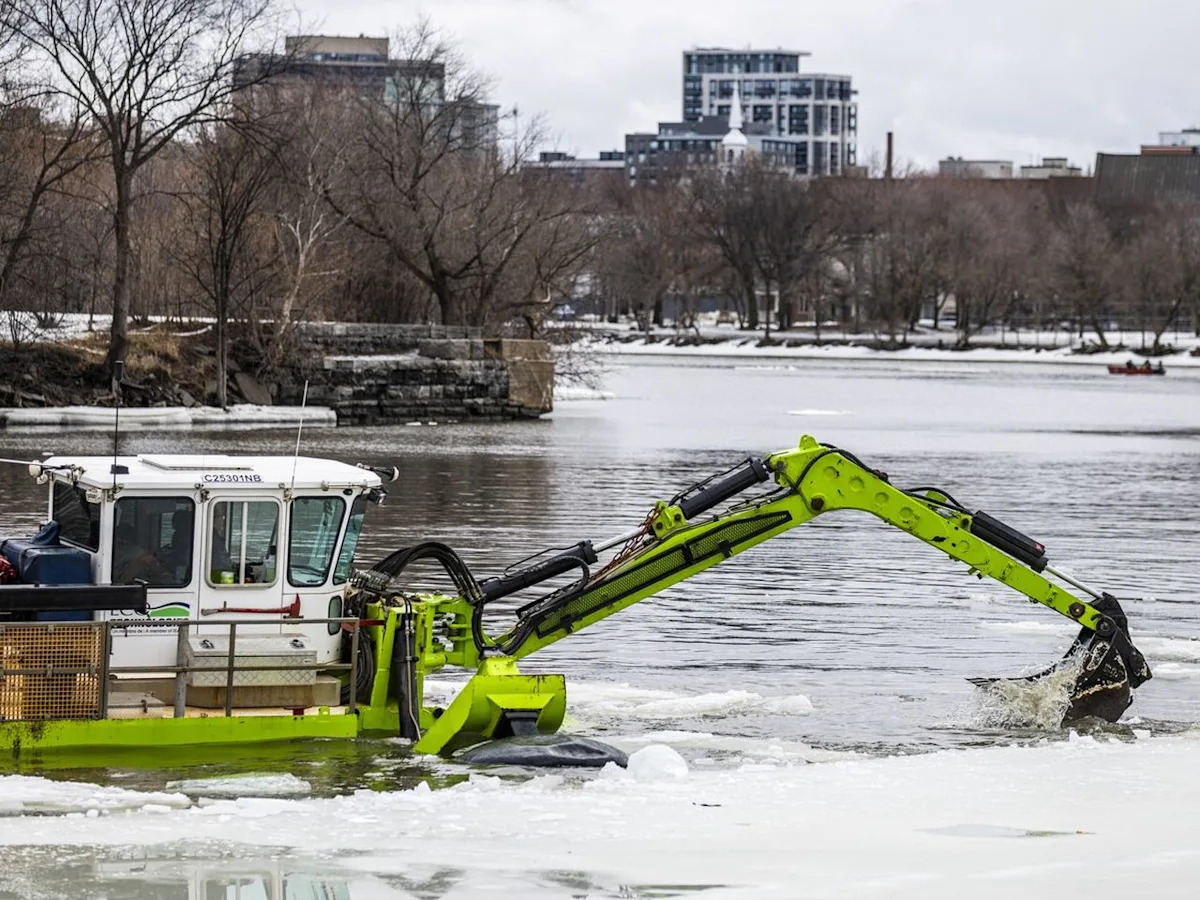
Spring has (almost) sprung in Ottawa, and a tell-tale sign for residents along the Rideau River is the sight — and sound — of the City of Ottawa crew’s hefty amphibious icebreaking machine.
The Eco Technologies-owned icebreaker looks a lot like a giant crab. Aside from its slightly off-putting demeanor, it’s in many ways an unsung hero and a true friend to residents along the Rideau River. In all its glory, the crawling behemoth glides along the water, pushing chunks of ice forward.
This allows water to flow unrestricted come spring, which helps prevent the flooding of residential areas along the river, according to the City of Ottawa. Otherwise, the water will go on top of leftover ice and flood the area, explained Jason Goyer, who was on site Sunday, March 8 at Stanley Park by the Rideau River, overseeing the icebreaking operations that morning.
Goyer, who works as a heavy equipment operator for the city, said operations began at the end of February this year.
“We break the ice basically because if we don’t the water coming down from Kingston will go on top of the ice and cause flooding,” said Goyer, who has been working with the city for 14 years. “That’s what we’re preventing.”
According to the city’s latest spring flooding update, warmer temperatures over the weekend and early in the week are expected to increase water levels in the Rideau, South Nation and Mississippi watersheds.
“This increases the risk of unstable ice and ice flows, localized flooding in low-lying areas and slippery riverbanks,” read the statement, which also advised residents to keep children and pets away from open water.
Nine crew members and three supervisors were hard at work on Sunday, some in boats creating waves to break up ice jams and others operating the icebreaking machine.
“The only spot where I’ve seen the water get a little bit high was Belmont, off of Main Street” Goyer said, adding that houses are closer to the river in that area compared to houses along Stanley Street.
“That’s the extent that I’ve seen personally,” he told the Ottawa Citizen.
Goyer said the ice was thick this season, averaging between 12 to 18 inches when the crew first came out to the Rideau River around the end of January to create test holes.
“As we finished blasting, there were some sections that were like 20-plus inches,” he said, explaining that removing snow from the ice decreases insulation, adding those extra inches to the ice bed.
Goyer said the city used to blast the entire river all the way up to Bank Street with dynamite before the amphibious machine was adopted as an eco-friendly alternative. The explosives were dangerous to wildlife and the environment.
It’s an everyday job for the city and Eco-Technologies crew until all of the ice is gone. How much longer the crew will be stationed on the Rideau largely depends on the temperature and the water flow. Goyer said it’s hard to judge.
“You can’t really say if we’re going to be here for a month or a month-and-a-half or three weeks.”
Since the late 1800s, the city, in partnership with the Rideau Valley Conservation Authority, has taken on the task of breaking and clearing ice along the Rideau River each year around late February and early March.
Our website is your destination for up-to-the-minute news, so make sure to bookmark our homepage and sign up for our newsletters so we can keep you informed.
Related