
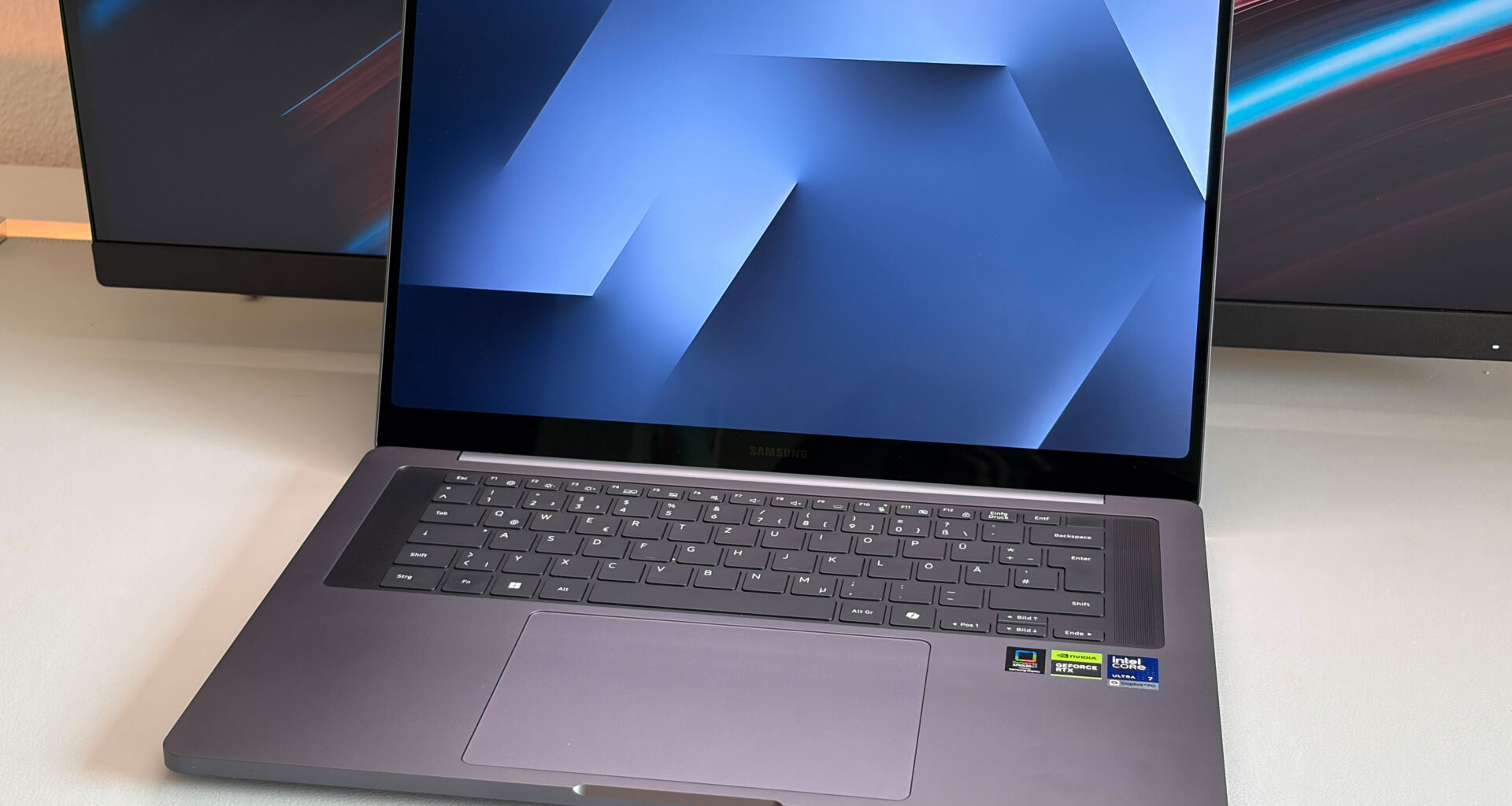
 Samsung Galaxy Book6 Ultra
Samsung’s OLED screens have not been very competitive in 2025, especially in terms of brightness. The new Galaxy Book6 Ultra finally gets an improved ILED panel, but competitors with tandem OLED screens or Mini-LED panels still have an advantage.
Even though Samsung is a large supplier for OLED screens, recent notebook screens have not been very competitive in terms of brightness. If you look at last year’s Galaxy Book5 models, the OLED panels offer a very good subjective picture impression in combination with 120 Hz refresh rate, but the brightness was limited to around 400 nits in SDR and around 550 nits in HDR scenarios, for example in the case of the Galaxy Book5 Pro 360.
We recently tested the brand-new Galaxy Book6 Ultra and Samsung finally uses an improved 16-inch OLED touchscreen. The resolution is still 2880 x 1800 pixels with a refresh rate of 120 Hz, but the brightness was increased. We now measure around 500 nits for SDR contents and more than 1100 nits peak brightness for HDR contents. This is a noticeable improvement and HDR content (movies or games) now looks much better.
If you look at the competition, however, we have to say that Samsung only managed to reduce gap, but it still cannot compete with the peak brightness values of the latest tandem OLED screens. They reach higher SDR values and especially higher HDR values up to 1600 nits, for example in the Asus ProArt P16 or the Lenovo Yoga Pro 9i 16. Apple’s MacBook Pro 16 with the familiar Mini-LED panel is also superior in terms of brightness (up to 1000 nits SDR, 1600 nits HDR).
This raises the question why Samsung did not use a tandem OLED screen for its 2026 flagship multimedia laptop, since it should have been even more efficient. The image quality of the current panel is still excellent and there is also no grainy impression despite the touch layer, but considering the high price, the competition is simply one step ahead. Please see our comprehensive review of the new Galaxy Book6 Ultra for more information.

I grew up with modern consumer electronics and my first computer was a Commodore C64, which encouraged my interest in building my own systems. I started working as a review editor for Notebookcheck during my dual studies at Siemens. Currently, I am mainly responsible for dealing with business laptops and mobile workstations. It’s a great experience to be able to review the latest devices and technologies and then compare them with each other.