
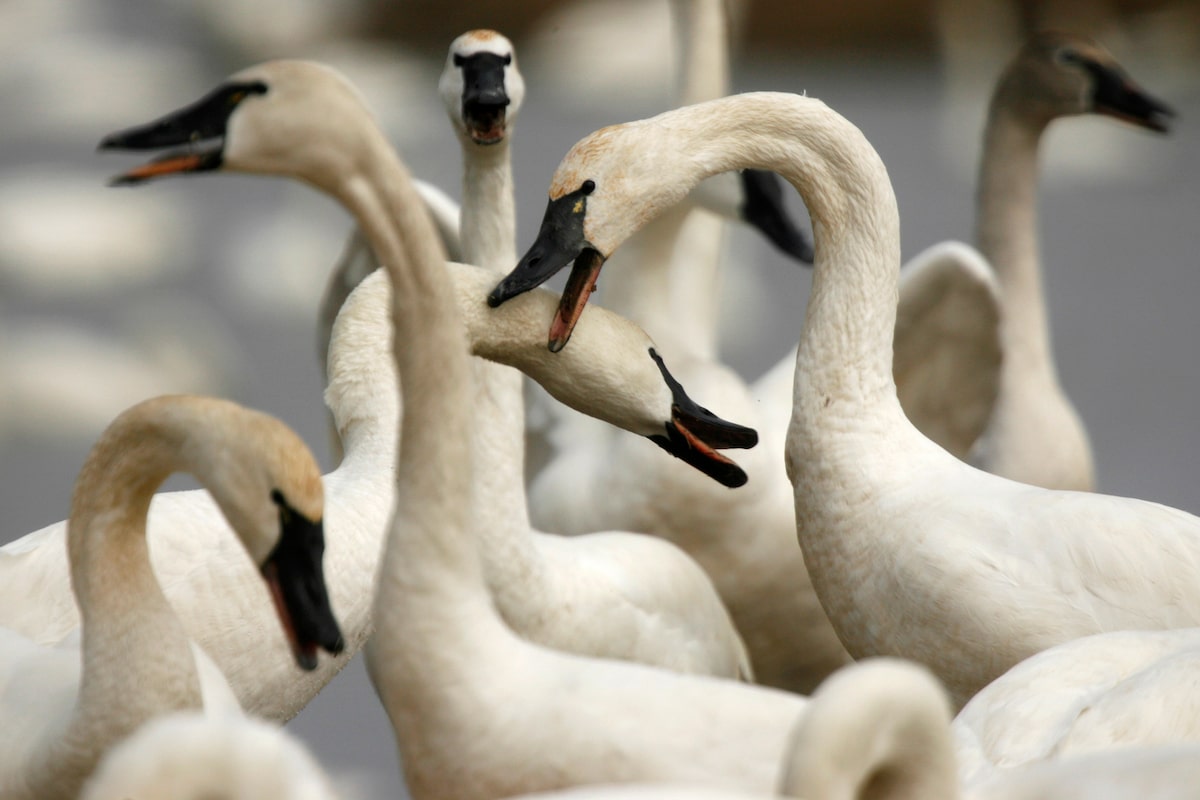
Tundra swans gather at a bird sanctuary near Aylmer, Ont., in March, 2009.DAVE CHIDLEY/The Canadian Press
Ottawa is consulting on allowing a native species of swan to be hunted in Canada, in a move that has provoked an outcry among conservationists.
The federal environment department has been looking at permitting the tundra swan, a species that mates for life and is currently afforded federal protection, to be killed by hunters, including those from outside Canada.
This North American species of swan breeds in the tundra of the Arctic and subarctic. It is found on lakes, rivers and pools, including in the Prairie provinces, and migrates in V-shaped formations.
Tundra swans raise three to five cygnets in pairs once a year and opponents of the proposed hunt say killing one swan could affect entire family groups and lead to their offspring dying.
Hunting of swans is generally outlawed in Canada, although Indigenous people are allowed to hunt them for food.
New study examines how best to address species declines in Southern Ontario
The federal environment department’s consultation says a “hunting season for Tundra swans would provide additional and unique hunting opportunities for existing game bird hunters, and additional marketing opportunities for outfitting businesses, without any additional harvest pressure occurring on the population.”
Under the proposal for hunting, non-Canadian hunters would also have access to permits.
Sport hunters, especially from the United States, are a lucrative source of income for outfitters in Canada.
Canada exports more hunting trophies, including parts of bears and wolves, than any other country in the world, according to the Convention on International Trade in Endangered Species of Wild Fauna and Flora (CITES), which compiles the figures.
In 2024, Canada exported about 8,600 hunting trophies. In second place was South Africa. Almost 5,400 Canadian bear trophies were taken home by American hunters, a quarter of the international trophy hunting trade in 2024.
Opinion: The grizzly hunt is no way to solve conflict between humans and bears
Conservationists have said that there is no evidence that the population of tundra swans, which has seen threats to its natural habitat, needs to be controlled. They have raised concerns that removing federal protection from tundra swans could lead to other swan species being accidentally shot.
Trumpeter swans, which are also white with black beaks, share some of the tundra swans’ migration routes, stopping off points to and from their breeding grounds, and wintering habitat.
Humane World for Animals is among the groups opposing the proposed changes to the Canadian Migratory Birds Regulations that currently protect tundra swans.
“We should be working to protect and celebrate our wildlife in Canada, not unravelling the few protections that they do have so that they can be killed for fun or for profit,” said Michael Bernard, deputy director, Canada.
Environment and Climate Change Canada (ECCC) is also consulting on allowing mourning doves, a light gray and brown North American dove with a bittersweet call, to be hunted.
The consultation on the proposed changes to the rules on hunting migratory birds ended in mid-February and ECCC is currently evaluating feedback it received.
“Comments will be carefully evaluated, and the final regulations will be published in July, 2026,” ECCC spokesperson Cecelia Parsons said in an e-mail.
New data put Canadian wildlife population declines in focus
The range of Canada’s eastern population of tundra swan extends across the Arctic and subarctic regions of Canada, including northern Manitoba. The birds migrate south and eastward toward the lower Great Lakes, and parts of the United States. They fly through the Northwest Territories, Nunavut, and parts of Yukon, northeastern Alberta, Saskatchewan and Manitoba.
Manitoba is a major staging ground for tundra swans migrating to breeding grounds and on their return flight to wintering grounds.
The federal environment department’s proposal says tundra swans could be “hunted sustainably” in Manitoba where a season could be established in fall of 2028.
Advocacy organization Animal Justice said in its submission to the consultation that allowing tundra swans to be hunted is “irresponsible from an environmental standpoint and puts swans of several species at risk of extreme and unnecessary suffering.”
It argued that there is no evidence that the population of tundra swans needs to be curbed. “Combined with loss of habitat on their migration routes, Tundra Swans already face significant and unpredictable risks to their survival,” it said.
“Tundra swans pair for life and when one mate dies, the survivor can take years to find a new mate. Juveniles also stay with and depend on their parents for much of their first year of life, and during their first migration,” it added.
Animal Justice said that as many of those killed would be breeding pairs, their offspring could die and there would be a “decline in broods for years to come.”
Groups advocating for the protection of swans expressed concern that other types of swans and even cranes, which look similar from the ground, could be accidentally shot if hunting of the tundra swan is allowed.
“Tundra swans are a conservation priority and Canada’s responsibility for the species is very high. The Trumpeter swan and Whooping crane recoveries should not be put at risk with the introduction of a Tundra swan hunting season, where the possibility of shooting non-target species is real and significant,” said Kelly Duffin, founder and president of the Mute Swan Society in an e-mail.
“Public sentiment would not be supportive of hunting any swan species.”