
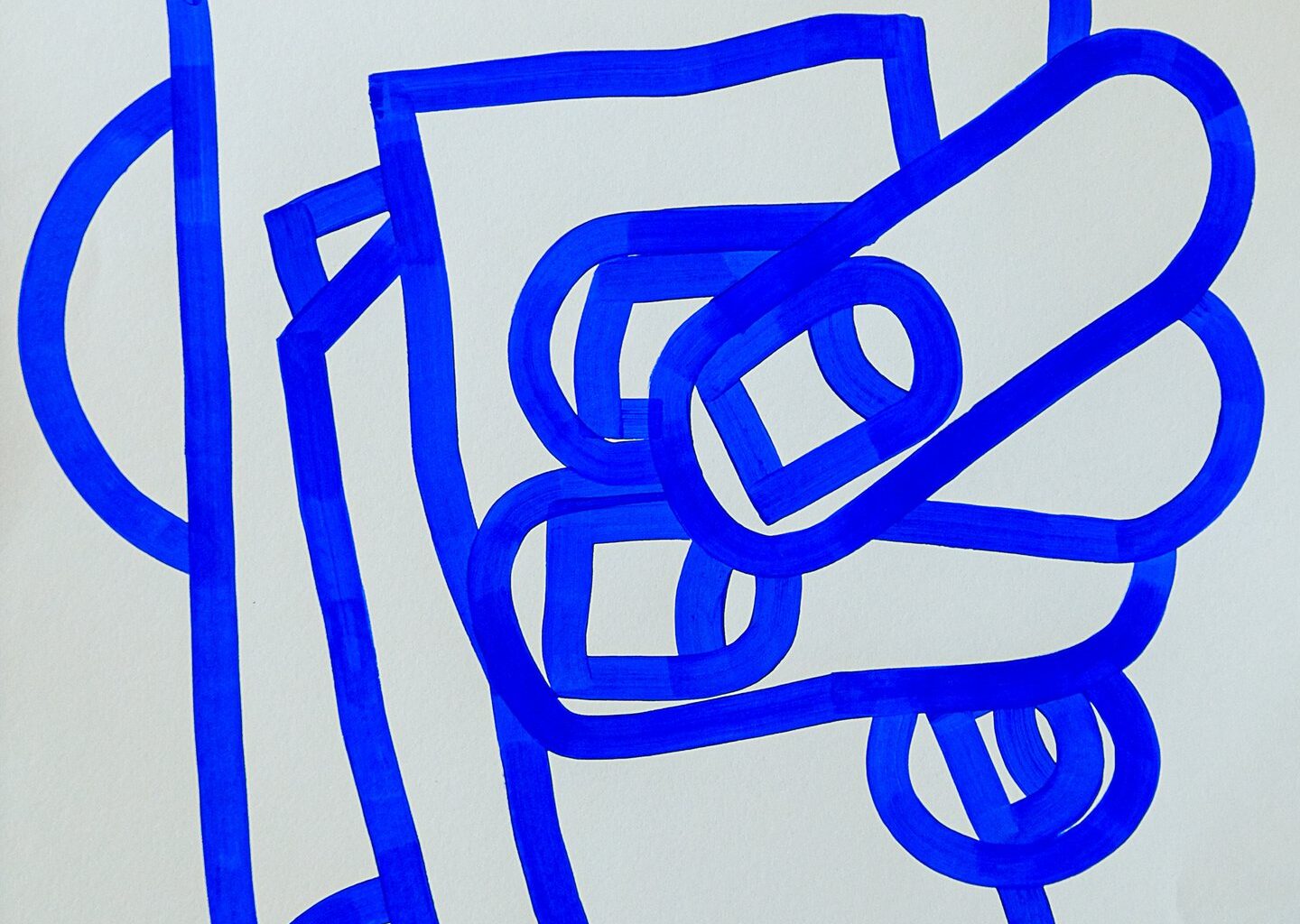
Moving away from the screen, Sebastian favours acrylic paint on canvas, not just for the tactility but also for the potential for working at a bigger scale. On a smaller scale, he uses coloured pencils and “messy cross hatch” styled colouring, taking pleasure in the low pressure and minor stakes. Before, he would have a digital file in a folder somewhere on his disk, now he has something right in front of him.
Most important are his studio’s print works. “We bought a press a year ago and it’s been really fun to figure it out at the studio. We are doing relief prints with wood now. Mixing the colors, cutting the paper by hand, stretching the paint and putting it on the wood plates,” says Sebastian. “Everything about this process drives me crazy and I love it. I don’t know a lot about printing and I’m eager to learn. Something about that is key to me.”
Nevertheless, digital tools still play a “huge part” in Sebastian’s work. It is, after all, how he’s trained to work, but now it plays a larger role in documenting his work, showing the world everything that goes into these deceptively simple prints. Sebastian has always been a tools-oriented person – he learned how to model something in 3D before he “knew anything about form or colour” – that’s why learning the “why of things” has changed everything for Sebastian.
“All sides are part of me. I like humour and I also like to explore drawing seriously. I see myself very much as a fine artist. But I also don’t take myself seriously, I’ve done collaborations with all sorts of brands that put my work on billboards or T-shirts,” says Sebastian. “I’m curious so I try new things. I come from a humble home and museums and arts weren’t part of my upbringing. Finding art in commercial mainstream objects still feels like a way to connect with that kid that doesn’t know yet he likes art.”