

Listen to this article
Estimated 4 minutes
The audio version of this article is generated by AI-based technology. Mispronunciations can occur. We are working with our partners to continually review and improve the results.
Community groups say the changing laws around secularism and immigration, coupled with budget cuts in sectors like health care and education, continue to put women in the province at risk.
And, they say, those issues are even more pronounced for migrant women in Quebec.
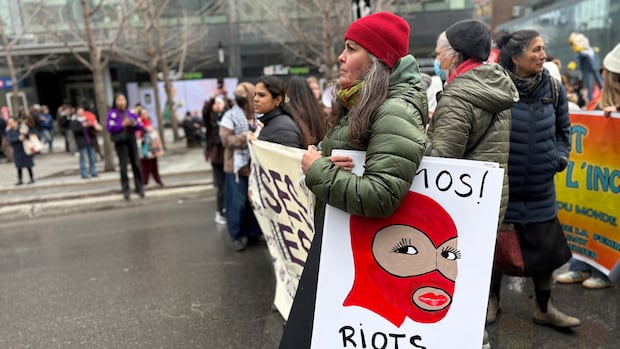
Hundreds gathered for two separate protests marking International Women’s Day in Montreal and Quebec City Sunday.
This was the 25th year Women of Diverse Origins, a grassroots organization in Montreal, organized a Women’s Day march in the city.
Member Dolores Chew said that while she has seen some progress throughout the years, some of the struggles migrant women in the province face continue to grow.
“Women who wear hijabs are going to lose employment, making them economically dependent,” she said, referring to the province’s religious symbols ban and recently proposed extensions to it.
The Quebec government has argued its secularism laws are meant to defend equality between men and women.
“There’s austerity and cutbacks in the health-care sector, in the education sector. The unions are being attacked and unions have traditionally supported women,” Chew added.
Thelma Castro, who helped found a group for Filipino women in Montreal about 30 years ago, said she too finds progress in some areas is stagnating.
She argues it’s becoming increasingly difficult for temporary foreign workers to permanently settle in Canada, for instance.
WATCH | Why some women in Montreal took to the streets for International Women’s Day: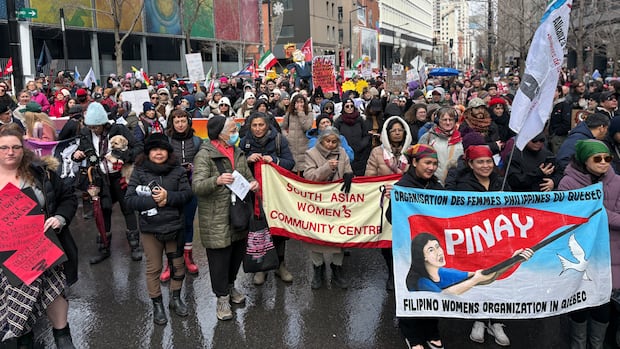
Protesters say there’s still a long way to go for women’s rights
Community groups and protesters gathered in downtown Montreal to commemorate International Women’s Day on Sunday.
“Women of colour, like me, always struggle with being accepted in any way, from professional to community to societal,” she said.
It’s an issue Deann Nardo sees frequently in her work. A member of Migrante Québec, she works closely with women who hold temporary work permits and she says they continue to be taken advantage of.
“A lot of these people, they’re here to work and they’re separated from their families for long periods of time,” she said. “They’re going through a lot of exploitation and abuse.”
The recent conflict in the Middle East was also on the minds of many protesters.
While Iranian Montrealer Golnaz Shaverdi want to see an end to the Islamic Republic’s regime in Iran, she fears the attacks will have a disproportionate impact on women and children in the region.
“The war is going to bring [destruction] and killing and it’s going to mostly impact the women and children,” she said. “We would like to see a change but not in this way.”
Concerns over abortion rights, obstetrics access
Over in the province’s capital, where protesters gathered outside the National Assembly, many expressed concern over the umber of cases of intimate partner violence-related death the province has seen this year.
Anne-Valérie Lemieux-Breton, coordinator with the Regroupement des groupes de femmes de la Capitale-Nationale, said the Quebec government’s initial decision to include abortion rights in its proposed Quebec constitution also continues to be cause for concern.
Justice Minister Simon Jolin-Barrette eventually agreed to remove that portion of the bill, after hearing from groups that enshrining abortion rights in the constitution could actually have the adverse affect and put those rights at risk.
But to some, the entire saga served to demonstrate just how precarious that right is.
“We see as well that there’s a rise in anti-feminist discourse,” said Lemieux-Breton.
Several obstetrics units and clinics also shut down across the province’s regions in recent months, whether temporarily or permanently, because of ongoing staffing shortages or a lack of funding.
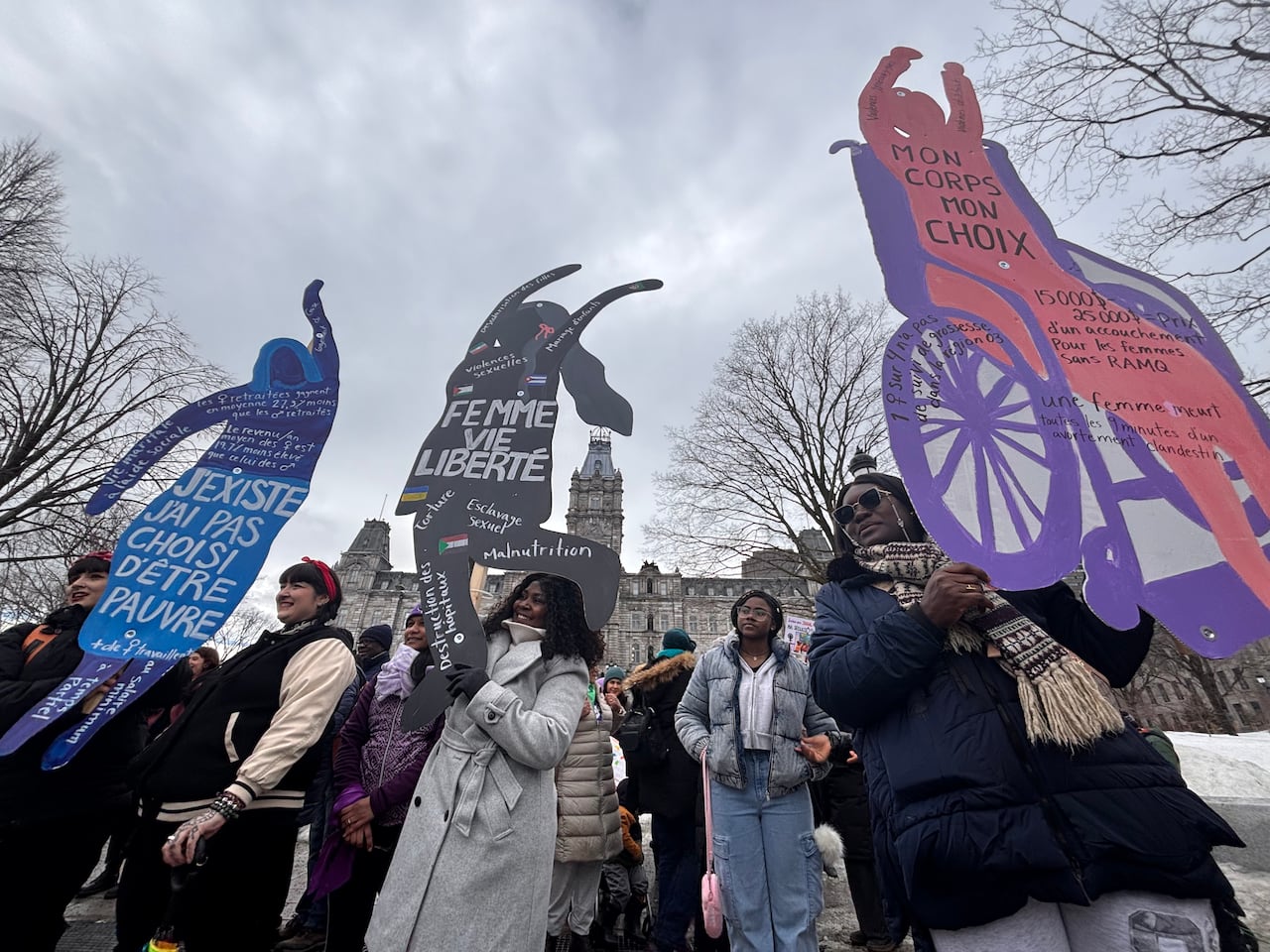 Women gathered outside the National Assembly on March 8, with many expressing concern over the rise of anti-feminist discourse. (Flavie Sauvageau/Radio-Canada)
Access to those clinics is also increasingly difficult for women who don’t have access to public health insurance, as the community groups that help them continue to lose government funding, Lemieux-Breton added.
“We also know that there are women living in contexts of conjugal violence cannot leave because there is a lack of housing,” she said.
Mathilde Leduc, another protester in Quebec City, echoed those concerns.
“With the rise of the far-right in politics, it has us scared that we will see the rights that we had disappear over time,” she said.