

Listen to this article
Estimated 4 minutes
The audio version of this article is generated by AI-based technology. Mispronunciations can occur. We are working with our partners to continually review and improve the results.
Premier Scott Moe has unveiled his government’s new blueprint for health care, which he says is focused on improving access across the province.
The plan, titled Patients First Health Care Plan, lays out more than 50 actions the government will take to ensure Saskatchewan residents are “receiving the right care in the right place at the right time,” Moe said.
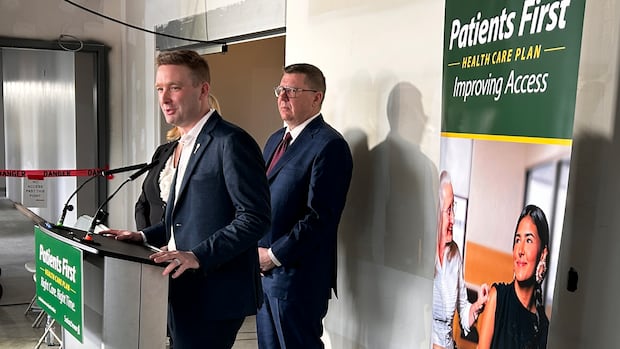
Speaking at the under-construction Urgent Care Centre in Saskatoon on Monday, Moe repeatedly highlighted his government’s commitment, made in the 2025 Throne Speech, to have every resident attached to a primary health-care provider.
It was a commitment echoed by Health Minister Jeremy Cockrill during his comments on Monday.
“That’s why as part of this plan, we are taking an all-in approach on the role of nurse practitioners in this province as a central part of improving that access to primary care,” said Cockrill.
Cockrill highlighted how even the premier sees a nurse practitioner as his primary-care provider.
Linking patients to primary care will also be achieved through the expansion of access to virtual care to all residents in the province, Cockrill said.
He pointed to Whitecap Dakota First Nation and its virtual health hub as a model and said certain communities will receive access to virtual care visits first.
WATCH | Every Sask. resident to have primary care provider, province promises: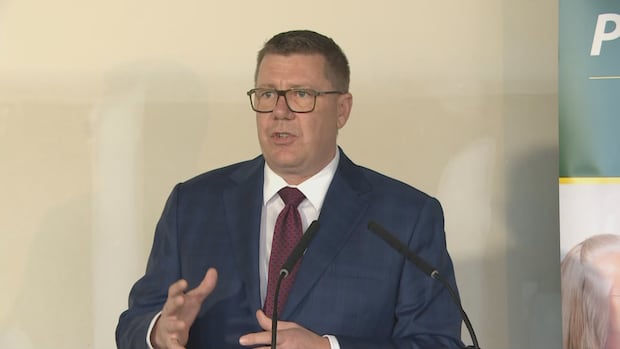
Every Sask. resident to have primary care provider, province promises
Saskatchewan’s premier and health minister unveiled a new patient-first plan that promises every resident will be attached to a primary care provider, whether it’s a doctor, nurse practitioner or physician’s assistant.
Plan rehashes old ideas, NDP says
In a statement, Saskatchewan Opposition NDP Leader Carla Beck said the plan rehashes old ideas.
Beck pointed to a 2012 announcement made under Premier Brad Wall about a Patients First Plan, which promised connecting residents to a family physician.
She highlighted how the province walked back its plan to have 24-hour staffing at the Regina Urgent Care Centre as a reason to not trust the new provincial plan.
“We need big, bold change to get our health system out of last place. Scott Moe and the Sask. Party broke our health-care system, and they can’t be trusted to fix it,” Beck said.
Scope of practice expansion
Part of the government’s plan includes expanding the scope of practice “for all health-care professionals.”
Cockrill said that will include dietitians, optometrists, nurses and “potentially chiropractors.”
Discussions with the respective regulatory bodies for each of those professions is underway, he said.
“We look forward to, I would say, introducing some fairly ambitious legislation in the fall session around scope,” Cockrill said.
The province will also continue to recruit, train and increase the number of doctors, nurses and nurse practitioners.
Cockrill said the province’s Health Human Resources Plan “laid the foundation” for the plan announced on Monday.
It’s why the province is expanding its training capacity, with the addition of 26 new nurse practitioner seats across the province, Cockrill said.
That will mean 13 new seats offered through the University of Saskatchewan and 13 new seats offered through the University of Regina, helping to increase the province’s nurse practitioner training capacity by 45 per cent, Cockrill said.
Cockrill said the province will be introducing a $78,000 financial incentive with a return of service contract to attract registered nurses to become nurse practitioners.
 Premier Scott Moe, speaking at the under-construction Urgent Care Centre in Saskatoon on Monday, says the province will be building more of the centres in cities in the province. (Trevor Bothorel/CBC)
Moe said the plan announced on Monday targets the following goals for 2028:
Every person in Saskatchewan having access to a primary care provider.90 per cent of patients receiving diagnostic scans within 60 days of being referred.90 per cent of patients having a three-month wait time for surgeries.Completing 450,000 surgeries over the course of four years.
To meet those surgical targets, the province will use more private surgery clinics to perform procedures that are publicly funded, said Moe.
The province also says it will build more urgent care centres in Saskatoon, Regina, Prince Albert, Moose Jaw and North Battleford to lessen the strain on hospitals.
Cockrill announced 36 new acute care beds will open at Royal University Hospital in Saskatoon later this year.
The Saskatoon Health Authority will also expand the neo-natal ICU at the Regina General Hospital by three beds, Cockrill said.