

The City of Ottawa is once again considering a contentious housing framework that would require private-sector developers to set aside a specific number of units as affordable housing when building near transit hubs.
City staff have released a discussion report on the feasibility of inclusionary zoning, a land-use tool that would require housing developers to sell or rent portions of their new-build units at reduced prices to meet affordability thresholds.
But experts, developers and advocates say the policy won’t be effective in the current housing market.
The city’s discussion paper itself outlines that inclusionary zoning won’t be effective right now, stating it will either increase rent prices for units not included in the policy or disincentivize developers from building in the first place.
As a result, the city is recommending putting an inclusionary zoning “regulatory structure” in place, meaning the policy wouldn’t come into effect immediately, but the requirements would be ready to activate once market conditions improved.
Inclusionary zoning is not intended to be a model for below-market housing and is instead targeted toward moderate-income households. City reports state the goal is to help “deepen affordability for everyone by increasing housing diversity in the market.”
So what’s the city’s history with inclusionary zoning, and could it ever work to increase housing affordability in practice?
When did discussions around inclusionary zoning start?
Discussions around inclusionary zoning began in 2019 as the City of Ottawa looked for tools to increase housing equity near transit stations.
A framework released in 2022 would require developers to dedicate 10 per cent of gross floor area to inclusionary zoning units meeting a designated affordability definition, with these units required to stay affordable for 25 years for rentals and 99 years for ownership.
At the time, many industry representatives praised the “cautious approach” the city was taking with the policy while trying to avoid upsetting the housing pipeline.
But, as the city eyed strengthening the framework, the province had other ideas: The Ford government solidified strict restrictions for Ontario municipalities looking at inclusionary zoning in 2024, stating that a maximum of five per cent of units could be set aside and that these units could be set at affordable prices for no longer than 25 years.
Now, nearly two years later, the city has come forward with a zoning bylaw amendment for inclusionary zoning, but the recommendation is just to improve the framework, without setting a timeline to enforce it.
The idea is that, if the city has the framework approved, it can “turn on” enforcement once housing market conditions improve, according to the discussion paper.
The proposal will be considered by the planning and housing committee on April 1.
What do experts say?
Since the beginning of inclusionary zoning conversations in Ottawa, some housing experts have questioned the effectiveness of the policy in any state of the housing market.
Carolyn Whitzman, an Ottawa-based adjunct professor and senior housing researcher at the Universty of Toronto’s School of Cities, says inclusionary zoning “is an idea that didn’t work 10 or 20 years ago,” and hopes Ottawa learns lessons from municipalities that have tried it in the past.
Around the same time Ottawa was discussing inclusionary zoning, Whitzman and other experts watched carefully as Montreal rolled out an “ambitious” policy in 2021, asking developers to set aside 20 per cent of units for inclusionary zoning.
While the concept may have sounded good, Whitzman said virtually no developers chose to adhere to it.
“They preferred paying a fine or a cash-out instead, in which case it just became another form of a development charge,” she said.
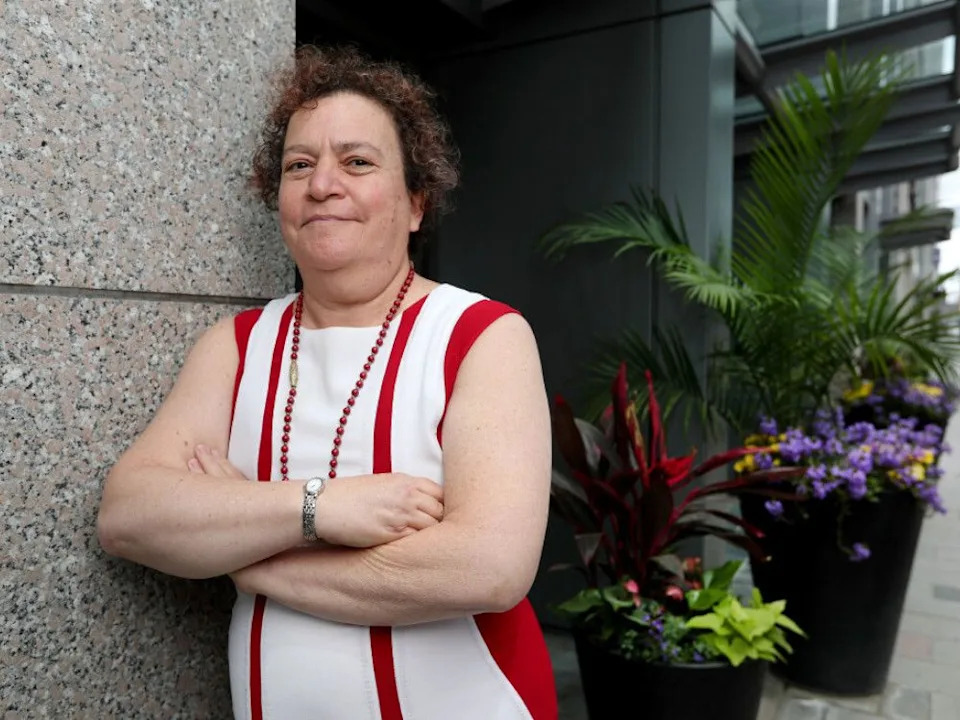
Carolyn Whitzman, an Ottawa-based adjunct professor and senior housing researcher at the University of Toronto’s School of Cities, sees inclusionary zoning as “an idea that didn’t work 10 or 20 years ago.” She is seen in a 2022 photo.
Similar trends also exist in cities such as Vancouver and San Francisco, Whitzman added.
“Generally, private developers hate it unless they can get really huge benefits from it,” she said. “It’s dependent on the private sector being forced to take a proportion and offer it at a cheaper rate, in which case it’s almost certainly going to affect the bottom line.”
Even amid research that it doesn’t work, some of which is included in Whitzman’s book, Home Truths: Fixing the Housing Crisis, municipalities continue to look for ways to make the policy work.
“There’s still a belief in market-sector levers that just haven’t worked because people want to believe they can get something for nothing from developers,” she said.
But for Whitzman it’s the value of the entire inclusionary zoning initiative she’s left to question, instead urging a focus on the lower-income tax brackets, where the level of core housing need is greatest.
What do developers think?
As the city looks to introduce another regulation on the private-market housing sector, some Ottawa-area developers are expressing concern about how they’re expected to fill the gap between high building costs while lowering rental prices.
“In practicality, it just doesn’t work out,” said Jason Burggraaf, executive director of the Greater Ottawa Home Builders’ Association.
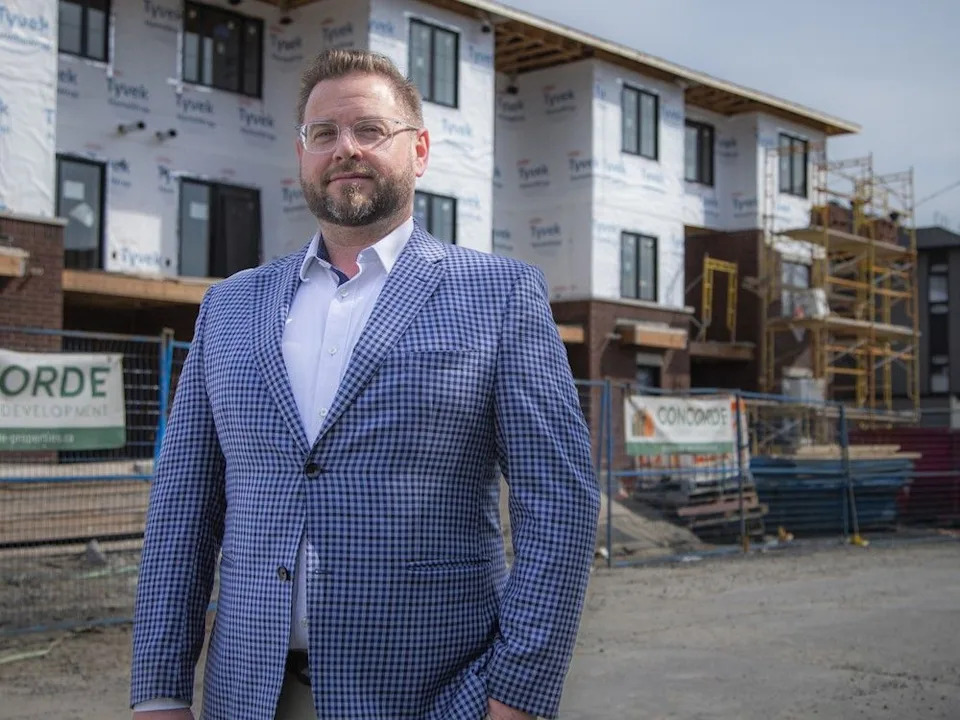
Jason Burggraaf, executive director of the Greater Ottawa Home Builders’ Association (GOHBA), is seen near a new residential construction site in Ottawa’s east end on July 5, 2025.
“The cost to build a building is the cost to build a building in terms of construction labour, the land price, the soft costs that go into all of these things. Then, if you want to take a 100-unit building and provide 10 per cent of those units well under the value of what market rent might be, then someone’s got to pay the difference in rental price.”
If developers aren’t going to get their money back on land parcels, especially those that may be of higher value near transit, then the project often becomes unviable and likely won’t get built in the first place, Burggraaf said.
While he says this dynamic between building costs and housing prices is properly recognized in the city’s discussions, he worries that, without proper provisions from the government, the housing market may never reach a place where inclusionary zoning makes sense for developers’ bottom lines.
“It’s a really small set of circumstances where it might pencil out,” he said.
What do housing advocates say can be done instead?
Kaite Burkholder Harris, executive director at the Alliance to End Homelessness Ottawa, said inclusionary zoning once seemed like an effective policy and was even included in the advocacy group’s list of key asks in the 2022 municipal election.
However, after watching how few affordable units were actually built under Montreal’s policy, she said they started to change course.
“It seems like a great idea, but in practice in Montreal at least it hasn’t garnered any units that are affordable because the costing just wasn’t working in the current economic environment,” Burkholder Harris said.

Kaite Burkholder Harris, executive director of the Alliance to End Homelessness, poses for a photo.
Rather than spending time and money on inclusionary zoning, Burkholder Harris said she’d rather see more funding for non-market developers like Ottawa Community Housing to provide deeply affordable units for people on fixed incomes.
“You can’t leave human rights with the private sector — the right to housing is functionally a government responsibility,” she said. “The government is charged with stepping in when the private sector can’t solve the problem, so I think we just have to name that and see it in a clear-eyed way.”
Whitzman, who has also authored a report on non-market housing for the Alliance to End Homelessness, added Ottawa was in a unique position with the amount of government land at its disposal to build on.
Housing advocates and experts say the city has better tools to maintain and improve its affordable housing supply.
Tenant rights group ACORN is also urging the city to enact an anti-displacement bylaw, which would provide stability within the affordable housing market by ensuring units could not be replaced with higher market rentals.
“This would allow families to remain in their communities and prevent increasing waitlists for affordable housing,” Sara Laviolette, chair of ACORN’s Vanier chapter, wrote in a statement.
What will discussions look like around the council table?
College ward Coun. Laine Johnson, who worked in housing before being elected to council, views inclusionary zoning as a way of “enabling more of that market rent near transit,” which she says isn’t “necessarily part of the conversation right now,” including areas in her ward, such as the one around Baseline Station.
“We don’t want to create a circumstance where no one can afford to live near transit, just creating a cost burden for transportation for these moderate-income families as their affordable housing just gets pushed further and further away,” she said.
However, Johnson says the city is also looking at other tools to create affordable housing that don’t include inclusionary zoning. This includes the 53 recommendations in the housing task force report, created in consultation with developers to include tools and incentives they’d need to build, she said.
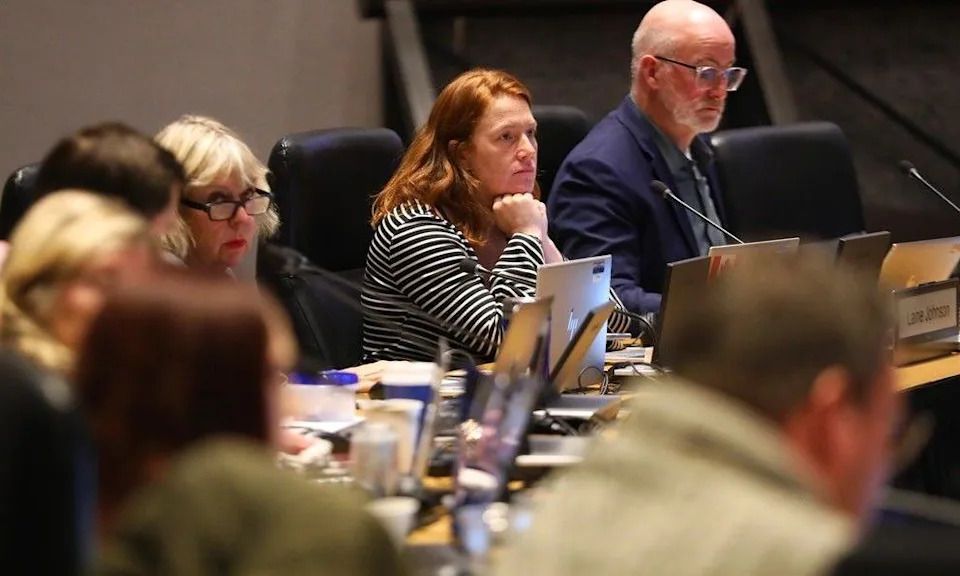
Laine Johnson, middle, Sean Devine, right, and other Ottawa councillors at City Hall on Nov. 12, 2025.
Developers are working to implement the task force recommendations and Johnson said she’d understand their hesitancy if the city “introduced more red tape” in the form of inclusionary zoning.
Johnson also predicts councillors may be skeptical when considering inclusionary zoning.
“I could hear my council colleagues suggest that it is in opposition or counter-directional to the intentions of the housing task force,” she said. “Inclusionary zoning could counter the commitments we had all agreed to in the housing task force and give a further wedge for the development industry to say that can’t possibly build under these circumstances.”
But, in what Johnson described as “throwing spaghetti at a wall” while the city finds ways to incentivize private housing development, she said inclusionary zoning could be worth a shot.
“I don’t know that I come down hard on one side or the other … but it’s an important puzzle piece, and I think it’s worthy of exploration.”
Related
Our website is your destination for up-to-the-minute news, so make sure to bookmark our homepage and sign up for our newsletters so we can keep you informed.