
Last Monday, an art exhibit opened at Western University’s D.B. Weldon Library, and before it was unveiled, user experience librarian Jennifer Robinson gave colleagues a helpful heads up. “I primed the staff,” she says with a laugh. “You may get questions.”
There’ll be queries on the current status of U.S.-Canada relations, no doubt. The show, Pax Americana, is a collection of satirical book covers and historical plaques by Dara Vandor, a multi-disciplinary artist from Toronto. The text imagines a not-so-distant future; a Canada fully absorbed by a fascist United States. And to sow a deliberate degree of confusion, Vandor has installed the signs guerrilla-style amid the stacks.
At the entrance to the Archives and Research Collections Centre, for example, there’s a sign identifying the space as A Repository for Canadian Culture. (Holdings include an “assortment of hockey erotica and 10 issues of Chatelaine.”)
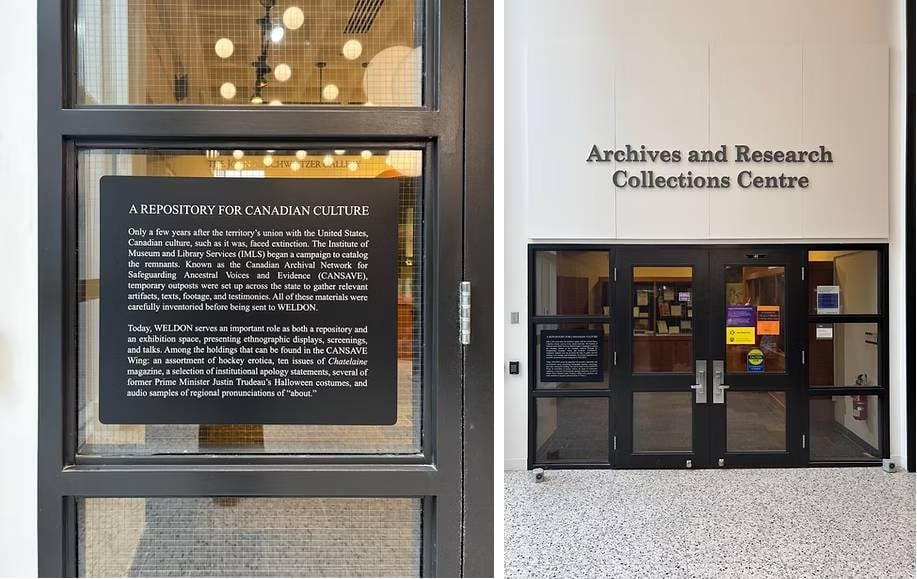 From Dara Vandor’s Pax Americana exhibit at D.B. Weldon Library: A Repository for Canadian Culture. (Dara Vandor)
Another aluminum plate, pasted on a window facing a courtyard, heralds the Philip Morris International Scrolling Garden, a “respite from knowledge and learning” established in 2041.
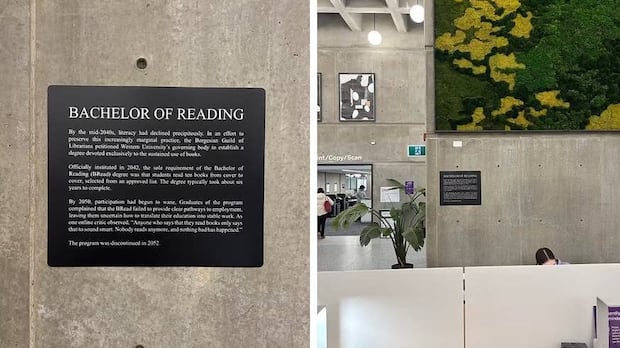
One of Robinson’s favourites, which hangs in Weldon’s grandest study hall, commemorates a short-lived degree program, the Bachelor of Reading. (To graduate, students must finish 10 approved books from cover to cover, a suggestion which would be laughably absurd if universities weren’t already offering courses in “reading resilience.”)
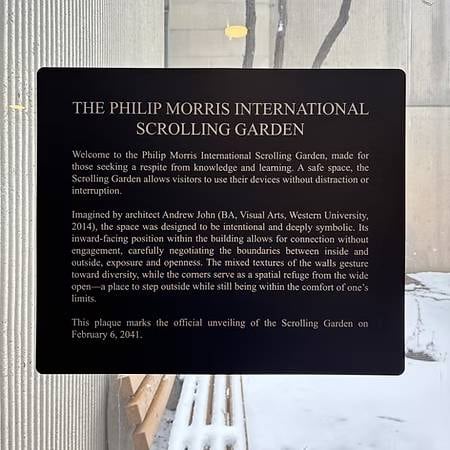 From Dara Vandor’s Pax Americana, The Philip Morris International Scrolling Garden. “”Welcome to the Philip Morris International Scrolling Garden, made for those seeking a respite from knowledge and learning. A safe space, the Scrolling Garden allows visitors to use their devices without distraction or interruption.” (Dara Vandor)
Robinson’s received positive feedback since the exhibit launched. A few colleagues were startled by the plaques, though they eventually remembered an all-staff memo about the event. Robinson’s initial reaction? “I laughed.” But the moment was shorter than a B. Read student’s attention span. “You sober up,” she says. “You know, these [signs] are pointing out some maybe dramatic but accurate pathways.”
This is what the 51st state could look like
The Weldon exhibit is an extension of a project Vandor began last March. Like many Canadians, she was shocked and angered by Donald Trump’s casual threats of annexation. Vandor wanted to take action, but how?
Patriotic sloganeering was on the rise, but to her, the cries of “elbows up” and “buy Canadian” rang hollow. A sitting president was thinking out loud about redrawing the border. Was boycotting California strawberries — or loudly questioning the provenance of a double double — truly going to do anything?
“All this stuff was way too banal for what I was feeling,” says Vandor. “Canada could easily disappear.” And so, she got to work.
“I wanted to create a series that imagined this alternate reality and confronted people,” she says. This is what life in Trump’s 51st State could look like.
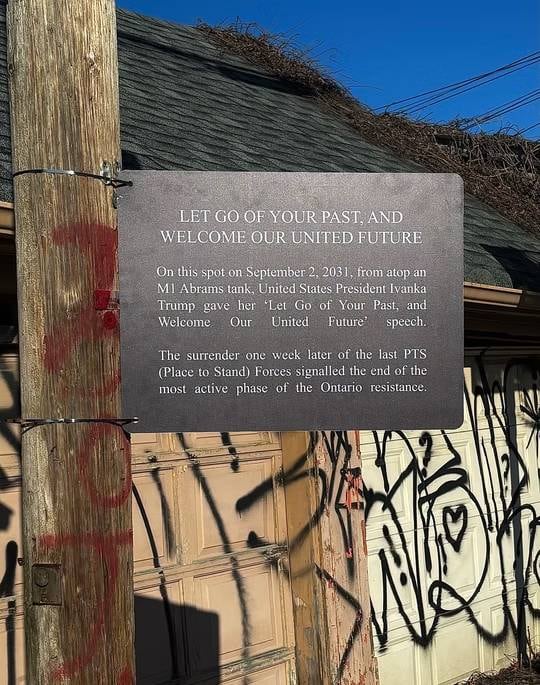 Let Go of Your Past, and Welcome Our United Future. Artist Dara Vandor hung this plaque in Toronto in March 2025. “On this spot on September 2, 2031, from atop an MI Abrams tank United States President Ivanka Trump gave her Let Go of Your Past, and Welcome Our United Future speech. The surrender one week later of the last PTS (Place to Stand) Forces signalled the end of the most active phase of the Ontario resistance.” (Dara Vandor)
Her first piece set the tone: an aluminum plate in the serious, unadorned style of Toronto heritage plaque. The text described the victory of “United States Patriot liberation forces.” On Aug. 11, 2031, “Canadian irregulars” surrendered on this spot. She hung the marker in an alley near her home.
One didn’t feel like enough to Vandor, so she made another, and another — and for the next nine months, often with her baby in tow, she toiled in secret as a one-woman department of civic monuments. (None of the original plaques remained up long, though she sells reproductions online.)
On Vandor’s website, she’s collected photos of all the plaques, and they read as a chronological saga. In this future history, Ivanka Trump is president, Alberta was “liberated” in 2027, Canadian insurgents “spread misinformation” at the Trinity-Bellwoods tennis court and the old MuchMusic building has been re-opened as 51st Productions – Stage One, home of popular state-sanctioned fare including Mel Gibson’s Anne of Green Gables.
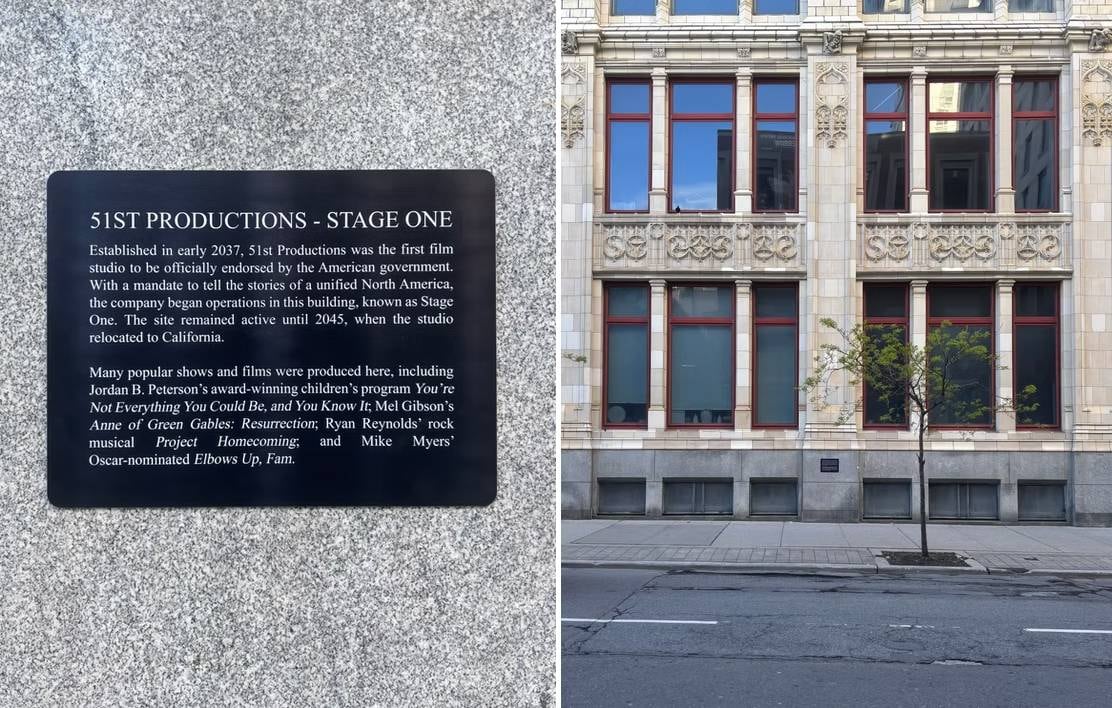 From Dara Vandor’s Pax Americana. In May 2025, the artist posted this marker at 299 Queen St. W. The Bell Media Queen Street building is the former home of MuchMusic. (Dara Vandor)
Vandor describes her writing process as “very improvisational jazz.” She hasn’t sketched out a plot. “The core nugget was just this idea of would Canadians fight? Would they be interested in picking up arms and standing up for our country?,” she says. “I didn’t have this grand narrative from the beginning.” A few details are canon, however, with events transpiring before and after Aug. 27, 2035 — or Unification Day, the date of Canada’s official absorption into the union.
What can we learn from a dystopian future?
Beyond Toronto, Vandor has left plaques in Tofino, B.C., Ottawa and Montreal. “I wanted to expand as much as possible,” she says, and in October last year, the idea for an exhibit was sparked.
That month, while speaking at Western University, Vandor connected with Frank Schumacher, a professor of history and director of Western’s international relations program. The professor was impressed by Pax Americana, especially its ability to bend the viewer’s sense of reality.
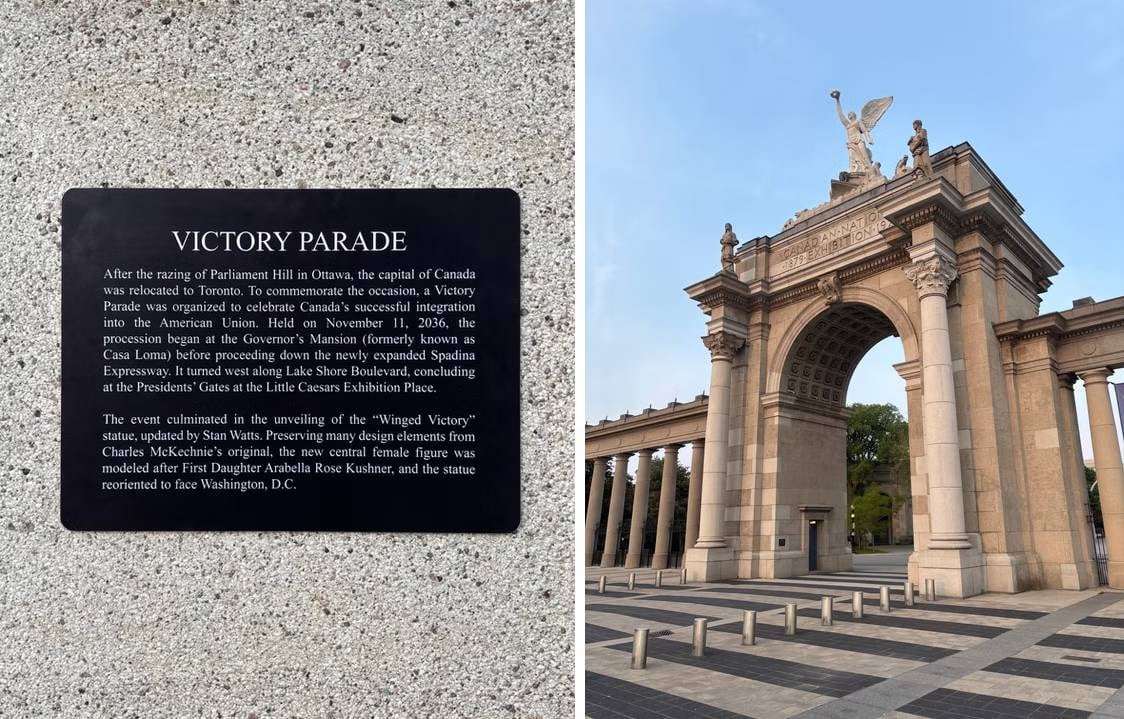 In June 2025, Dara Vandor posted this sign, Victory Parade, at Princes’ Gates in Toronto. “”After the razing of Parliament Hill in Ottawa, the capital of Canada was relocated to Toronto. To commemorate the occasion, a Victory Parade was organized to celebrate Canada’s successful integration into the American Union. Held on November 11, 2036, the procession began at the Governor’s Mansion (formerly known as Casa Loma) before proceeding down the newly expanded Spadina Expressway. It turned west along Lake Shore Boulevard, concluding at the Presidents’ Gates at the Little Caesars Exhibition Place.” (Dara Vandor)
Finding one of Vandor’s plaques in a familiar place is a shocking experience, he says, and he wanted his students to experience that thought-provoking jolt for themselves.
Speculative fictions such as Pax Americana can be an opportunity to think creatively about thorny international issues, Schumacher explains. “It gives the students a vantage point from which they can explore an existential question, but they can do it within the safety of something imagined,” he says. “It doesn’t have to be [this way]. It’s not happening yet.”
Schumacher had never organized an art exhibit before, but he connected with Robinson at the D.B. Weldon Library about securing display and exhibition space. Robinson was a fan of the project right away. Upon viewing Vandor’s work, its timeliness was apparent. Her colleagues in the United States were already grappling with defunding and censorship, and changes to the Library of Congress have an impact on catalogue systems elsewhere, including here in Canada. For example, anything about the “Gulf of Mexico” must now be filed as “Gulf of America.”
The saga continues
“We are seeing the impacts and then sort of wondering, ‘OK, what would happen here?’” says Robinson. “Libraries really help support and uphold values that enable democracy. And so when those things start to erode and they sort of erode quietly, I’m not sure if people notice. … This felt like an opportunity to be like, well, what could we do to put this in front of more people?”
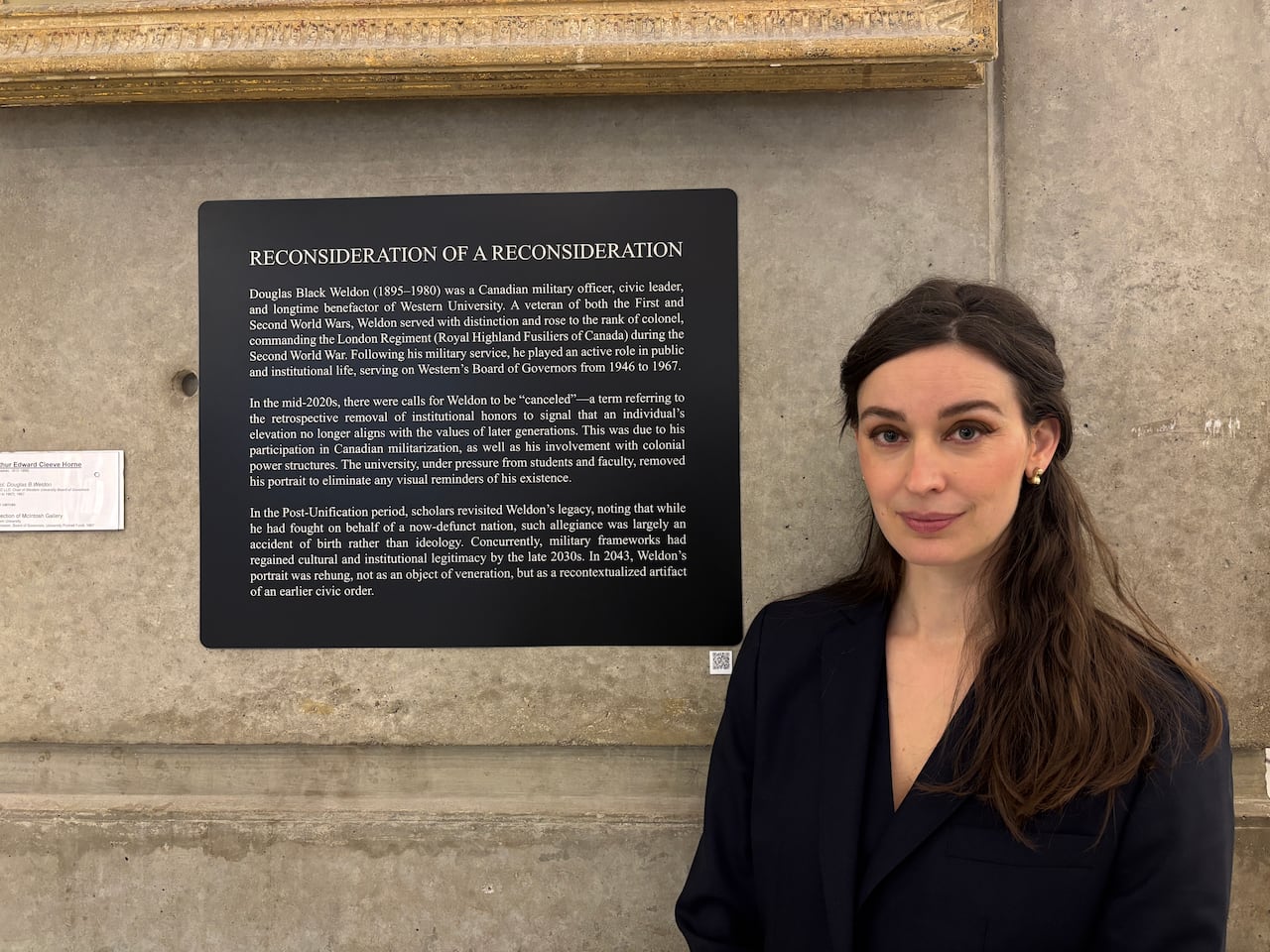 Artist Dara Vandor stands beside one of her fictional historical plaques installed at Weldon Library at Western University. The series imagines a future in which Canada has been annexed by the United States. (Josiane N’tchoreret-Mbiamany/CBC)
For the exhibit at Weldon, Vandor created 20 original plaques for the space. They can be read on their own or as part of the larger narrative she began spinning in Toronto, though many of the new episodes are eerily close to contemporary life, with or without the context of American expansionism. One plaque commemorates Robert F. Kennedy Jr.’s Brain Pyramid, which “ranks fields of study according to their national utility.”
Creating stories inspired by the library was an exciting exercise for Vandor. The first volume of Pax Americana asked whether we would fight for our country, and envisioned what would change if our borders were erased. The series at Weldon widens the focus. Our national sovereignty is as fragile as democracy itself. What do we lose when knowledge and freedom of information is devalued?
“This building allowed me to add a whole other layer to this series,” says Vandor. “We’re seeing a lot of censorship, a lot of control of information and opinion … And I don’t think it’s an American problem. It’s also happening on our side of the border.”
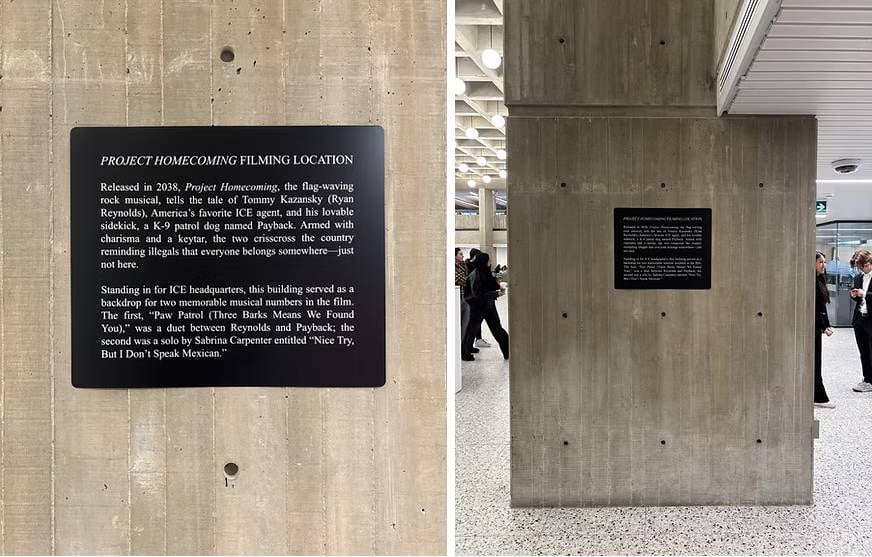 This plaque from Dara Vandor’s Pax Americana: D.B. Weldon Library marks the site of a Project Homecoming Filming Location. “Released in 2038, Project Homecoming, the flag-waving rock musical, tells the tale of Tommy Kazansky (Ryan Reynolds), America’s favorite ICE agent, and his lovable sidekick, a K-9 patrol dog named Payback. Armed with charisma and a keytar, the two crisscross the country reminding illegals that everyone belongs somewhere — just not here.” (Dara Vandor)
In producing the exhibit’s plaques and books — which include “corrected” editions of Call of the Wild and Sunshine Sketches of a Little Town (“Now set in America!”) — Vandor worked with Robinson in selecting where to place the signs, and though visitors can request an exhibition guide in the lobby, the work is intended to be a sort of interruption.
“I really wanted it to be a scavenger hunt,” she explains. “This is a series that is about all of us, about our collective future and our collective present, and what world we are building.”
At Weldon, Robinson has noticed students eyeing Vandor’s work with curiosity. So far, none of the plaques have been pried off the wall to become dorm-room decor, but if anyone has questions about the exhibit — the feasibility of Albertan secession or whether undergrads are truly reading less than ever before — well, they’re in the right place to research the answers.
“Libraries should be spaces where you’re confronted by uncomfortable ideas and libraries should be spaces and places where you can then explore, well, is this true?” says Robinson. “I hope [Pax Americana] might inspire people to ask, well, where could I learn more about how to avoid this situation?”
Dara Vandor. Pax Americana. To April 30 at D.B. Weldon Library (1151 Richmond St.), Western University, London, Ont. www.daravandor.com