
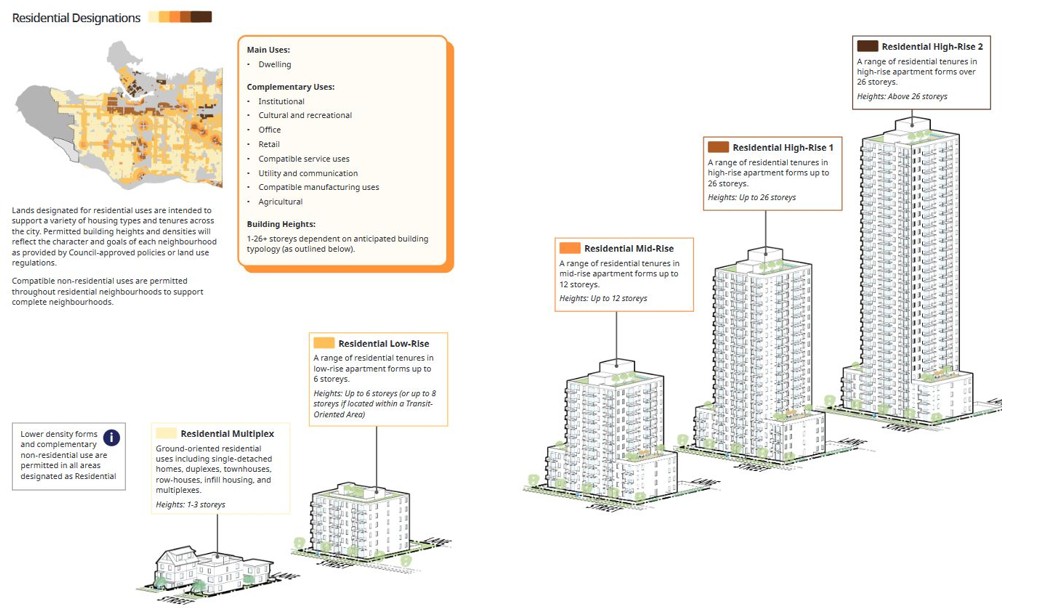
 Above: These are the typical housing designations for each zone in the General Land Use Map. Mostly apartment buildings in tower forms of varying sizes. If the ODP is approved, public oversight and even City Council involvement in major rezonings decisions would be significantly curtailed. The de facto control of many decisions would effectively be done by unelected staff at City Hall. See “Urgent” for more details.
As Vancouver City Council begins its public hearing tonight March 10 on the proposed 30-year citywide Official Development Plan (ODP), supporters of the plan — including, City of Vancouver staff, development-industry and closely-aligned YIMBY advocates — are repeating a number of familiar talking points.
The Public Agenda is here (https://council.vancouver.ca/20260310/phea20260310ag.htm) along with official materials and instructions on how to write or speak to Council. Speakers must sign up by 5 pm.
These arguments deserve careful scrutiny. The following outlines several common claims being advanced in support of the ODP, along with responses grounded in expert analysis, civic planning experience, and concerns raised by community groups across the city. City staff and even media (including prominent civic reporters for mainstream media) wrongly repeat many of these claims. It behooves our elected officials to get the facts straight in order to process the statements they hear and receive, and to make decisions based on fact and solid evidence. All of our responses below have been well documented. We have covered many aspects in previous posts on CityHallWatch. Links and other media coverage and reading material will be added as time permits.
1. Claim: The ODP reflects eight years of planning and therefore represents a well-vetted consensus.
Argument:
Supporters say the ODP is the culmination of nearly a decade of planning beginning with the Vancouver Plan in 2019, and therefore represents a carefully developed long-term vision for the city.
Response:
Length of process alone does not guarantee legitimacy or good planning. Critics note that the Vancouver Plan itself was approved by the previous council in 2022 despite widespread concerns about the quality of consultation and the clarity of the policy framework.Community organizations such as the Coalition of Vancouver Neighbourhoods argue that meaningful neighbourhood engagement was limited and that much of the city’s existing community-based planning work has effectively been overridden.
More recently, the public has been asked to review a 204-page draft ODP with limited time for careful analysis, raising legitimate questions about whether residents are being given a genuine opportunity to evaluate the implications of such a sweeping policy shift. Where other major municipalities held much more meaningful consultations, including townhall meetings where questions and concerned could be addressed in public at an earlier stage, the City of Vancouver resorted to limited, tightly controlled, and minimally attended events online and in a small number of locations.
Good planning is not measured simply by how long a process takes, but by the quality of engagement, transparency, and evidence behind the final proposal.
2. Claim: Opposition comes from a small group of “retired” planners who are out of touch.
Argument:
Some supporters have dismissed critics as a group of “mostly retired” planners who already have housing and are attempting to block change.
Response:
This characterization is misleading and dismissive.
The open letter from Housing Reset (https://housingreset.ca/2026/02/25/cov-vancouver-official-development-plan-odp/) raising concerns about the ODP was signed by 30 respected urban experts, including former Vancouver co-chief planner and internationally recognized urban designers. Many of these experts are still very active today, researching, teaching, and consulting.
These individuals helped shape Vancouver’s widely admired planning framework over several decades — including policies that produced many of the livable neighbourhoods the city enjoys today.
Their critique is not about resisting change. It is about ensuring that new planning policies are grounded in sound urban design principles, financial reality, and protections for existing communities.
3. Claim: Increasing housing supply will reduce rents.
Argument:
Supporters argue that high housing costs are primarily caused by insufficient housing supply. Streamlining approvals and enabling more development through the ODP will therefore reduce prices.
Response:
The relationship between supply and affordability is far more complex.
Many critics argue that the proposed ODP primarily facilitates market-driven development without mechanisms to ensure affordability.
In fact, upzoning across large parts of the city can increase land speculation, raising land prices and making genuinely affordable housing even harder to deliver.
There is also concern that redevelopment encouraged by the ODP could lead to the demolition of existing lower-cost rental housing, displacing tenants and replacing relatively affordable units with far more expensive new construction.
At a time when Vancouver had been experiencing some of the lowest vacancy rates in North America, policies that accelerate displacement without strong protections risk worsening housing insecurity for many renters.
4. Claim: Eliminating project-by-project public hearings improves efficiency and democracy.
Argument:
Supporters say a citywide plan will create a predictable system where projects consistent with the ODP can proceed without public hearings, avoiding lengthy battles over individual rezonings.
Response:
Predictability for developers should not come at the cost of democratic accountability.
The ODP would significantly reduce opportunities for residents to participate in decisions about major changes in their neighbourhoods. Public hearings — though sometimes contentious — are an important mechanism for community oversight of large developments.
Replacing this system with a blanket policy framework risks shifting power away from citizens and toward a planning regime that prioritizes speed of approvals over careful evaluation of local impacts.
Vancouver’s neighbourhoods differ widely in infrastructure capacity, housing types, and community needs. A one-size-fits-all approach risks ignoring these differences.
5. Claim: Vancouver must build upward because land is scarce.
Argument:
Supporters argue that geography limits Vancouver’s ability to expand outward, making higher density inevitable.
Response:
While Vancouver’s geography does constrain expansion, this does not automatically justify a citywide upzoning strategy.
Urban planners widely agree that how density is introduced matters as much as how much density is added. Thoughtful, context-sensitive growth can add housing while maintaining neighbourhood livability and protecting existing rental housing.
Critics argue that the ODP prioritizes large-scale redevelopment rather than a balanced approach that includes preserving existing housing, supporting smaller-scale “missing middle” housing, and ensuring infrastructure keeps pace with growth.
6. Claim: The ODP is only a “first step.”
Argument:
Some supporters frame the ODP as simply an initial policy framework that can be refined later.
Response:
In practice, citywide plans shape development patterns for decades. Once adopted, the ODP will guide zoning, approvals, and investment decisions across the city. The ODP is a statutory document with teeth.
If significant problems emerge — such as displacement, speculation, or infrastructure strain — they may be difficult to reverse.
Major planning frameworks should therefore be carefully scrutinized before adoption, not treated as experiments to be corrected later.
Conclusion
Few people dispute that Vancouver faces a serious housing challenge.
But solving that challenge requires policies that balance housing supply with affordability, tenant protection, infrastructure planning, and democratic accountability.
A citywide Official Development Plan could play an important role in shaping Vancouver’s future. Yet many urban experts and community organizations believe the current proposal raises serious concerns that deserve careful consideration before the city commits to a planning framework that could shape development for the next generation.
Additional YIMBY / Industry claims to know about
These appear frequently in housing debates and also merit close scrutiny.
Claim: “Red tape and lengthy approvals are the main reason housing isn’t being built.”
Counter:
Many projects stall due to financing conditions, interest rates, and developer business decisions — not simply municipal approvals.
Claim: “Vancouver must grow rapidly to accommodate population growth.”
Counter:
Population projections are uncertain, and approved projects already represent a large pipeline of future housing.
Claim: “Most land is locked up in single-family zoning.”
Counter:
This framing ignores existing density in many neighbourhoods and oversimplifies complex zoning patterns. Iin Vancouver, this is false. Single-family zoning has NOT existed in Vancouver for years already. Even prominent civic reporters with the CBC get this wrong.
Claim: “Opposition is just NIMBY resistance and anti-housing voices to change.”
Counter:
Many critics support housing but question the financial model, scale, and lack of affordability protections.