
The build-up to any Formula One season is greeted with speculation and excitement, but rarely has a new campaign promised so much change as this one, with revamped regulations, new teams, and a debut race in Madrid all promising to shake up the competitive order.
But despite all the on-track changes – some fans are yet to be convinced by the increased reliance on battery power following a chaotic Australian Grand Prix – the sport’s off-track success has remained constant.
Financial growth continues
Formula One’s financial growth since being acquired by Liberty Media in 2017 shows no signs of slowing down. Annual revenue rose 14 per cent year-over-year (YoY) to US$3.87 billion last year, contributing to a US$2 billion increase under Liberty’s leadership. Ignoring the Covid-disrupted 2020 season, overall revenue has risen each year since the takeover.
Breaking it down further, primary Formula One revenue rose to US$3.09 billion, a figure which comprises income from race promotion (26.7 per cent), media rights (31.3 per cent), and sponsorship (21.7 per cent). This is the first time that sponsorship has accounted for more than 20 per cent in the Liberty media era.
Record Q4 revenues of US$1.38 billion, up 22 per cent from US$1.13 billion in 2024, were largely driven by the success of the Las Vegas Grand Prix, now in its third year. The creation of the Grand Prix Plaza has turned the city into a year-round destination for fans, which should help to drive passive income for the sport outside of its regular schedule.
All of this contributed to a 28 per cent increase in overall operating income from US$492 million in 2024 to US$632 million last season.
Robust sponsorship portfolio
With ten global partners and 34 lower-level partnerships, it’s no surprise that sponsorship accounts for a bigger chunk of revenue than ever before. In terms of new deals, Standard Chartered has come on board as the series’ official wealth management and corporate and investment banking partner and T-Mobile has expanded its partnership with the Las Vegas Grand Prix to become Formula One’s regional 5G innovation partner.
But the biggest change for 2026 is the introduction of Betway as Formula One’s first ever official betting operator in a multi-year deal spanning Europe, the Middle East and Africa, as well as Canada and Mexico. This is a non-exclusive arrangement, so Formula One will be seeking further partnerships and is expected to announce US-specific operators will be announced in the buildup to the Miami Grand Prix.
The team sponsorship market is similarly buoyant. According to Ampere Analysis, sponsorship spend across Formula One and its teams is projected to exceed US$3 billion in 2026, a potential year-on-year (YoY) increase of 15 per cent.
Increasing interest from the technology industry has been a significant factor, with the sector spending US$565 million, extending its lead over financial services, Hewlett Packard Enterprises and Oracle account for a quarter of the overall figure alone.
Artificial intelligence (AI) deals are a notable source of activity, with nine partnerships signed in the last six months alone, including Meta AI with Mercedes and Anthropic with Williams.
Research conducted by RacingNews365 suggests Red Bull’s title partnership with Oracle is the most valuable in the sport at US$110 million per year. Ferrari is the only other team to break nine figures through its US$100 million-a-year deal with HP.
New TV horizons
Formula One’s global broadcast strategy is shifting, as evidenced by its decision to leave behind a successful media rights partnership with ESPN in the US, which averaged a record 1.32 million viewers in its final year.
While the move to Apple has obvious financial benefits to the tune of around US$150 million per season, Formula One is adamant it is about expanding reach. Although ESPN is the largest, most relevant sports broadcaster in the country, Formula One believes Apple’s vast digital ecosystem of devices and services will provide more touchpoints with fans.
To amplify this, Apple is collaborating with Netflix for the first time in a partnership that will see the Canadian Grand Prix air on both platforms, with the latest season of Netflix’s Drive to Survive arriving on Apple TV for US viewers.
Reach is also a focus in Brazil where Formula One rejected a US$10 million-a-year deal to stick with Globo in favour of a lower US$8 million bid from Bandeirantes, which reaches more fans.
Other new deals for 2026 include Arena Sport in the Balkans, Omega Channel in Cyprus, Grupo Televisa in Mexico, and Viettel Telecom in Vietnam. There have also been major extensions agreed with Foxtel in Australia, worth around AUS$60 million (US$42.9 million) per year, and ESPN in Latin America and the Caribbean.
Attendance analysis
Of course, none of this would be possible without fans turning up in droves to the races. Since the Covid-disrupted years of 2020 and 2021, global attendance has risen every season.
In total, 6.75 million fans attended the 2025 Formula One season, up from 6.53 million the year before. However, the average attendance of 281,250 is lower than the 288,000 figure recorded in 2023.
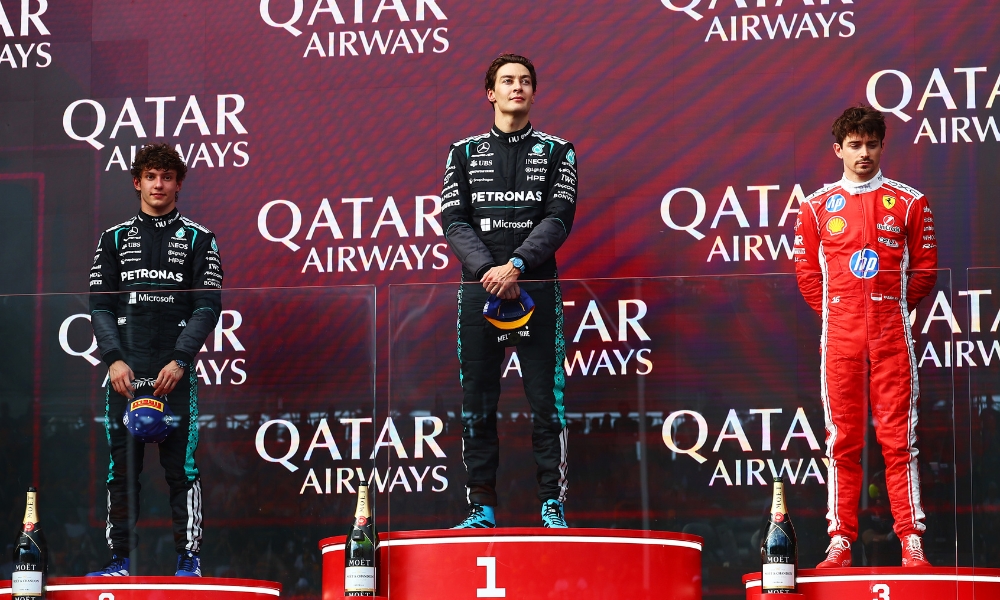
Headline figures from the 2025 season include the 500,000 fans that attended the British Grand Prix and the 465,498 at the Australian Grand Prix. Albert Park has already smashed this record attendance in this season’s opening race as 483,934 people saw George Russell take victory for Mercedes.
But all eyes will be on reactions to the new Grand Prix in Madrid. The promoters have paid a reported €48 million (US$52 million) for the race, which will be held at a semi-permanent track around the fairground of the Ifema Madrid exhibition centre. The expectation is that more than 110,000 fans per day will be able to attend, rising to 140,000 within the first half of this contract.
Formula One will no longer visit Imola as a result, an expected move after Formula One chief executive Stefano Domenicali revealed “it will be increasingly difficult to have two races in the same country”. In this context, it will be interesting to see how the sport balances races in Madrid and Barcelona now that the latter has agreed a rotational deal until 2032.

Enjoying this content? We think you’d be interested in our upcoming event, the BlackBook Motorsport Forum.
Taking place at Mercure London, Earls Court on 24th March 2026, join the entire motorsport ecosystem to examine the forces driving performance, profitability, and long-term growth.