
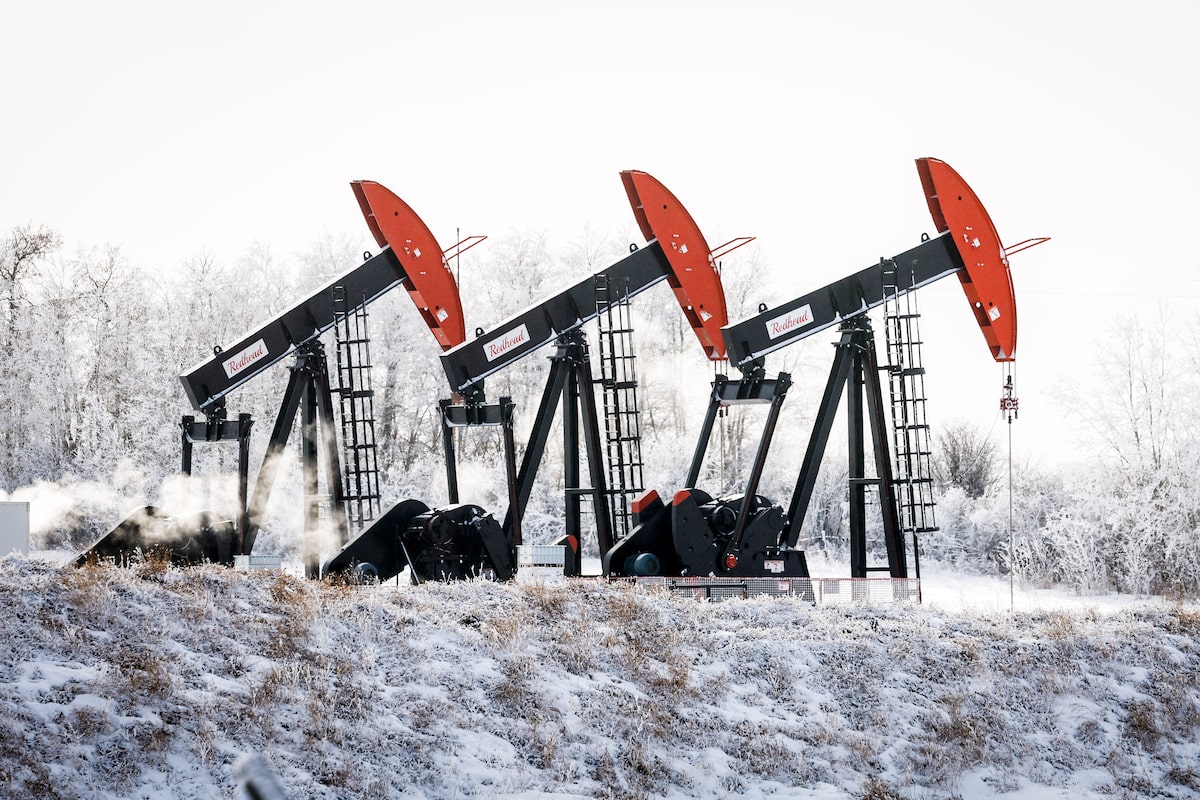
Pumpjacks draw out oil and gas from wells near Carstairs, Alta., Feb. 3, 2025. Canada has periodically looked at establishing strategic reserves since the late-1970s oil crisis.Jeff McIntosh/The Canadian Press
As members of the Group of Seven explore tapping their strategic reserves of crude oil to address the surge in fuel prices, Canada stands apart as the only G7 country without an emergency store of petroleum, the result of its status as a long-term net exporter of oil.
But the debate over Canada developing its own strategic petroleum reserve (SPR) dates back decades, and as war in the Middle East threatens global oil shipments, the question looks set to return.
“Canadians can’t understand why we have all this oil but we don’t have our own reserves,” said Gordon Laxer, a political economist and former director of the Parkland Institute at the University of Alberta.
“Now would be the right time if we had a strategic reserve to draw on it, but with prices so high it’s absolutely the wrong time to be thinking about establishing one.”
Opinion: Iran is using the oil weapon
Last month Conservative Leader Pierre Poilievre, in a speech at the Economic Club of Canada, pitched the creation of an energy and critical minerals reserve maintained in the country “so that we would have them in abundance in the event of a war, a crisis or a supply disruption.”
He argued having such a reserve would also give Canada leverage with the U.S. by providing access “only at commercial prices and only if they keep our relationship tariff-free.”
But then U.S. President Donald Trump, alongside Israel, launched waves of air strikes against Iran, which retaliated by bombing neighbouring countries and threatened to attack any tanker traffic passing through the critical Strait of Hormuz.
The conflict caused global oil prices to surge more than 60 per cent to nearly US$120 on Monday before settling back around US$91 as of Tuesday evening.
The threat of oil supply restrictions prompted G7 energy and finance ministers this week to push the Paris-based International Energy Agency to review the security of oil supplies, a step toward deciding whether to unleash IEA emergency stocks.
The IEA, which has 33 member countries, requires those that are net importers of petroleum to hold enough emergency oil in reserve to cover 90 days of the previous year’s net imports.
However, the policy doesn’t apply to countries that are net exporters, a short list that includes Canada, Mexico, the U.S. and Norway.
Since the late-1970s oil crisis, Canada has periodically looked at establishing strategic reserves, though those early moves were aimed at developing reserve capacity in the country to hold U.S. strategic reserves.
In 2008, amid soaring prices, Mr. Laxer authored a study making the case for a Canadian SPR amid fears the world was reaching peak oil production.
Opinion: In the Iran war, good news is bad news for oil, Canada and our future
Instead, a decade later, the world was awash in oil from surging U.S. shale-oil production, and other experts made a different case for Canada to develop its own strategic reserves.
Amid disruptions to Midwest U.S. refineries and pipeline constraints, the price paid for oil sands bitumen had fallen so far that producers were losing money on every barrel they produced. Against that backdrop, in 2019, C-FER Technologies, an Edmonton-based oil and gas engineering company, produced a report examining the feasibility a SPR to mop up excess Canadian crude.
“We said, wouldn’t it be great if the government could buy oil under those circumstances and put it back in the ground somewhere and let it out slowly, it would be a hedge against being confined to one customer, the U.S.,” said Brian Wagg, director of testing services at C-FER and an author of the report.
The expanded Trans Mountain pipeline, which has allowed Canada to diversify its oil exports away from the U.S., has alleviated some of that constraint.
But as the report noted, even though the country is a net exporter of oil, that obscures the east-west divide in its energy markets. While Western Canada supplies vastly more oil than it imports, it’s the reverse for Central and most of Eastern Canada.
And in the same way massive salt caverns in Alberta and Saskatchewan could be tapped to store Canadian crude – just as much of the U.S. SPR’s 413 million barrels are contained – salt caverns in Ontario could serve the same purpose.
“The idea is not only an Alberta thing, it’s a Canadian opportunity,” Mr. Wagg said.
But even the U.S.’s own strategic oil reserve looks outdated given that country’s transformation into an energy superpower, said Andrew DiCapua, principal economist with the Canadian Chamber of Commerce.
“In Canada it comes down to what is the point of a strategic reserve? Is it to get into a price setting environment, or is it to shore up supply to use in a crisis?” he said, adding the country’s supply is likely too small to move oil markets, while limited refinery and pipeline capacity in Eastern Canada would pose constraints.
Instead, he argued efforts should focus on infrastructure and trade corridors to replicate the success Canada has had with Trans Mountain.
“Clearly with this massive energy shock we should be looking at ways we can become more resilient on the energy front, but I’m not sure that a strategic reserve will fix our issues,” he said.