
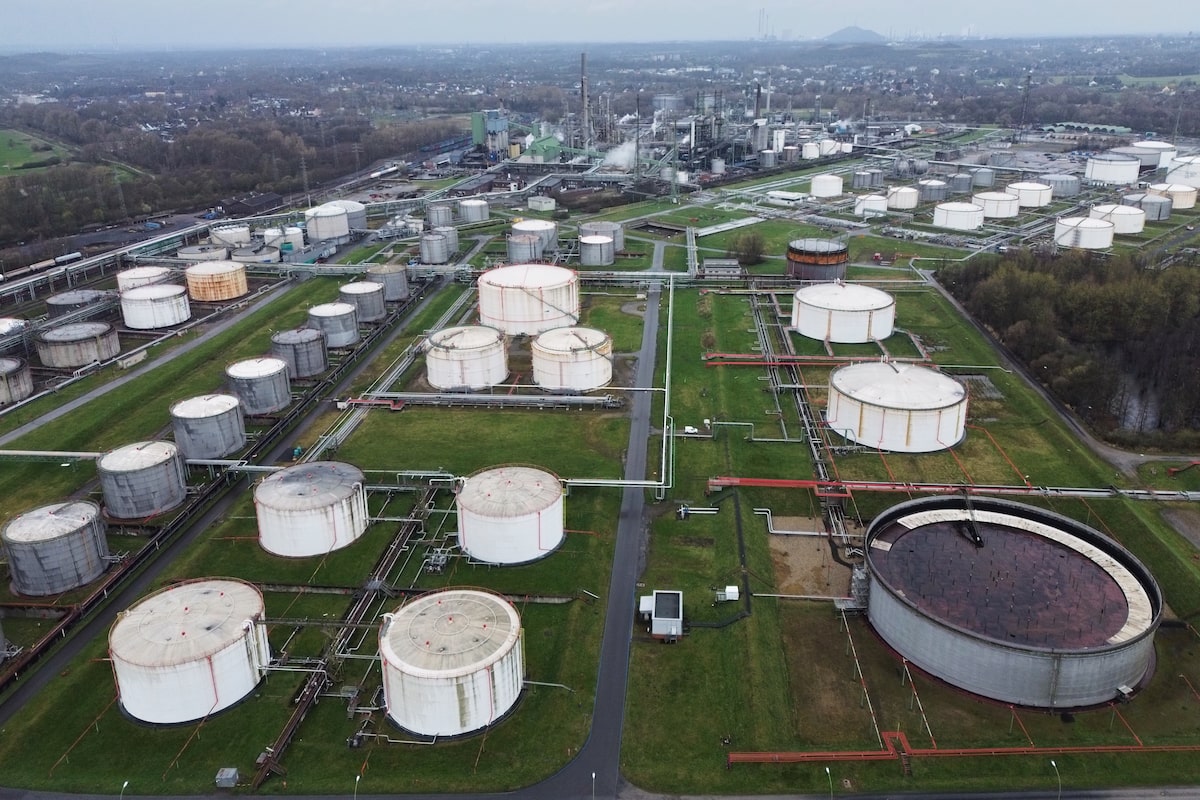
Big oil tanks are shown in front of the BP refinery in Gelsenkirchen, one of the biggest fuel producers in Germany, on Wednesday.Martin Meissner/The Associated Press
The International Energy Agency’s 32 member countries have unanimously agreed to release 400 million barrels of oil reserves into the global market – the largest-ever move in its history – in a bid to bolster supplies and calm markets amid the escalating U.S.-Israeli war with Iran.
The release, announced by IEA executive director Fatih Birol Wednesday morning, is in response to Iran’s effective closure of the Strait of Hormuz in the Persian Gulf. The narrow waterway normally provides a route to market for 15 million barrels per day of the world’s crude oil supply and another five million barrels per day of oil products – roughly a quarter of the world’s oil trade via sea.
Ottawa is already eyeing moves to boost oil production amid global supply shock. It has already asked Canadian oil producers to assess how much crude they could supply as part of the co-ordinated, global effort to release oil stocks.
China needs Strait of Hormuz to remain open, but has stayed on the war’s sidelines
What to know about the challenges of reopening the Strait of Hormuz
With routes to markets squeezed and storage close to full, Middle East oil producers have started to reduce production, putting extreme pressure on supplies – particularly to Asia, which relies on crude from the region.
Energy infrastructure has also been attacked and refinery operations disrupted during the war, with “major implications” for jet fuel and diesel supplies, Dr. Birol said.
While the 400 million barrels agreed to by IEA countries will go some way to alleviate the immediate effects of the current market disruption, Dr. Birol said “the most important thing for a return to stable flows of oil and gas is the resumption of transit through the strait.”
Oil prices have surged to near four-year highs since U.S. and Israeli forces began bombing Iran on Feb. 28.
Combined, IEA member countries hold more than 1.2 billion barrels of public emergency oil stocks, with a further 600 million barrels of industry stocks held under government obligation.
International benchmark Brent oil was up 5 per cent at US$92.18 a barrel after IEA’s announcement. It’s down from a high of almost US$120 early in Monday’s session. West Texas Intermediate sold for US$87.61 a barrel, also up about 5 per cent.
The rise in oil prices shows that the market had been anticipating such a move from the IEA members after days of talks, and that it is no long-term substitute for shipping through the Strait of Hormuz, said Hamad Hussain, climate and commodities economist at London-based Capital Economics.
The strait remains effectively blocked, and the resumption of traffic through the key waterway appears no closer. With the conflict still raging, Iran has been reported to have laid mines in the strait. The U.S. military said on Tuesday it had destroyed 16 Iranian minelayers near the strait.
Important aspects of the release of stockpile are still unknown, Mr. Hussain said. “One of the key details is over what time frame the barrels will be released. We’ll get a sense then of exactly how much oil on a daily basis will be brought to the market,” he said.
“My sense is that you’re not going to see enough oil provided to the market by the IEA and its members to be able to offset the daily losses of supply from the Middle East as this conflict drags on.”
Silos at the Depot Petrolier de France and the depot’s burning flare tower at the Marseille-Fos industrial dock in Fos-Sur-Mer, southern France.THIBAUD MORITZ/AFP/Getty Images
The IEA plans to release details soon on how, when and where the stocks of oil will flow to the market. In the meantime, it will continue to monitor the situation in Iran and make further recommendations if needed, Dr. Birol said.
The IEA has undertaken five similar releases in the past: during the first Gulf War, Hurricane Katrina, the Libyan Civil War, and twice in the months after Russia’s invasion of Ukraine.
Although Canada is an IEA member, as one of the world’s top producers and a net exporter of oil it is not obligated to keep strategic stockpiles. Refiners and marketers keep buffer supplies on hand in case of emergencies or plant outages, however.
“Canada was clear in the meeting that if there is a desire for a co-ordinated, multilateral release of strategic reserves, we will do our part,” Energy Minister Tim Hodgson told The Globe on Tuesday.
He pointed to 2022, when Canada was part of the IEA’s release of 182.7 million barrels after Russia attacked Ukraine.
Canada’s role in getting those barrels to market would likely look a little different than, say, the U.S., where the massive vessels that transport oil to Asia already have easy access to deep water ports.
Canada produces roughly six million barrels of oil each day. Almost one million of those head to the Pacific Coast through the Trans Mountain pipeline system. Mr. Hodgson said the government would “make sure that was maximized” to assist in the global release.
Analysis: Should Canada have a strategic oil reserve? It’s complicated
The bulk of the rest of Canadian crude heads south to the U.S., including to the Gulf Coast where it is upgraded and shipped overseas. Keeping those volumes at a maximum would allow the U.S. to export off the Gulf to allies, Mr. Hodgson said.
He said Canada has “a tremendous ability” to tap the oil sands – what he called “the best strategic reserve in the world” – to help with a global effort to get barrels to market.
Mr. Hodgson said Canada has “a number of tools” to help with its commitments as an IEA member.
Maintenance could be delayed at oil sands or conventional sites to keep production as high as possible, for example. The government may also ask companies to release some of their inventories or tweak production “to get the extra barrels out the door,” or ask refineries that use some imported oil for feedstocks to switch to domestic supplies for now.