
UVic researchers strengthen Antarctica ocean monitoring
Published 10:30 am Wednesday, March 11, 2026
In a partnership with Spanish National Research Council (CSIC), Ocean Networks Canada (ONC) was recently able to double its capacity to monitor the Antarctic Ocean with two new subsea observatories deployed near the Juan Carlos I Antarctic Base on Livingston Island.
The newly installed observatories transmit near real-time data that can be viewed through ONC’s open online portal, Oceans 3.0. It allows scientists to track environmental change even when the seasonal base is unstaffed.
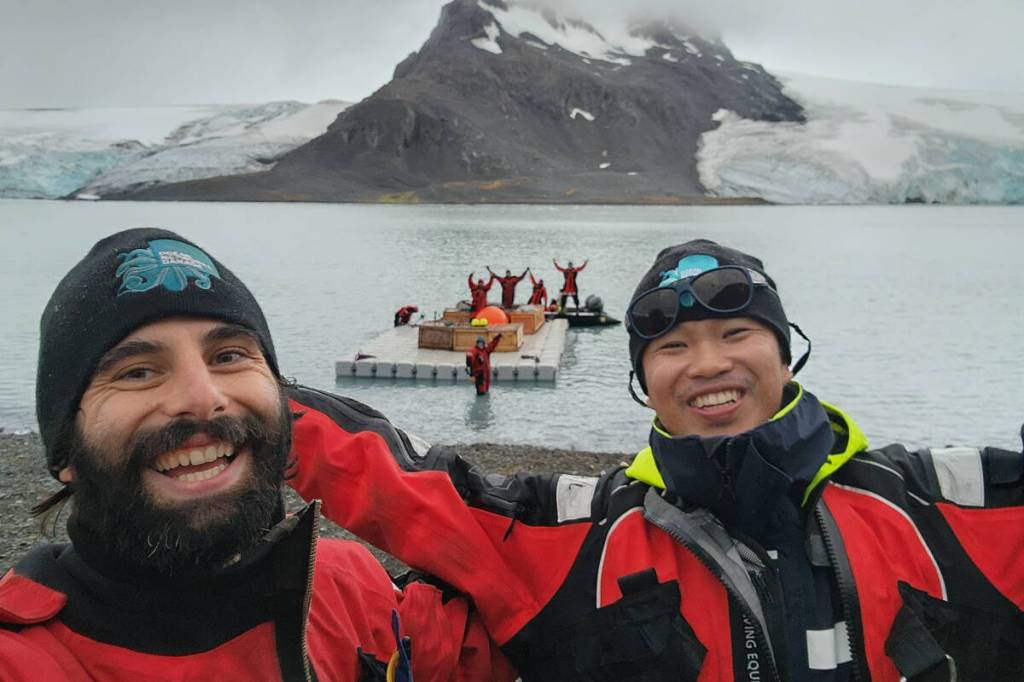
ONC Marine Technology Centre staff Ruchie Custan and Bradley Wells were members of the group that travelled to Livingston Island. Speaking to Victoria News, they described their experience of carrying out the work alongside CSIC’s Unit of Marine Technology.
They replaced an earlier observatory that had suffered data interruptions and installed a second unit, successfully doubling monitoring coverage.
“We added a lot more protection to this new observatory to ensure that they can survive through the Antarctic winter and the sea ice,” Custan said.
The duo described that protecting the equipment from large ice movement was a challenge that had disrupted data flow at the original site. The weather was another challenge the group had to go through.
“We’re waiting for tides, we’re waiting for the wind to die down. It’s extremely windy there all the time, or more often than I would have expected,” Wells added.
After the 15-day journey started, the group of scientists started noticing differences in the environment in Antarctica. Wells noticed that it was somewhat similar to the Arctic polar region with being extremely rocky, without trees, foliage, and had some moss like lichen.
“Another major difference that was quite interesting was the wildlife there. So there’s lots of penguins. There’s elephant seals. There’s birds flying around. There’s lots of wildlife that is very unafraid of humans. They’re not used to people being around, so they’re just there,” said Wells.
Custan added that his experience in Antarctica to be similar, and also that the harsh environment had their equipment breaking in the field.
“My laptop broke. My camera broke. And a few other pieces of equipment broke because of this type of environment. I think those are kind of the things that I wasn’t expecting to happen,” Custan added.
He also noted that for him personally, Antarctica and the vastness of its geography was awestriking.
“Seeing the glaciers, huge glaciers, right next to where we’re working. They’re tapping throughout the day as we’re there. You can hear huge booms as the glaciers crack throughout the day.”
The duo pointed out that this journey was of utmost importance to them as a group of scientists, and also to Canada. Custan said that Antarctica, which is crucial to the global climate system, has undergone a huge change.
“And there’s been a call from the scientific community to increase the observations of the Antarctic waters as a whole. So this is the way of Ocean Networks Canada answering that call. So basically, we are enabling near-real-time, year-round ocean monitoring in that part of Antarctica…So we need to understand what’s going on, and so we can act accordingly,” Custan said.
Agreeing with his colleague, Wells said that studying Antarctica from a global point of view is important. And for the ONC, testing their system in Antarctica was a great opportunity to ensure that it will also work in the Arctic.
“And one of our goals in the future and now is to continue pursuing more Arctic research and to eventually, hopefully, deploy more observatories in the Arctic region,” Wells added.
Also of note is that much of technology that’s implemented to help with the remote monitoring is Canadian made and built by Wells.
“I think we’re all kind of proud that we’re able to pull this together. I think it’s important to know that ONC keeps pushing forward the boundaries of technology in terms of monitoring the ocean in remote areas and harsh environments like the one in Antarctica.”