
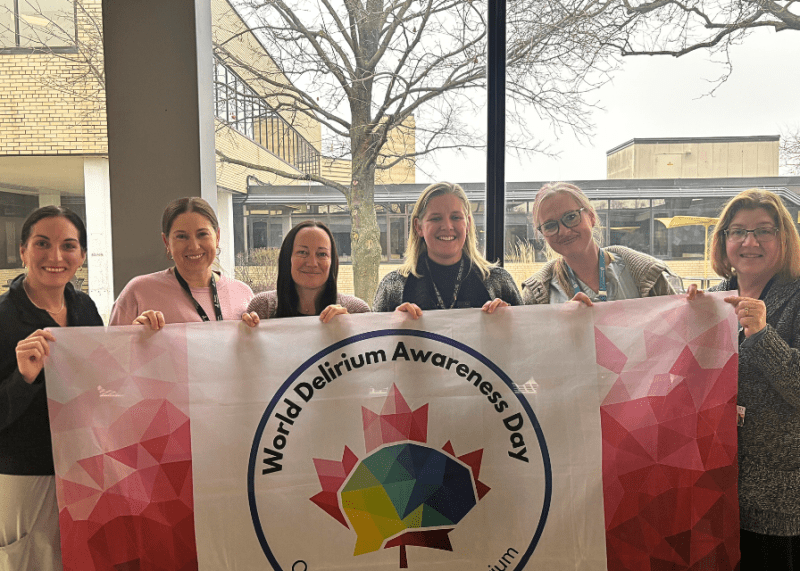
Niagara Health has acknowledged World Delirium Awareness Day for more than five years, building awareness among staff and increasingly sharing public-facing education. With March 11 recognized globally as World Delirium Awareness Day, the flag’s visit offered an opportunity to extend that message beyond hospital walls.
Delirium is a sudden change in a person’s thinking, behaviour or level of awareness that develops over hours to days. It often presents as an abrupt shift from a person’s usual cognitive or functional baseline. Family members or caregivers may notice that their loved one seems more confused, disoriented, withdrawn or agitated than usual.
Older adults, particularly those with dementia or other cognitive vulnerabilities, face a significantly higher risk.
“There are real risks that hospitalization presents for older adults,” Rubel explains. “When you think about the Emergency Department environment – the sights, sounds, reduced ability to move around, those things can contribute to delirium and deconditioning.”
Deconditioning, the rapid loss of muscle strength and function, can occur quickly in older adults. Even a single day in bed can lead to measurable decline, with impacts on mobility and independence that may last beyond the hospital stay.
One of the most important messages behind World Delirium Awareness Day is that prevention strategies are often straightforward.