
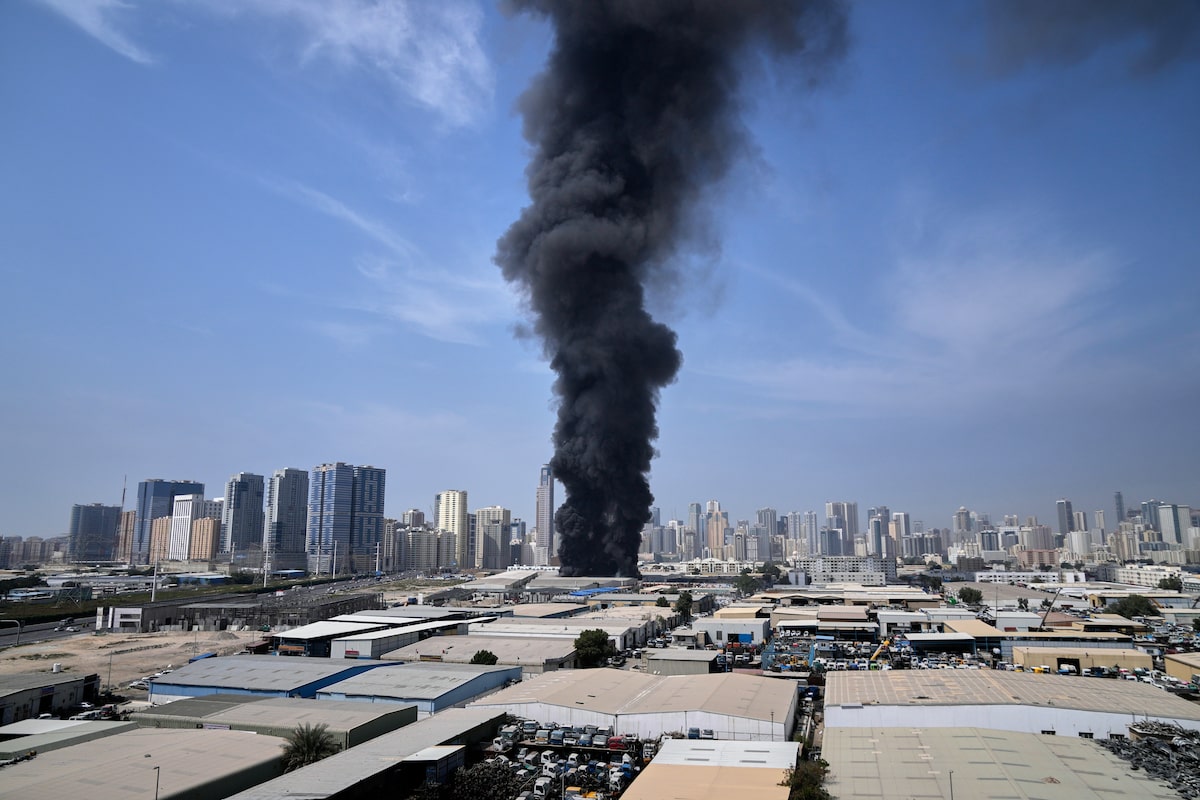
Smoke rises from a warehouse at the industrial area of Sharjah City in the United Arab Emirates, on, March 1.Altaf Qadri/The Associated Press
One of the world’s leading tourist destinations, the United Arab Emirates is home to some nine million expatriates. Hailing from almost 200 countries, many have come with their families to build a new and better life, working and living among more than a million native Emiratis.
When the first waves of Iranian missiles and drones struck the Persian Gulf last week, the United Arab Emirates, long regarded as one of the Middle East’s safest and most stable countries, found itself confronting an unfamiliar reality: the psychological toll of war.
Iran has fired more than 1,400 missiles and drones at the UAE, resulting in six deaths among Emirati, Pakistani, Nepalese and Bangladeshi nationals. Another 122 people have been injured, including nationals of Egypt, Sudan, Ethiopia and the Philippines.
The UAE has borne the brunt of Iran’s attacks in the region, and while the country’s sophisticated air-defence systems have intercepted most of the incoming threats, limiting the amount of physical damage, the emotional impact has been immediate.
Pedestrian walk in the Umm Suqeim district of Dubai, on Wednesday.The Globe and Mail
Psychologists across the UAE report a sharp increase in anxiety, sleep disruption and requests for urgent therapy sessions, reflecting how quickly geopolitical instability can ripple through daily life.
“There has been a 25- to 30-per-cent increase in demand this first week,” said Devika Mankani, resident psychologist at the Hundred Wellness Centre in Dubai.
“I’ve seen a significant uptake in people reaching out for support. … It isn’t just fear − it’s the loss of predictability,” she said. “Many residents in the UAE live with an assumption of stability and safety, so when conflict feels closer than expected, the nervous system reacts fast: hypervigilance, sleep disruption and a constant sense that something could happen.”
The UAE was voted the world’s safest country this year for the second year in a row by Numbeo, a quality-of-life database.
Rebecca Steingeisser, consultant clinical psychologist and clinical neuropsychologist at Spierings Medical Group.Christopher Pike/The Globe and Mail
Psychotherapists say the crisis has reshaped their daily work. Rebecca Steingeisser says sessions with her regular clients in Dubai have shifted almost entirely toward coping strategies for the current situation.
“As a psychologist I see my clients fairly regularly, but even with clients who I see weekly, the topic of our sessions has been primarily how we are and can cope with the current circumstances,” she said.
She has received multiple requests for additional sessions, as well as urgent requests from new patients. But accommodating them is difficult. “My caseload is already full,” she said. “This is where things get tricky − people in need can’t easily access support in a timely way.”
The psychological responses emerging across the UAE resemble what clinicians often see during acute stress events.
“People are hypersensitive to loud sounds, sleep is disrupted and many are experiencing strange or unusual dreams,” Dr. Steingeisser said. “Daytime fatigue and anxiety that peaks in the evenings are also common, especially since military activity seems to happen mostly at night.”
The UAE has borne the brunt of Iran’s attacks in the region and the emotional impact has been immediate.The Globe and Mail
Among the most common symptoms she sees are chest tightness, racing thoughts and catastrophic “what-if” scenarios, alongside compulsive news-checking and irritability at home. Other patients report headaches, stomach discomfort, heart palpitations and panic episodes.
The surge in anxiety is affecting a wide cross-section of UAE residents. Parents with school-aged children are seeking guidance on how to manage their own fears while maintaining a calm home environment. Teenagers and university students, who often consume high volumes of social media news, are particularly susceptible to alarmist content and graphic imagery. Expatriate professionals, who make up the majority of the UAE’s population, face additional pressures.
“Many are worrying about their families abroad while trying to remain calm here,” Ms. Mankani said.
Workers in industries directly affected by the crisis, including aviation, hospitality and logistics, are also feeling the strain as airspace disruptions and travel cancellations create sudden uncertainty about jobs and business operations.
A passenger aircraft operated by Emirates Airline flies overhead in Dubai.Christopher Pike/The Globe and Mail
Some people appearing more frequently in therapy sessions are individuals with a history of trauma.
“I’m also seeing retriggering in those with earlier experiences of war, displacement or chronic trauma,” Ms. Mankani said.
Recognizing the psychological strain, UAE authorities and health care providers have moved quickly to expand mental health support.
Multiple free emergency mental health helplines have been launched in recent days alongside community support groups offered by several clinics.
Only Emirati citizens have free health coverage, so access to help is uneven.
“Many residents still access psychological support privately and pay out of their own pocket,” said Jane Halsall, a chartered counselling psychologist in Dubai. “There are increasing conversations within the UAE about improving access to mental health care more broadly, including support for lower-income workers,” a challenge across a region that depends on such labour.
People along the Kite Beach promenade in Dubai. The surge in anxiety is affecting a wide cross-section of UAE residents.The Globe and Mail
While the missiles and drones continue to target the country, in recent days reaching densely populated residential areas in Dubai such as Barsha and Dubai Marina, experts say the psychological effects currently being seen are likely to remain short-term for most residents, particularly if the conflict does not escalate further.
Because physical destruction within the UAE has been limited so far, many people may stabilize relatively quickly once the immediate threat subsides. However, prolonged exposure to fear or repeated crises could produce longer-lasting consequences.
“Post-traumatic stress disorder would be more common in chronic or repeated exposure to this level of fear or stress,” Dr. Steingeisser said.
Ultimately, psychologists say, the experience could reshape how mental health services are prioritized in the region.
“The UAE has mobilized support rapidly,” Ms. Mankani said. “But no country has unlimited mental health capacity during sudden surges.”