
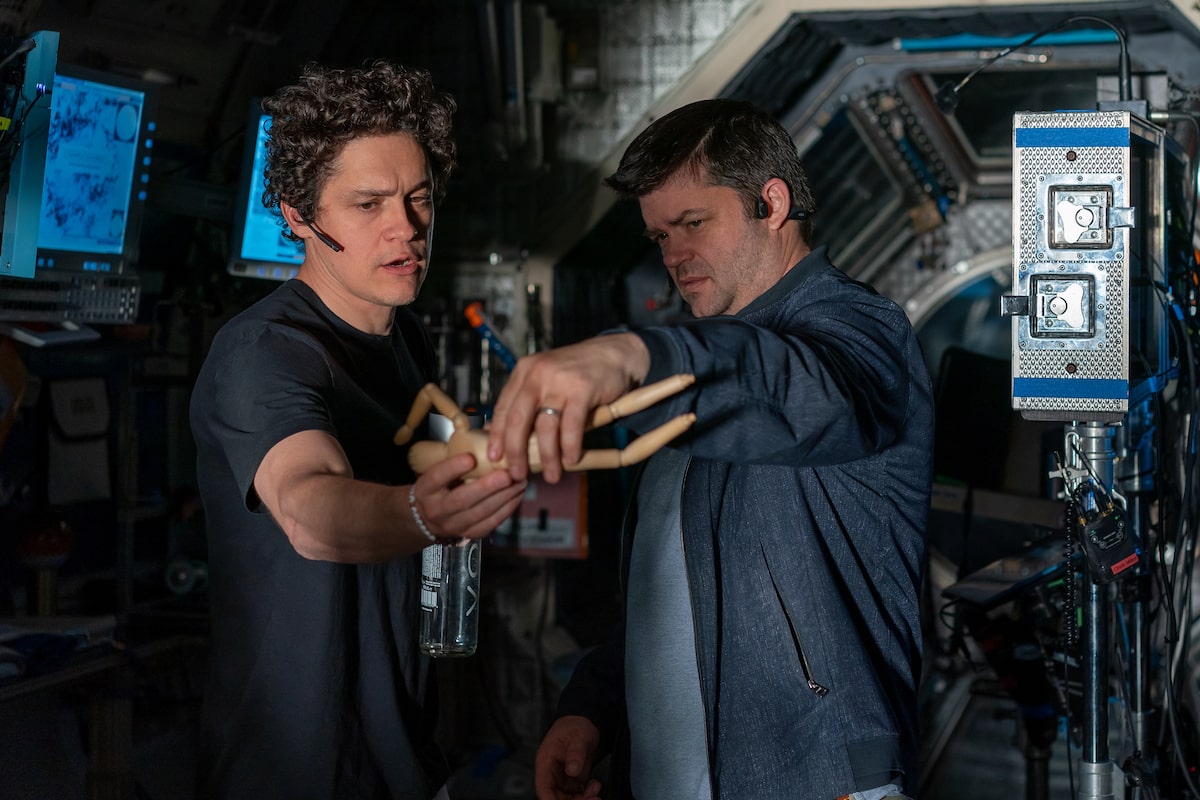
Directors Phil Lord and Christopher Miller on the set of Project Hail Mary.Jonathan Olley/Supplied
The easiest way to describe a conversation with the filmmakers Phil Lord and Christopher Miller is “animated.” The pair, who have known each other since their college days at Dartmouth in the mid-’90s, have a give-and-take energy that is quick-witted and jumpy, to the point that an interviewer might feel as if they’ve suddenly fallen into a kind of real-world cartoon. Which is appropriate given that Lord and Miller have, over the past two decades, built an animation empire, from Clone High to the Lego movies to the ever-expanding Spider-Verse franchise. Even their live-action work, such as the 21 Jump Street reboot, feels like it belongs in Toontown.
But with their latest collaboration, the sci-fi comedy Project Hail Mary, the duo is trying to remain as grounded in the real world as possible, even as the film leaves Earth behind to explore the depths of the cosmos. Based on the bestselling novel by Andy Weir (The Martian), the film follows the interstellar adventures of an amateur astronaut played by Ryan Gosling, who finds himself alone at the edge of space with the fate of humanity in his hands (and those of his cute new alien buddy, nicknamed Rocky).
Ahead of Project Hail Mary’s release March 20, Lord and Miller spoke with The Globe and Mail about their journey.
This is the first film that you’ve directed together since 2014’s 22 Jump Street. How does the dynamic work when you’re both in the director’s chair, so to speak?
Phil Lord: It’s no different than it’s been for us every day of our career, where we’ve been producing and writing these Spider-Verse movies and other films and television. We have a great back-and-forth collaboration. It’s all about communication.
Has that relationship taken on new contours, though, as you’ve gone back and forth between the animated and the live-action space?
Christopher Miller: Clearly we haven’t been to couple’s therapy, like we ought to. But I’d say that the evolution of it is that you simply become ever more grateful for the other person’s contributions, especially as you get older and get fewer ideas. You’re just so glad there’s somebody next to you who might have some.
Lord: Film is the most collaborative art form there is, so it’s just building on each other’s ideas and then translating that to the whole crew. You have to take advantage of all the smart people and their creative thoughts that we’d never have.
You guys have a reputation for improvisation on the set, making adjustments on the fly. Were you still able to do that, playing around with performers, on a project of this scale?
Lord: We’re working with Ryan Gosling, who is an unbelievably playful performer. And that goes for the rest of the cast, too. Sandra Huller, she’s incredible! So that spirit of play was pervasive across the stage floor, including [cinematographer] Greig Fraser, who is up for anything. Our mantra is to play and then be willing to adjust the plan. But on a movie of this scale, you have to do a lot of planning. We basically shot this movie virtually first in order to figure out where to put the cameras on set, and how to handle the zero gravity.
Miller: We wanted to make sure that our zero-gravity movement was messy, because our NASA consultants said that the first time that people are in zero gravity, they’re very clumsy. So we set up these situations where we have Ryan in a harness where we could spin his body any way we want, even if it was him bonking into things. We set up this playground for him, and he had the incredible physical performing skills to do what felt natural to him.
This method of prefilming, where you shoot using digital imaging before ever stepping foot on the set, is that similar to the previsualization digital technology that action movie directors use to stage set pieces?
Miller: It’s like previz …
Lord: But you participate in it. It’s not like sending an e-mail to the VFX team and then getting footage back. You’re creating it.
Miller: Greg was operating the camera and as we were trying to find the type of angle to set it up. It’s sort of a rehearsal to make sure that we had the sets of the right size, and we could break away parts of the set if we needed to put the camera in places that couldn’t fit the spaces.
Can that method be transferred to animation? Are you using it for the next Spider-Verse sequel?
Miller: We’re using the very same system for the final Spider-Verse movie because it’s just so flexible. We’ve changed the pipeline of this third Spider-Verse movie to use this, and it’s been fantastic. The directors are having the best time.
Does this mean the end of last-minute adjustments for you guys? Were you two weeks away from Project Hail Mary’s print going out and, like, changing the sound of a button, as you did on Across the Spider-Verse?
Miller: This movie, we finished quite early. And that’s normal, you know, polishing that happens at the end of a movie. We sweat the details, and the people we work with sweat them, too. Nothing is like, set it and forget it.
This movie is one of Amazon MGM’s big new bets on the theatrical marketplace. How important is it for you guys to have the movie open theatrically?
Lord: It’s what we designed the movie for. This movie is about, you know, our ability to project personhood onto a rock. It’s a movie about co-operating and how there are common interests across societies and cultures. It ought to be experienced shoulder to shoulder with strangers, because one of the things that you do in a theatre is laugh together, cry together. And when the movie gets dramatic, you can hear a pin drop, because everyone is paying attention at once.
This interview has been edited and condensed.