
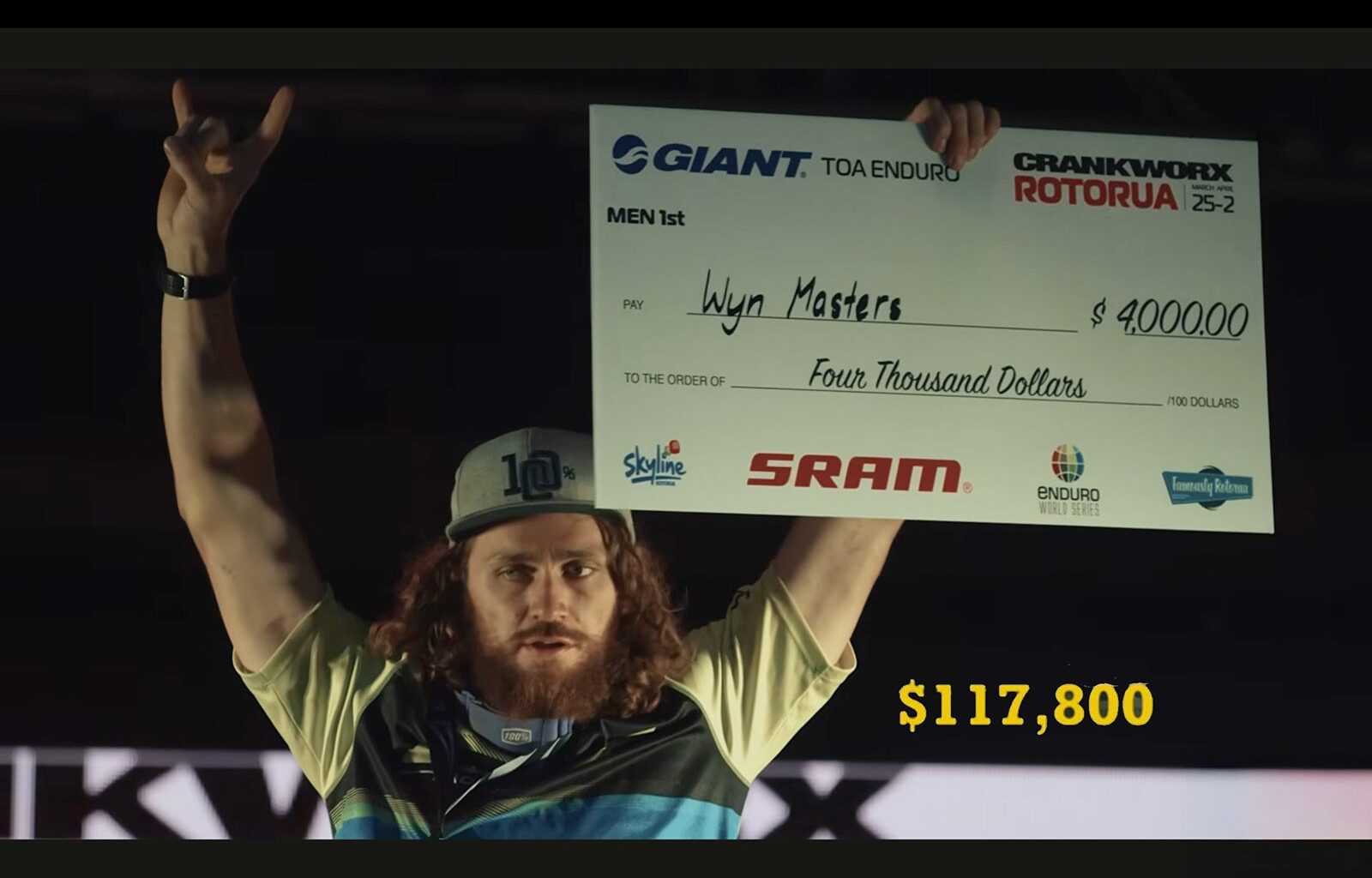
How much does a professional downhill racer actually make? For years the answer has mostly been a secret.
Contracts in mountain biking rarely become public and riders almost never talk about their salaries. But in a recent video, New Zealand racer Wyn Masters decided to change that, pulling back the curtain on his career earnings from his first World Cup season in 2008 through his later years with GT Bicycles.
“I’ve had this idea for a long time to finally say what I actually made as a World Cup downhill and enduro racer,” Masters said in the video.
The numbers tell a story familiar to many riders: years of scraping by before finally landing a proper professional contract.
The early years: racing broke
Masters began racing World Cups in 2008 as an elite rider.
He flew to Europe alone with a budget of $11,000 NZD. He bought a used Iron Horse Sunday for $4,000 NZD. Travel alone cost roughly $3,000 NZD.
The result: a season that cost about $15,000 NZD.
He earned nothing.
“I flew to Europe and I didn’t know anyone,” Masters said. “I didn’t have a van. I didn’t have anything.”
A small Italian brand, Ancilotti Cycles, offered support the following season. It covered race logistics but paid no salary. The only money he earned that year came from prize money including €1,200 from an urban race in Bergamo that helped pay for travel to later World Cups.
“It felt like a million dollars at the time,” he said.
Bikes instead of pay
For the next several seasons, Masters continued racing largely without salary.
In 2010, riding for Kenda-Playbiker, he still wasn’t paid but received a downhill bike and a four-cross bike he could sell at the end of the season.
In 2011, he finally signed a proper contract with MS Racing worth €12,000, though part of that included expenses. A brutal preseason crash shattered his arm and cut the season short. He ultimately received about €1,000 plus a bike he later sold.
Even by 2012, after another injury-ruined season, the sport still hadn’t paid him a salary.
“I still hadn’t made money from racing,” Masters said.
To survive financially he worked off-season trail-building jobs in Portugal, Chile and New Zealand. Those contracts eventually helped him save enough for a house deposit.
The first real paycheck
Masters’ first true professional salary arrived in 2013 when he joined a team backed by Bulls Bikes.
His contract: €15,000 per year, with travel and equipment covered.
At the time, it felt huge for Masters.
“That was the dream for me,” Masters said. “I was finally getting paid to be a mountain biker.”
A new deal soon followed worth €20,000 annually through the mid-2010s. It wasn’t glamorous money but it allowed him to race full time.
Betting on GT (and paying for it)
In 2016, Masters made a bold career move.
He wanted to ride for GT Bicycles. A brand he grew up watching in mountain bike films. But to leave Bulls he had to buy out his contract for €20,000.
GT signed him to a $40,000 salary, meaning half his first year’s pay immediately disappeared.
“I figured if I lost half but got onto the bigger team it was worth it,” he said.
The move proved pivotal. GT would remain his main sponsor for nearly a decade.
Turning personality into pay
Masters’ biggest financial leap didn’t come from race results.
It came from media.
Years earlier he had started filming his own race-scene series, Wyn TV, along with social clips like Wheelie Wednesday. The videos built a large following and made him valuable to sponsors beyond race results.
By 2018, he negotiated a creative contract structure: A $65,000 USD base salary and a $40,000 media bonus tied to video views.
Because the bonus depended on content performance rather than race results, he could earn it even if injured.
“I knew I could reach those targets pretty easily,” Masters said.
The deal pushed his total earnings to roughly $105,000, the first time he crossed the six-figure mark.
The peak years
By the early 2020s Masters had become one of the sport’s most recognizable personalities.
A later contract carried a $90,000 base salary with $30,000 in media bonuses, bringing his total to about $120,000 USD annually.
It was a far cry from sleeping in vans and racing for spare change in Europe.
Still, Masters says the sport rarely pays like mainstream athletics.
“In the grand scheme of things that’s not crazy money,” he said.
From racer to ambassador
By 2023, Masters shifted away from full-time racing and began running his own program supporting privateer riders. His base support package was around $115,000 from frame sponsorship while he managed additional partners independently.
The change meant more work but also closer relationships with sponsors.
Then it came to an end.
“GT finished unfortunately in the middle of 2025 and that was the end of it,” says Masters. “It was a privilege and a pleasure to be part of the brand for ten years. But it also allows me to make this video because a lot of this stuff is normally meant to be kept confidential. But I like to be able to come out and say this because no one really ever has any idea and you’re just guessing numbers rather than actually knowing what someone made.”
Why the numbers matter
Masters released the salary breakdown after GT shut down its race program in 2025, ending his decade-long run with the brand.
His goal was simple: transparency.
Professional mountain biking rarely discusses money openly, leaving young racers guessing about the realities of the sport.
“I think the more this stuff gets talked about the better it is,” Masters said. “Otherwise everyone’s just guessing numbers.”
For aspiring riders, the lesson is clear. Success in mountain biking isn’t only about race results. Sometimes it’s about building a brand around yourself and filming the whole thing along the way. Masters has earned every penny along the way. And we thank him for it.