
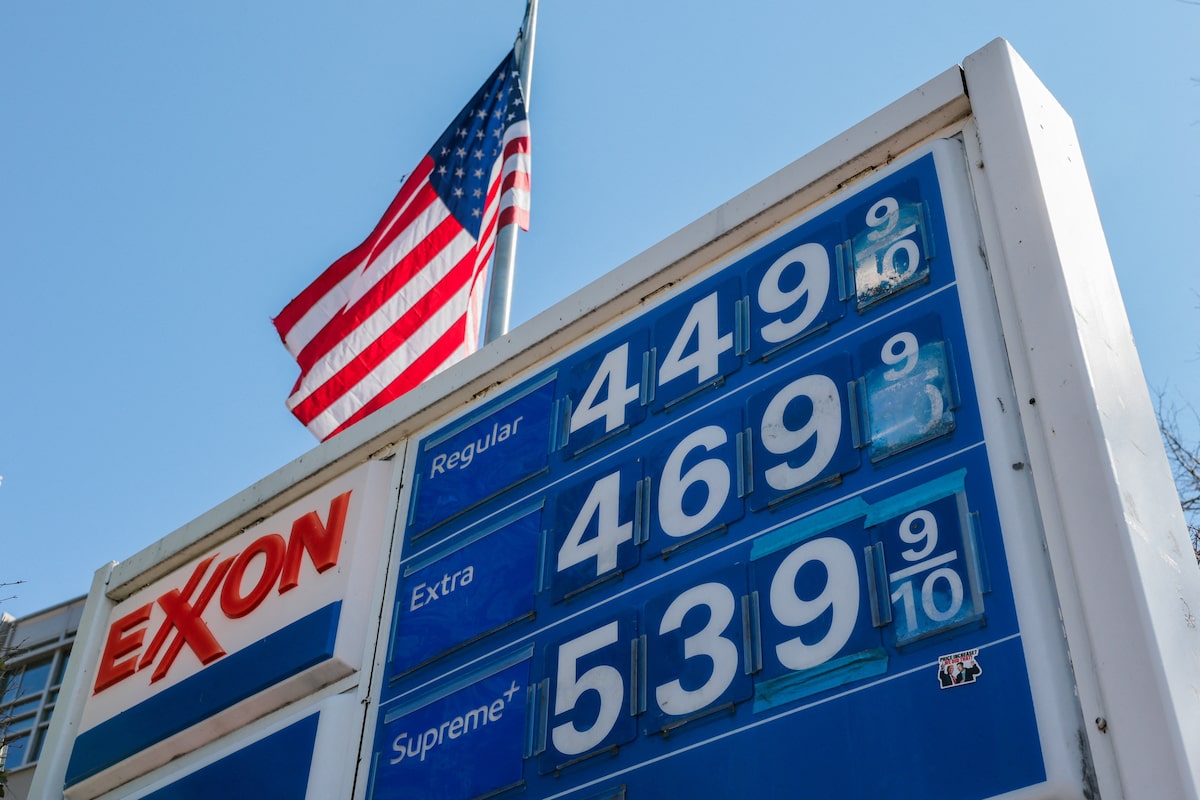
Gas prices are displayed at an Exxon station in Washington on Tuesday.Kylie Cooper/Reuters
The price of West Texas Intermediate crude oil is off its highs since hitting US$120 a barrel on Monday. But traders won’t be resting easy just yet.
U.S. President Donald Trump declared on Monday that the war in Iran is “very complete, pretty much,” although that message got a bit muddied by his subsequent admission that it’s not quite “won enough” and could get worse.
Rising pump prices at American gas stations are hurting the President’s ratings and undermining his party’s affordability-focused strategy for the midterm elections. It’s clear that he wants to claim a victory and get back to business as usual.
What’s far from clear is how that might be achieved. None of the many strategic objectives that Mr. Trump and his administration have listed over the past week have been reached, making a dignified withdrawal challenging. Meanwhile, Israel is pressing the offensive forward.
Opinion: Iran oil shock may get Trump a Democrat Congress in 2027
Then there is the small matter of Iran, which has learned that the global economy turns on the fulcrum of the Strait of Hormuz, giving Iran enormous geopolitical leverage that can be exploited with a squadron of cheap drones or by laying mines in the Strait.
All this makes another jump in oil prices a distinct possibility. Supply increases – rerouting, production increases and perhaps even the release of strategic reserves – might cap extreme moves, but we should take the risk of sustained US$100-a-barrel oil seriously.
How would Canada fare under such a scenario? The broad answer is “better than most countries,” although it depends on which Canadian you ask; all relative price changes create winners and losers.
The key to the outlook is the Canadian dollar. Since the first missiles of the war were fired, the loonie has appreciated by about 2 per cent against the Bank of Canada’s basket of trading partners’ currencies, excluding the United States (the largest weekly rise since March, 2020), and by a more modest 0.9 per cent against the greenback (which itself has risen because of higher oil prices and safe-haven demand).
In the scenario of sustained US$100-a-barrel oil, we’d be looking at an exchange rate above 75 US cents per Canadian dollar for the first time since 2023.
Oil jumps again as Iran escalates attacks on Gulf shipping
We’re watching in real time as the loonie recouples to the oil price. The 30-day correlation between changes in the Canadian dollar and WTI crude oil prices has risen from zero (unconnected) to 0.7 (close to lockstep).
For the past two years, it’s been tariffs and interest-rate differentials that have driven the exchange rate. Now they’re syncing up again, as was the case in the wake of the 2014 oil collapse, the COVID-19 pandemic and Russia’s invasion of Ukraine. The loonie isn’t a true “petrodollar,” but when oil-price moves are large enough to outweigh other forces, they take over the currency.
Canada’s oil exports averaged 4.3 million barrels a day over the past year, accounting for 20 per cent of total exports by value. Assuming US$100 oil prices and a modest bump in output, that figure would rise to around 25 to 30 per cent. Plus, since Canada runs a hefty non-oil deficit, the stronger exchange rate also works to improve the trade balance. Helpful for Prime Minister Mark Carney’s negotiating team in Washington, and enough to stave off a technical recession after the economy contracted in the fourth quarter of 2025.
We can trace similar effects on inflation. Energy prices have a weight of just over 5 per cent in the Consumer Price Index, so a roughly 50-per-cent rise in oil prices to US$100 (compared with US$67 in February) would take headline inflation up to 2.6 per cent year-over-year, from 2.3 per cent currently. Over time, spillovers from higher oil prices into other categories would push that closer to 3 per cent. Using the Bank of Canada’s exchange rate pass-through coefficient, a 2-per-cent stronger loonie would shave a negligible 0.1 percentage point off inflation, so we’d be left meaningfully above target.
From the Bank of Canada’s perspective, the combined inflation and growth uptick would be enough to rule out any interest-rate cuts, although the bar to increasing rates would remain very high, leaving the policy rate at 2.25 per cent.
One final thought: It could be better. Underinvestment in energy commodity export capacity, especially liquefied natural gas, prevented Canada from stepping in to help Europe weather severe shortages after it was cut off from Russian LNG supplies in 2022. Canada did not act fast enough to be ready to play a meaningful role this time around, either. With geopolitical instability seemingly the only global constant, one can only hope that we don’t miss the next inevitable crisis, too.
Dylan Smith is the founder of arcMacro, a research and advisory firm specializing in macroeconomic advice for private markets investors.