
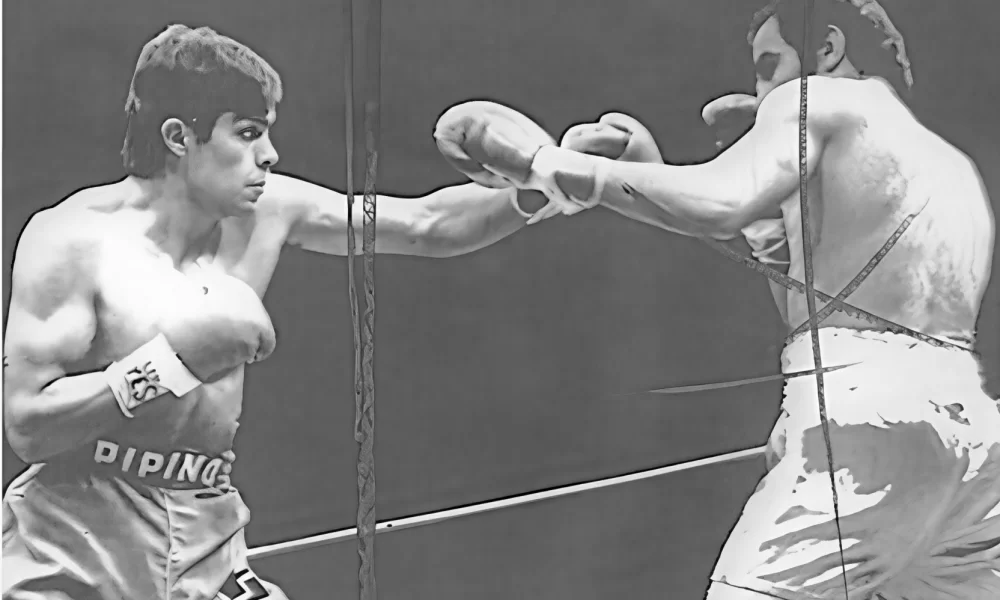
On March 12, 1977, at El Toreo de Cuatro Caminos in Mexico City, Pipino Cuevas defended his WBA welterweight championship against Argentine challenger Miguel Ángel Campanino. Cuevas went into the fight with a record of 17-6, and Campanino’s record stood at 81-4-4.
Cuevas won the bout by second-round knockout, successfully retaining his title and continuing a series of early-round victories that had defined the start of his championship reign.
The fight also highlighted the contrasting career paths of the two fighters: Cuevas, a young champion who had captured the world title just a year earlier, and Campanino, a veteran contender who had steadily worked his way through the regional ranks in Argentina.
The Rise of Pipino Cuevas
Pipino Isidro Cuevas Gonzalez was born December 27, 1957, in Santo Tomás de la Platanos, Mexico (today known as Mexico City), Mexico. He turned pro a little over a month shy of his fifteenth birthday, which was not unusual at the time for Mexican fighters.
Cuevas quickly established a reputation for knockout power, particularly in his right hand. His early style combined patience and selective aggression, often allowing him to end fights in the early rounds. While he lost five of his first dozen pro fights; his first eleven wins were by KO.
On July 17, 1976, Cuevas captured the WBA welterweight title by stopping Ángel Espada in the second round, becoming one of the youngest world champions in boxing history at the age of eighteen.
Miguel Ángel Campanino: The Argentine Contender
Born in Argentina, Campanino developed his career within a boxing culture long respected for producing technically sound and resilient fighters. Argentine professionals typically gained experience through frequent competition, often building their records across regional circuits before reaching international recognition.
Through steady performances against domestic and regional opponents, he compiled a solid professional record and gradually advanced in the rankings. By the mid-1970s he had earned a reputation as a determined and capable welterweight contender.
Campanino entered the Cuevas fight with a 37 fight win streak, interrupted by a lone draw, which is saying something as all but four of his bouts (the other four were in Italy) happened in the “draw” capital of the world, Argentina.
The opportunity to challenge Cuevas in Mexico City represented the first world title opportunity of his career.
El Toreo de Cuatro Caminos
Few venues in boxing carry the historical weight of El Toreo de Cuatro Caminos, a building long associated with championship nights and passionate crowds.
On that March evening the audience gathered to see their young champion continue his reign.
When the opening bell rang, Campanino attempted to keep the contest measured, avoiding reckless exchanges and trying to limit the champion’s opportunities. Cuevas remained patient. Advancing behind a probing jab, he looked for the opening that had ended so many previous bouts.
In the second round, Campanino found himself on the canvas. While he beat the count, his body did not want to cooperate and referee Isaac Herrera was correct in halting the contest. The official stoppage gave the champion another knockout victory and another successful defense of his WBA welterweight title.
For the crowd in Mexico City, it was a familiar result.
Cuevas’ Title Reign
The victory over Campanino became one chapter in one of the most formidable title runs of the late 1970s.
Between 1976 and 1980, Pipino Cuevas successfully defended the WBA welterweight championship eleven times. Ten of those victories came by way of KO, reinforcing his reputation as one of the most dangerous punchers in the division. Among the notable challengers he defeated during that period were: Randy Shields (33-5-1), Clyde Gray (58-5-1), and Pete Ranzany (40-2-1).
Cuevas rarely left the outcome in the hands of judges. His fights typically ended well before the final bell. Cuevas’ reign ended in August 1980, when he lost the WBA welterweight title to Thomas Hearns at the Joe Luis Arena in Detroit, Michigan by second-round stoppage. Hearns would go on to become one of the defining welterweights of the 1980s. Cuevas retired in September of 1989 with a record of 34-15, with 31 KOs.
Campanino’s Continuing Career
Argentine fighters have long been respected for their resilience, and Miguel Ángel Campanino returned to the competitive circuit. He continued on his professional career, fighting a dozen times within his native Argentina and winning them all. In September of 1978, Campanino retired with a record of 93-5-4, with 34 KOs.
Looking Back at March 12
It brought together two fighters from distinct boxing cultures—one from the busy gyms of Mexico City, the other from the determined circuits of Argentina. For Pipino Cuevas, the night added another knockout to a rapidly growing championship résumé. For Miguel Ángel Campanino, it represented the opportunity every professional fighter seeks: a chance to challenge for a world title.
To comment on this article in the Fight Forum, please CLICK HERE