
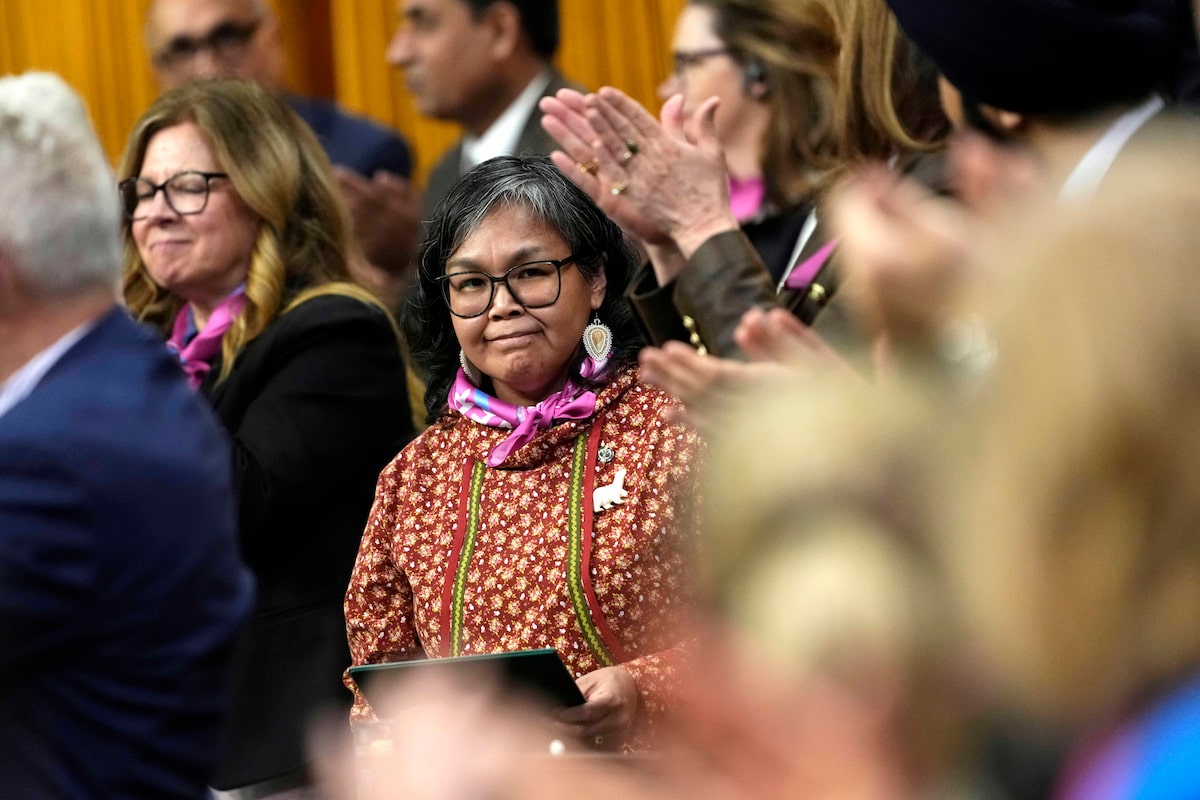
Liberal MP Lori Idlout, who crossed the floor from the NDP, is applauded by her new caucus colleagues on Wednesday.Justin Tang/The Canadian Press
A former Northern MP who crossed the floor of the House of Commons decades ago is applauding Lori Idlout’s decision to do the same, saying it is easier to influence policy from the government side than the opposition.
Peter Ittinuar was the first Inuk ever elected to Parliament and represented the riding of Nunatsiaq, which later became Nunavut.
In 1982, he crossed the floor from the NDP to the Liberals. He said he did so to be able to influence the government in the negotiations that eventually resulted in the creation of Nunavut in 1999.
“It’s far easier to influence policy development within government than it is from the opposition side,” he said in an interview this week.
He also said it was an opportune time for Ms. Idlout to cross because she would have more leverage, given that the Liberals are on the cusp of a majority government.
Nunavut MP Lori Idlout cites Northern priorities in joining Liberals
Ms. Idlout, who had been an NDP MP since 2021, met with Prime Minister Mark Carney on Tuesday. The two walked together into a caucus meeting on Wednesday. She is Nunavut’s only MP.
Nunavut’s landmass comprises about a fifth of Canada, spanning three time zones. Ms. Idlout travels extensively to its 25 fly-in communities to ensure people can share their concerns directly with her.
She said Wednesday that there was no one thing that sealed her decision to leave the NDP.
“There are a variety of many things that have allowed me to really reflect on this, and I’m very thankful to be so warmly welcomed,” she said.
Mr. Ittinuar gave Ms. Idlout “kudos” for what he calls a “big decision.”
Peter Ittinuar, centre, walks with Prime Minister Pierre Trudeau and Indian Affairs Minister John Munro to a Liberal caucus meeting in December, 1982.Peter Bregg/The Canadian Press
“I hope Mark Carney and his cabinet give her the attention she needs to make some tangible, pragmatic policy changes toward Nunavut,” such as addressing food insecurity, he said.
Children in Nunavut are going to school hungry, and “that should not be allowed in Canada,” he added.
In 2022, Nunavut had a child poverty rate of 41.8 per cent —the highest in Canada, according to a 2024 report from the anti-poverty advocacy group Campaign 2000. It said Canada’s national rate for 2022 was 18.1 per cent.
Statistics Canada reported that Nunavut’s food insecurity rate was 62.6 per cent in 2022, compared with a rate of 22.9 per cent for people living in the provinces.
Mr. Ittinuar warned, however, that not everyone in Nunavut will be supportive of Ms. Idlout’s decision.
“People will not understand the big picture, and they won’t be able to see the forest for the trees,” he said, adding that he plans to speak with her about this soon.
“They don’t understand. And no matter how well you explain it, they will refuse to understand, and the knives will be out.”
Opinion: Of the floor crossings so far, Lori Idlout’s defection will leave a mark
While some constituents on Nunavut-based social-media pages are upset, the territory’s current premier and a former one both backed her decision.
Nunavut Premier John Main said in a statement Wednesday that Ms. Idlout continues to have the full support of the territorial government.
“A strong partnership with the federal government is important to fill gaps in Nunavut for the betterment of our residents,” he said. “We expect she will continue to be a strong voice for Nunavut in Ottawa.”
Former premier P. J. Akeeagok, who led the territory from 2021 to 2025, said on social media that Ms. Idlout’s floor-crossing is a significant win for Nunavut’s self-determination.
“Moving to the government benches puts our priorities, Arctic sovereignty, generational investment and community sustainability directly at the highest decision-making table,” he said.
“I’ve seen first-hand that Prime Minister Carney understands the strategic importance of the Arctic.”