
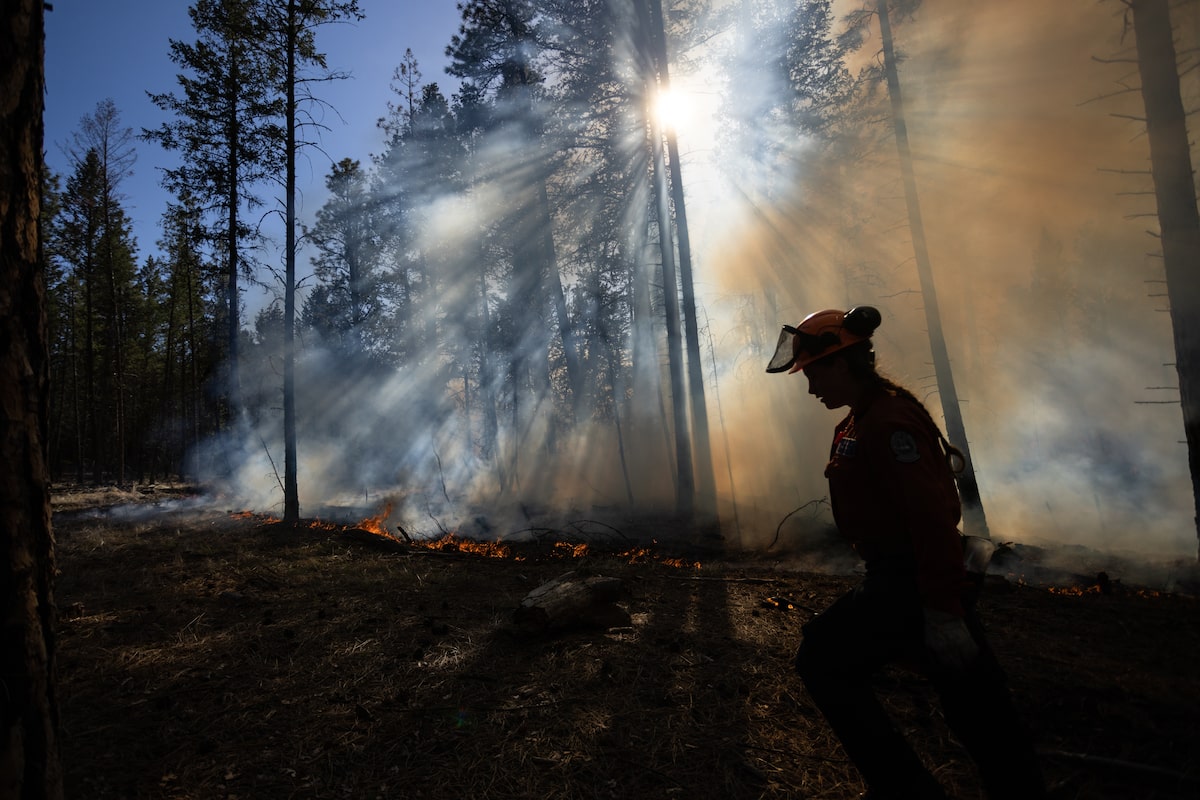
Wildfire smoke is a toxic cocktail of gases, small particles and other ingredients. It’s known to contain hundreds of chemicals. It contains particulate matter, sometimes referred to as soot. There’s also polycyclic aromatic hydrocarbons (PAHs), pollutants produced during incomplete combustion. There’s formaldehyde and benzene, both carcinogens. Carbon monoxide, a colourless and odourless gas, can cause asphyxiation.
Even for those living hundreds of kilometres away from an active fire, travelling smoke can irritate throats and eyes, trigger heart and respiratory conditions and, sometimes, kill. For city-dwellers, the advice is simple: Stay indoors. The decision to evacuate a community is often based solely on the presence of smoke.
So it may seem remarkable that wildland firefighters – unlike their counterparts at municipal fire departments – wear little or nothing over their mouths to protect themselves, despite the fact that smoke exposure on the fire line could be 10 or 20 times greater than what urban residents experience, according to Drew Lichty, an occupational hygienist with the Canadian Partnership for Wildland Fire Science who’s helping the BC Wildfire Service understand and mitigate smoke impacts.
According to an article published by Stanford University, repeated, acute exposure to smoke can shorten firefighters’ life expectancy by about a decade.
One thing politicians can agree on is that firefighters shouldn’t be rewarded for their service with respiratory damage, cancer and early death. A bipartisan bill introduced in the U.S. Senate in November, dubbed the Healthy Lungs for Heroes Act, contemplates ordering federal agencies to make protective equipment available.
Guy Bourgouin, an NDP member of provincial Parliament in Ontario, has demanded breathing protection for wildland firefighters in the province’s legislature. He says the government has been receptive.
“We see forest firefighters going in with bandanas and N95s,” Mr. Bourgouin says. “There’s got to be better equipment out there to protect them … When you’re exposed to cancers, you need a better mask.”
With widespread political support, at least in principle, the quest to find that better mask has begun. In 2024, the BC Wildfire Service began issuing three respirators to its members. Ontario distributed fabric neck gaiters to its fire rangers last year.
Find a better mask: it sounds straightforward. Whether it’s welding, farming, demolition, mining or hospitals, masks are already used in many industries to address a sprawling range of hazards. But finding one for wildland firefighters is a whole lot trickier. Respirators for other industries perform poorly under extreme conditions on the fire line, and purpose-built models don’t exist.
“When we land at a fire and we’re carrying heavy gear, laying hose and chasing the fire to get it under control, we know we can’t wear a respirator,” says Noah Freedman, an Ontario initial attack firefighter with 10 years in the field who serves as a local union executive. “We don’t have anything for that.”
Open this photo in gallery:Open this photo in gallery:
The worker at top had a respirator while clearing fire debris in Altadena, Calif., last summer. Compare that with this fire crew near Yosemite, Calif., in 2023, where some have only bandanas.Jae C. Hong/AP; Tracy Barbutes/Reuters
Firefighters told The Globe that for most of the years they served, employers offered little or nothing. Bandanas, which provide minimal protection, became the closest thing to an industry standard.
“You were never given anything,” recalls Harold Larson, a municipal firefighter who worked previously as a wildland firefighter in northern Alberta, on Vancouver Island and in Australia for a combined 20 years.
“Maybe you could request, like, a dust mask or some little handkerchief.”
A 2021 paper by University of Alberta occupational epidemiologist Nicola Cherry and colleagues studied respondents to the 2016 Horse River wildfire, which destroyed much of Fort McMurray. Roughly 70 per cent of structural and industrial firefighters surveyed wore respiratory protection gear; not one of the wildland firefighters did.
Instead, common-sense practices have evolved to reduce exposure. These include working upwind, taking breaks in fresh air, and withdrawing when smoke becomes too severe or when man-made materials ignite.
Provincial agencies share information and resources through the non-profit Canadian Interagency Forest Fire Centre. It sets standards, including a fitness test used to determine whether a candidate is strong enough to withstand the job’s rigours. But CIFFC has no discernible role in breathing protection and denied an interview request for this story.
Provinces co-ordinate fire response across their borders, as Alberta and Saskatchewan did during these burns in 2016. National standards on breathing protection have been more elusive.NASA
About 15 years ago, the U.S. National Fire Protection Association drew up a standard on respirators for wildland firefighting called NFPA 1984. To comply, products must be certified by the National Institute for Occupational Safety and Health (NIOSH), the same body that certifies breathing protection for many other industries. NIOSH hasn’t approved a single respirator under NFPA 1984.
A few years ago, the U.S. Department of Homeland Security teamed up with a company called TDA Research Inc. to develop and test a mask called the Wildland Firefighter Respirator (WFFR). It featured a blower about the size of a VHS cassette, powered by standard AA batteries, and weighed slightly more than one pound.
TDA’s website says the WFFR reached the “operational prototype” stage. But Homeland Security terminated involvement amid Trump-era cuts to grants and co-operative agreements programs. TDA did not respond to enquiries about its project.
Stacy Richardson is a regulatory engagement specialist in the personal safety division of 3M, the worker safety and consumer goods conglomerate. She says 3M has worked with the California Division of Occupational Safety and Health, the first jurisdiction on the continent to set standardized breathing protection for wildland firefighters.
“What they tried to do a couple years ago is bring a bunch of different manufacturers, including 3M, together to brainstorm this,” she says. What emerged was that nobody was quite certain about which hazards to focus on or how to make something firefighters would wear.
“And I’ll be honest,” she says. “It still hasn’t been developed.”
Recruits in the B.C. Wildfire Service’s boot camp must learn challenging jobs: Carrying gear non-stop for two hours, digging hand guards and ‘cold-trailing’ extinguished fires, to name a few. The B.C. force has emerged as Canada’s leader in the search for better breathing protection.
Jesse Winter/The Globe and Mail
Eating smoke
The main reason why a respirator for wildland firefighters hasn’t emerged yet is that the list of requirements is formidable.
Depending on their role, a wildland firefighter might carry 50 pounds of gear, including large volumes of drinking water, a hose, a chainsaw and a jerry can of fuel. So, for starters, it must be sufficiently light and compact to stow in a pack.
It shouldn’t interfere with hydration. It must be heat-resistant and easy to clean in the field. It should be comfortable to breathe through while lugging gear up an uneven slope or in searing heat radiating from a large fire on a summer day.
“I couldn’t imagine working 14 hours a day with something on my face that was making me feel more uncomfortable than I already am,” says Mr. Larson.
If one accepts the principle that employers should not knowingly expose workers to hazardous substances, then perhaps the greatest hurdle is protecting against smoke’s complex, variable ingredients.
The list depends on what’s burning, at what temperatures and how far it’s travelled. Burning peat bogs, poison ivy and garbage dumps are just a few of the curveballs that can dramatically alter the mix. Increasingly, wildfires are burning through communities, lighting up cars, mattresses and other manufactured products.
Fires strong enough to melt metal from a car can also unleash all kinds of toxic fumes in the air.Darryl Dyck/The Canadian Press
And it doesn’t end with smoke. Crews will sometimes use a bulldozer to cut a “control line,” which can also be used to access the fire. Conditions are typically dry, so moving along the control line kicks up dust, including silica, which can cause lung damage and silicosis.
“When you’re walking through a burnt forest, it’s like the bottom of a wood stove,” says Sebastian Kallos, who’s served for 15 years as a wildland firefighter in B.C., the Yukon and Australia, and now works for the BC General Employees’ Union.
“There’s all that really fine ash that gets stirred up from just walking.”
The U.S. National Wildfire Coordinating Group warns wildland firefighters that cumulative exposure to smoke can lead to cancer, cardiovascular disease, respiratory infections such as pneumonia, and fatigue.
Yet existing research leaves plenty of unanswered questions about long-term consequences. Said Mr. Lichty: “We don’t have that data, so it’s like: ‘Just trust me, this is bad for you. Wear a respirator.’ That’s not a great place to be.”
While last summer’s wildfires spread red skies over cities such as Vancouver, the intensity of the smoke was nothing compared to what firefighters faced close to the source.Darryl Dyck/The Canadian Press
He added that his profession usually tackles simpler workplace hazards such as formaldehyde gas. Health effects are understood, exposure limits have been drawn up, and exceedances are straightforward to identify and address. Smoke is altogether more challenging.
And so is studying firefighters’ exposure in the back country. “People are very hard to track down and follow,” says Mr. Lichty’s colleague, Natasha Broznitsky, the BC Wildfire Service’s senior officer for research and innovations, and a former wildland firefighter.
“They’re going in helicopters. They’re camping in remote areas. They’re working long shifts.”
Workplace culture presents further hurdles. Mr. Kallos says most wildland firefighters sign up when they’re young and rarely stay longer than a few years.
“When you’re in your 20s, you’re in the prime of your life, you have good respiratory capacity, you’re physically fit,” he says. “A couple years of wood smoke doesn’t seem like that big of a deal.”
There’s also an ethos of enduring hardship without complaint. Mr. Larson puts it this way: “I knew that that can’t be good for you, so obviously I would mitigate the risk as much as I could. But I also love fighting fire, so eating smoke was just part of the job.”
N95s were in high demand during the pandemic, though one Vancouverite in 2020 had a mask to spare for the Robbie Burns statue in Stanley Park. Today, some wildfire agencies favour N95s, but they can come with drawbacks in the field.
Fred Lum/The Globe and Mail; Darryl Dyck/The Canadian Press
Off the shelf
N95 masks seem to have emerged as a preferred option among many wildfire agencies. Ms. Richardson says that while 3M’s visibility is limited (its masks are sold through distributors, not directly), it appears some agencies have ordered N95s, disposable filtering respirators which became familiar during the COVID-19 pandemic.
NIOSH says N95s can protect workers from wildfire smoke, ash and fine particles, provided they’re fitted and worn correctly. It recommends supplying them for voluntary use.
Problem solved? Not even close.
N95s don’t protect against many small particles, vapours or gases present in smoke. Perhaps the biggest objection, though, is that they make breathing more difficult. The U.S. National Wildfire Coordinating Group recommends N95s not be used on the fire line, where they might cause wearers to overheat.
Mr. Kallos experimented with N95s and found them useful only for narrow applications such as extinguishing smouldering tree stumps during postfire mop-up.
“When you’re actively digging in soot and dry, dusty soil, you can feel the grit in your mouth when you don’t have a mask on,” he says. “But wearing N95s, you’re not tasting it as much.”
So it is with virtually every other available option for protecting wildland firefighters: they offer partial protection and are suitable only for specific tasks.
The crucible
Some shortcomings become obvious after simple thought experiments, others only after rigorous field testing.
“Your technology is highly likely to fall down for lots of different reasons,” says Sandra Dorman, director of the Centre for Research in Occupational Safety and Health (CROSH) at Laurentian University. She’s a researcher who’s collaborating with Ontario’s Aviation, Forest Fire and Emergency Services to find something better.
The BC Wildfire Service has emerged as Canada’s leader in this quest. Working with the University of Alberta, in 2019 it began studying smoke’s contents and sought to determine whether they were getting into workers’ bodies, with or without N95 masks.
“We felt like we were really starting from scratch,” Ms. Broznitsky says.
In 2022, the agency began a survey of commercially available, NIOSH-approved respirators, supplemented by members’ recommendations. It bought a variety and field-tested them. Since 2024, it has offered members three options, all made by 3M.
The Aura N95 is a half-mask featuring an exhalation valve. The other two are half-face, dual-cartridge respirators intended for tasks such as demolition, welding and woodworking: the Rugged Comfort Quick Latch and the Secure Click.
Hose duty is one of a firefighter’s less exerting tasks – the ideal setting to use a respirator, says Drew Lichty, who advises the B.C. Wildfire Service on smoke safety.Jesse Winter/The Globe and Mail
Uptake has been uneven. User surveys found that crew members typically only used respirators for less than an hour at a time, during particularly smoky conditions.
“Over the course of a 12-, 14- or 16-hour shift, somebody may put their respirator on three to five times a day, for 30 minutes at a time,” Mr. Lichty says.
He adds that about half the fire line staff ordered respirators last year, but far fewer are using them in the field. “Gut feeling, it might be 15 per cent of the staff,” he says.
Among this select group, Mr. Lichty reports the masks have won devotees. Mr. Kallos, though, is among the doubters.
“It’s just not tenable to wear the current masks that are provided,” he says. “And if you did wear one, it would dramatically decrease your productivity.”
With no silver-bullet solution available, Mr. Lichty seeks incremental gains. He says B.C.’s respirators are ideally suited for hosing activity, which is not physically demanding. Younger members are more willing to don respirators than their older peers, creating openings to boost the adoption rate incrementally.
Fabric is not as good as respirators in keeping out fine types of particulate matter.Nicolas Palacios/Reuters
In 2025, Ontario offered the BarriAire neck gaiter. It features three layers of fabric including Nomex, a product from American chemical giant DuPont commonly used in firefighting garments. Its manufacturer, PGI Inc., claims it filters particles, viruses and bacteria. It’s light and easy to pack. The provincial government recommends employees carry two and wear them as often as possible, including during suppression.
But the BarriAire isn’t NIOSH-certified. The Ontario government acknowledges it won’t protect users against all particulates or gases, nor is it as protective as certified respirators.
“Performance is questionable, due to lack of primary quantitative testing and individual use variances,” notes a summary provided to the Ministry of Natural Resources and Forestry.
Mr. Freedman says the government’s documentation failed to establish that the BarriAire protects users. He witnessed little buy-in among fellow staffers.
“These masks have zero proven efficacy, outside of the textile manufacturer’s own internal research,” he says.
“It’s just a friggin’ piece of elastic fabric dangling over your face.”
Ms. Dorman says she regards the BarriAire as an interim measure while the government and CROSH work toward something better.
“We don’t have a solution right now,” she acknowledges. “We know anything in front of your face is better than nothing.”
After several smoky seasons in Toronto, the province is trying to figure out more lasting solutions to help wildland firefighters breathe better on the job.Carlos Osorio/Reuters
Ms. Dorman sees a difficult road ahead. This year, researchers will collect data to better understand what they’re exposed to while performing specific tasks, and work with vendors to test new equipment.
Whichever mask is selected will not miraculously end all exposures, she says, nor is it possible to wear one throughout an entire shift. And masks will introduce a host of new challenges that must be addressed in turn.
Even so, she regards improving respiratory protection as entirely achievable. She’s encouraged by growing co-operation agencies; Ontario and B.C. are sharing information, she says, and collaborating with U.S. organizations such as CalFire and FEMA.
“We are all sharing our data and efforts broadly, so that successes can be picked up and failures can be discarded,” she says.
“I’m really proud to be part of the work. I think it’s gonna make a difference in people’s lives.”
Jesse Winter/The Globe and Mail
Where there’s smoke: More from The Globe and MailThe Decibel podcast
Indigenous communities are among the places hit hardest by smoke. In 2023, Dr. Nicole Redvers from Western University spoke with The Decibel about the health and social impacts they face from smoggy skies. Subscribe for more episodes.
Darkened by ash from wildfires, glaciers in the Canadian Rockies are melting even faster
First Nations land guardians on Vancouver Island are the keepers of a changing coast under threat