
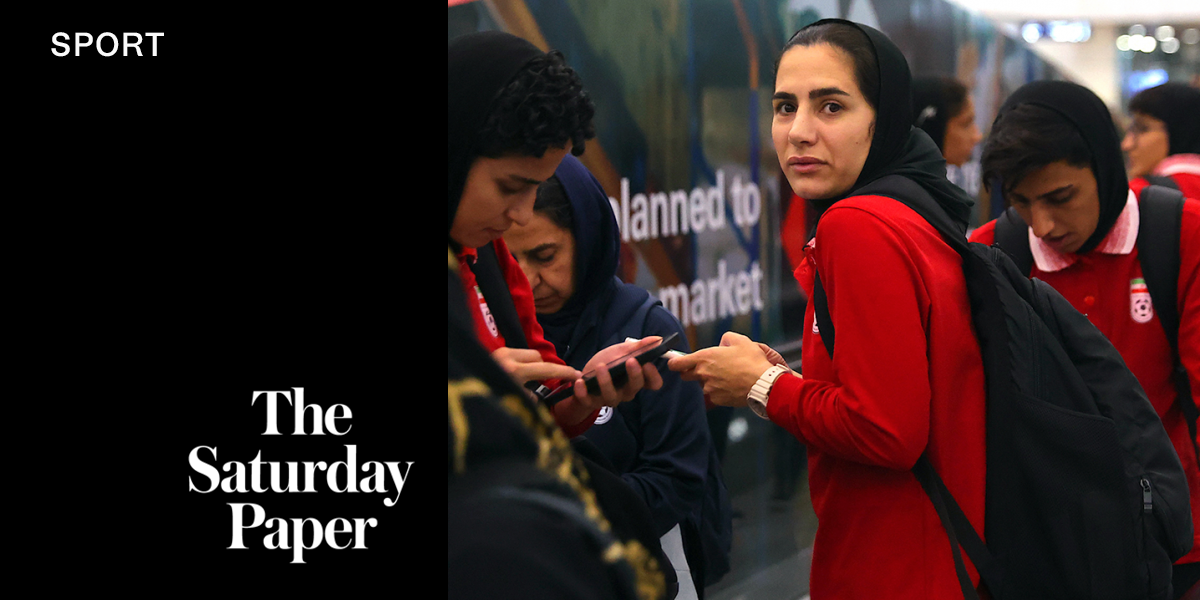
Brokering their escape was both strange and delicate. Strange because civilians were involved; delicate because the stakes were so high and the world was watching.
The Australian Federal Police, assuming the entourage for the Iranian women’s soccer team would contain elements of the Islamic Revolutionary Guard Corps (IRGC), or at least proxies for them, assigned an officer to the team. Ostensibly they were there to protect the women, which was true, but their role would soon become more complicated.
The improvised exfiltration operation happened on Monday night at the Gold Coast’s Royal Pines Resort, where the team were staying. One of the civilians there was Tina Kordrostami, a Sydney architect and City of Ryde councillor, who only weeks before had testified before the Parliamentary Joint Committee on Intelligence and Security about her intimidation by proxies of the IRGC. The public hearings were called to review the recent listing of the organisation as a state sponsor of terrorism. “We are not dealing with a conventional armed force,” she said of the IRGC. “We are dealing with a hybrid entity – part military, part intelligence agency, part business network, part ideological machine,” Kordrostami said.
“Many Australians welcome [the Iranian women’s soccer team] and rightly so. Iranian women athletes themselves have shown extraordinary courage. But accompanying delegations include individuals widely understood within diaspora communities to be affiliated with, supportive of or aligned with IRGC structures. And these people have just landed in our country within the last few hours.
“This creates an impossible situation. On one hand, we open our doors to sports, cultural exchange and people-to-people diplomacy. On the other hand, we risk inadvertently enabling networks that operate in the shadow of an illicit or soon-to-be illicit entity. This is not about athletes. This is about the ecosystem that travels with state delegations from authoritarian regimes.”
Now, from the lobby of the Royal Pines Resort, Kordrostami was trying to thwart that very entity by helping prise some of the women from its grip.
One week before, the Iranian team played their opening match of the AFC Women’s Asian Cup. On the Gold Coast that night the crowd numbered less than 3000, but very quickly the whole world would see what happened. The United States president would soon be briefed about it and the Iranian state broadcaster would fanatically condemn it – in words so sinister that many interpreted it as a de facto promise of execution.
What we do know is that the Lionesses arrived as a team last month and barely half of that team has departed – flying towards bleak but uncertain consequences.
Iran’s first match, at Robina Stadium against South Korea, was itself unmemorable. It was what occurred before kick-off – or what bravely didn’t occur – that has made this fixture one of the most politically significant sporting events in Australian history.
As is customary, the respective anthems of the competing teams were played as the two squads stood in solemn rank on the pitch. When Iran’s played, its women stood silently – theocratic will, zealously upheld, demanded they declare allegiance to their country by passionately singing the anthem while maintaining a salute. They refused.
Their defiance was made more courageous for its context. The team had arrived in Australia in February, just before the US and Israel began their attacks upon Iran, but their first match occurred after the bombs fell and while Iranian authorities fought against their own extinction.
The squad’s protest would have always risked grave consequence, but that women were subtly declaring their contempt for Iranian theocracy while the body of its supreme leader lay beneath rubble was especially and dangerously provocative. “In times of war, traitors must be dealt with more harshly,” fumed Mohammad Reza Shahbazi on state television, where he serves as an angry trumpet for the ruling clerics.
“Take this issue of not singing the national anthem in our women’s football team … This is no longer some symbolic protest or demonstration. In wartime conditions, going there and refusing to sing the national anthem is the height of shamelessness and betrayal. Both the people and the authorities should treat them as traitors in a time of war, not as individuals staging some kind of symbolic protest … They must be properly dealt with so that others take a warning from it.”
It could be safely assumed that no daylight existed between the vengeance encouraged by Shahbazi and the besieged regime he speaks for, and thus grave fears were held for the women.
If their quiet protest occurred on the other side of the world, proxies for the ayatollahs were right beside them – members of the IRGC appointed to shadow and gag them and prevent their defection to Australian authorities.
Grim-faced men chaperoned the players to and from their matches, limited their contact with media and, The Saturday Paper understands, aggressively reminded them of the fruitlessness of their seeking asylum.
The Lionesses’ second match was three days later, on March 5, against the Matildas. This time, when the Iranian anthem played, the ashen-faced squad fixed their salute and sang without any observable enthusiasm.
That the women were not merely being closely observed but effectively held captive was clear enough to those watching. What wasn’t obvious was the intensely personal and high-risk calculus that members of the team were considering.
We did not know what each individual woman felt about the long, murderous reign of the Iranian clerics – or the war being waged to dislodge them. We did not know if any had pre-empted their asylum claim and, if so, had arranged the safe hiding of their families back home. We did not know if any players had children and what their collective protest might mean for their safety. We did not know what profound, potentially irreversible severance their Australian asylum would impose.
We did not know the contents of their hearts, nor the weight of their decisions, which they contemplated under the intense and hostile scrutiny of their minders and were made globally significant by virtue of the war.
The Saturday Paper understands that the government was always receptive to any asylum claim by the team members, but the delicacy of brokering such claims obliged discretion – as well as respect for the variety of individual intentions.
Characteristically indiscreet, Donald Trump criticised Prime Minister Anthony Albanese on social media early on Monday morning (AEDT), for “making a terrible humanitarian mistake by allowing the … team to be forced back to Iran, where they will most likely be killed”.
While Trump was running his mouth, five members of the team had made their escape and were sitting before Home Affairs Minister Tony Burke, department staff and translators, securing their applications for political asylum. Such is Trump’s insulting impulsivity that he made his remarks before calling Albanese, which he did about 2am on Tuesday. It was then that Albanese explained the situation. Not long after, Trump posted: “He’s on it! Five have already been taken care of, and the rest are on their way. Some, however, feel they must go back because they are worried about the safety of their families, including threats to those family members if they don’t return. In any event, the Prime Minister is doing a very good job having to do with this rather delicate situation. God bless Australia!”
The delicacy should have already been apparent to the US president, but when the leader of the free world takes his briefings from the morass of social media, respectful appreciation can suffer.
By the time the team left Australia for Iran on Tuesday evening, another two members of the squad had claimed asylum here. In a statement to The Saturday Paper, the exiled Iranian Crown Prince Reza Pahlavi, eldest son of the last Shah of Iran, said: “I would like to thank Prime Minister Albanese for his action to protect some of the players of the Iranian Women’s football team. This regime has a brutal track record of violence and intimidation against sports athletes who have bravely stood against this murderous Regime.
“The Australian Government is also right to proscribe the IRGC. Its network of cells and proxies in Australia promote terror and hate and are a threat to the Australian people.”
At Sydney Airport on Tuesday evening, before boarding their flight to Kuala Lumpur, Australian Border Force officials took the women aside individually to allow them to speak their mind, and request asylum if they wanted, away from their minders. None did. By Wednesday morning, one woman who had stayed behind in Brisbane, decided she would instead return to Iran.
The desires and fates of the others are unknown. It is difficult to contemplate. They have left our soil now, and its protections. Respecting another’s agency – and acknowledging our ignorance of others’ intentions – is complicated in this instance by the assumption that very wicked coercions have been imposed upon these women.
What we do know is that the Lionesses arrived as a team last month and barely half of that team has departed – flying towards bleak but uncertain consequences.
This article was first published in the print edition of The Saturday Paper on
March 14, 2026 as “Lion hearted”.
For almost a decade, The Saturday Paper has published Australia’s leading writers and thinkers.
We have pursued stories that are ignored elsewhere, covering them with sensitivity and depth.
We have done this on refugee policy, on government integrity, on robo-debt, on aged care,
on climate change, on the pandemic.
All our journalism is fiercely independent. It relies on the support of readers.
By subscribing to The Saturday Paper, you are ensuring that we can continue to produce essential,
issue-defining coverage, to dig out stories that take time, to doggedly hold to account
politicians and the political class.
There are very few titles that have the freedom and the space to produce journalism like this.
In a country with a concentration of media ownership unlike anything else in the world,
it is vitally important. Your subscription helps make it possible.
Send this article to a friend for free.
Share this subscriber exclusive article with a friend or family member using share credits.

Used 1 of … credits
use share credits to share this article with friend or family.
You’ve shared all of your credits for this month. They will refresh on April 1. If you would like to share more, you can buy a gift subscription for a friend.
SHARE WITH A FRIEND
? CREDITS REMAIN
SHARE WITH A SUBSCRIBER
UNLIMITED
Loading…