
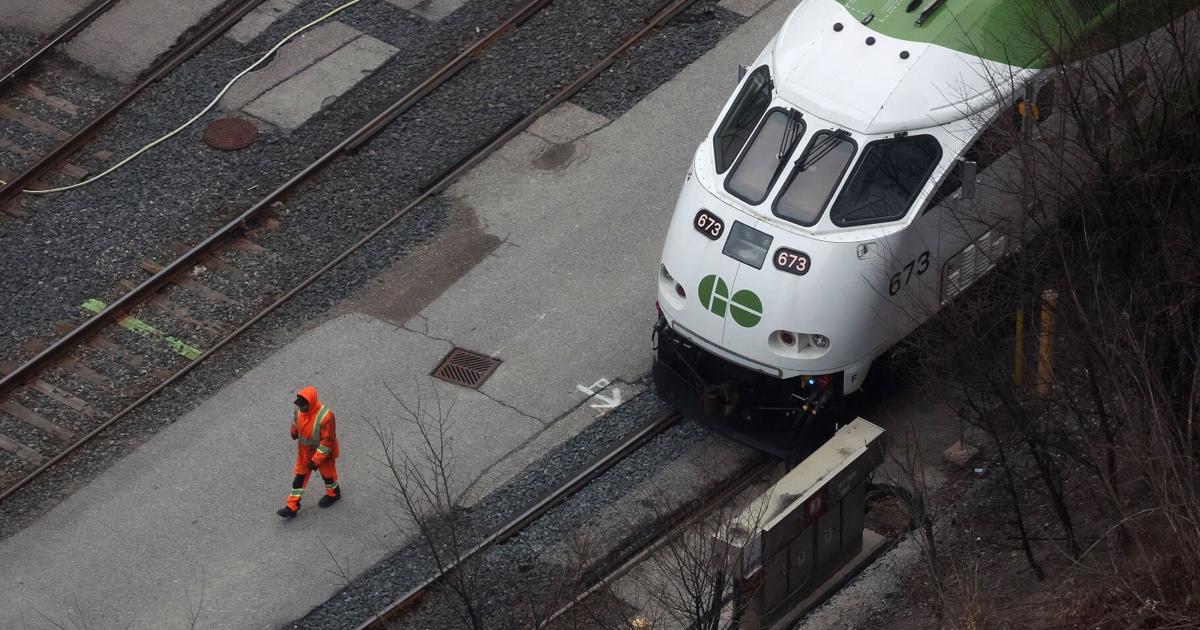
A GO train carrying 120 passengers was within seconds of derailing near Oakville earlier this year, according to an internal Metrolinx report obtained by the Star, a close call that one expert said could have resulted in a “high-fatality” crash.
The incident — which the report says was the fourth time a GO train sped past a stop signal over the previous 12 months — has railway experts raising questions about the safety and transparency of the province’s commuter railway, which carries an average 244,000 passengers daily.
On Jan. 5, a westbound GO train just outside of the Oakville GO Station blew through a stop signal and crossed over to a different track at about 112 km/h when it should have only been travelling at about 24 km/h, despite the driver hitting the brakes, according to the confidential, preliminary Metrolinx report of the incident.
While no one was injured, the report found a “very narrow margin between the actual outcome and a credible worst-case scenario, including derailment or collision.”
Passing stop signals is “recognized across the rail industry as one of the most serious operating violations,” the report added.
What happened is called a signal passed at danger — essentially blowing through a stop signal. It’s a failure that has caused fatal railway crashes in the past, says Gareth Dennis, a U.K.-based railway engineer who previously worked with Metrolinx and who reviewed the details of the report for the Star.
Dennis called it “the worst possible kind of (signal passed at danger) — an incident that is seconds away from being a high-fatality risk incident.”
“It is luck alone, and the resilience of track materials, that this train was not derailed and slewed, resulting in fatalities,” he added.
Metrolinx worried about reputation
Once the GO train came to a stop, passengers were let off at the Oakville GO Station. The incident contributed to a 60-minute delay on the system, the report found.
The preliminary report also laid out the immediate actions that Metrolinx and Alstom, the company contracted to operate the GO network, took, including an internal investigation.
After the incident, there were three main concerns for Metrolinx: “safety risk on a high-ridership passenger corridor, regulatory and reputational risk associated with a confirmed (signal passed at danger), operational reliability impacts and implications for customer trust.”
According to the Metrolinx report, an internal investigation would be completed within 60 to 75 days of the incident. But no report has so far been made public and there is no indication from the provincial transit agency that it will be.
“The incident is being reviewed under established rail safety protocols,” said Dakota Brasier, a spokesperson for the Ontario minister of transportation. “Metrolinx has one of the strongest safety records in North America and we are confident the existing processes provide the oversight required to protect passengers and strengthen the network.”
Nic Defalco, a spokesperson for the Transportation Safety Board, the federal agency in charge of investigating safety incidents on Canada’s railway network, told the Star it is not currently investigating the Jan. 5 incident.
In a statement to the Star, Metrolinx spokesperson Lyndsay Miller said that the two Alstom operators of the train have been dismissed.
“While taking GO Transit continues to be one of the safest ways to travel, this incident provides an important opportunity to reinforce safety compliance across our rail network,” Miller said.
Ian Naish, former director of rail investigations at the TSB, said it was “extremely surprising” the train didn’t actually derail.
Had the train driver braked 1.5 seconds later, as laid out in the report, “it had the potential to have been one of the worst recorded Metrolinx accidents in its 16-year history,” Naish said. “A high-speed derailment would likely have resulted in multiple passenger injuries and, possibly, some fatalities.”
But, Naish added, there are “so many unknowns.”
Jeff Casello, a planning and engineering professor at the University of Waterloo, agreed, adding that “blowing signals and going through complex track structures at much higher speeds than designated are two of the most dangerous operational outcomes … in rail systems.”
If the train had derailed at its reported speed of 112 km/h and if the heavy bi-level GO trains had tipped over, said Casello, “it’s going to skid for some distance … the passengers inside are going to be tossed all over the place — the same way you would be in your car if you didn’t have a seatbelt.”
Deadly consequences in the past
Transit vehicles failing to obey stop signals have had deadly outcomes in the past.
In 1995, a TTC subway train ignored three sets of red lights on Line 1, and collided with another train near Dupont station, killing three passengers. In 1999, 31 people were killed near London, England, when two passenger trains collided after one passed a red signal, prompting widespread implementation of train protection technology.
The U.S. mandated technology that automatically stops speeding trains or trains operating unsafely after a 2008 passenger train collision in Los Angeles that killed 25 people.
Since 2001, the TSB has called for fail-safes that guard against speeding and the subsequent derailments that often occur, but it has not been nationally mandated.
GO Transit currently doesn’t have the safety systems that have become widespread in modern railway systems.
In 2024, Metrolinx announced it would roll out a European-standard signalling system that would include train protection as part of its GO expansion plans. The transit agency has not provided a timeline for when the new signalling system would be implemented.
“The level of protection that GO Transit operates with is essentially the same as Britain’s operating system in the 1940s,” Dennis said.
Meanwhile, the Ontario government and Metrolinx have run increased service on several of the GO network’s busiest routes, including the Lakeshore West and East lines, the Barrie line and the Stouffville line.
“If you’re going to see an increasing level of service on GO transit — as is happening right now — and not seeing a commensurate increase in the level of protection … is that acceptable?” Dennis said. “I would postulate that it isn’t.”
Casello said that although the incidents are worrying, riders shouldn’t be concerned about taking the GO train regularly.
“Certainly, they should worry much less than when they get in the car to drive on the 401,” he said, but added that riders still should expect higher operating standards for the GO network.
A lack of oversight
Neither the January GO incident, nor February’s derailment at Union Station will be subject to an independent investigation, because the TSB has no jurisdiction to investigate safety incidents on provincially owned railways, which is the case for the majority of the GO network.
Instead, Metrolinx will conduct its own investigation, with no guarantee the results will be made public as there is no requirement to do so. No public reports on signals passed at danger in the past year have been published.
The TSB has, in the past, called for more regulatory oversight of the GO network, either by the Ministry of Transportation or another government body, as part of a 2023 TSB report on a 2019 incident on Lancaster Street in Kitchener where an adult and child were struck by a GO train.
“Given the current complex (Ontario Ministry of Transportation) regulatory framework that involves multiple agreements, there are gaps in the oversight processes that can lead to occasions when the (Ontario Ministry of Transportation) will not be able to provide effective safety oversight,” the TSB wrote in its report. “The Board is concerned that the Province of Ontario does not provide effective safety oversight of provincially regulated railways.”
More transparency can help spur better regulations and safety technology said Naish, the former TSB director. But as it stands, Metrolinx and the GO network have no independent oversight aside from the provincial government.
“There’s just so much we don’t know … There’s no accountability,” Naish added. “I know it causes bureaucracy and it costs money, but you need to be accountable.”
Correction – March 13, 2026
This article was updated from a previous version to note that the 2019 incident where an adult and child were struck by a GO train occurred at the Lancaster Street crossing in Kitchener, not in Lancaster community in eastern Ontario.