

Thanks for reading the Her Hoop Stats newsletter. We’re excited to announce a new partnership with Hudl. Hudl’s industry-leading tools – Sportscode, Instat, and Fastmodel – elevate the preparation, performance, and player development of WNBA and NCAA teams. We appreciate their support and look forward to working with them to help bring more insight about the women’s game to you.
You can find me on Bluesky and HHS on Bluesky, Twitter, YouTube, Facebook, and Instagram.
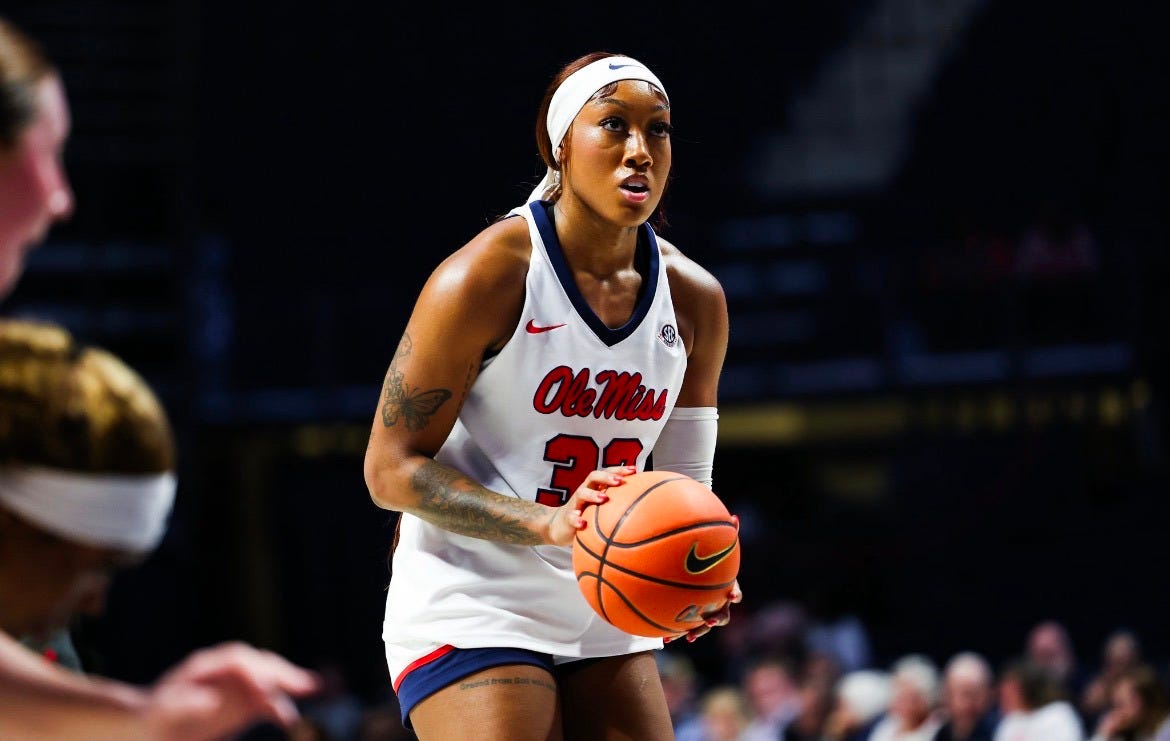 Photo courtesy of Ole Miss Athletics
As the 2025–26 college season nears its end, WNBA front offices are closely reviewing their draft boards and underscoring players who offer positional size, top-tier athleticism, a polished skill base, and a competitive edge. Key decision-makers are drawn to players who impact winning in a variety of ways, have a clear commitment to working on their games, and exhibit the potential to grow into more prominent roles as their careers progress. Below are several players who offer these qualities and project as intriguing options for the wing position at the next level.
Although just 19 years old, the 6-foot-1 wing already possesses veteran-level strength and physicality and has established herself as one of the preeminent international prospects in the 2026 WNBA draft class. Averaging 13.5 points, 4.9 rebounds, and 2.3 assists for BLMA (Basket Lattes Montpellier Association) in EuroCup play, she blends exceptional scoring instincts with an explosive first step, incredible body control, and excellent footwork. She thrives at attacking the lane and has a knack for finishing through traffic or earning herself a trip to the free-throw line. For WNBA teams seeking a powerful, two-way wing who has already proven she can make an impact at the professional level, Angloma is an attractive high-floor prospect who also has significant draft-and-stash appeal.
To fully unlock her potential, Angloma’s perimeter shooting is the most obvious differentiator. While she’s a dominant force in getting to the rim, her outside shot has been inconsistent, connecting on only 32.4% on 2.4 3-point attempts per game in EuroCup play. In the WNBA, where defenders are quick to sag off non-shooters and clog driving lanes, a reliable shot from beyond the arc will be essential to maintaining offensive gravity and maximizing her downhill game. In addition, continuing to improve her on-ball defense will be critical to ensuring she can contain elite perimeter opponents without relying so heavily on her size and strength. Still, her physical gifts, scoring talent, and contributions to a competitive French team make her a desirable selection for teams prioritizing athleticism, offensive prowess, and a battle-tested mentality.
Despite stepping away from basketball for a year before transferring to Texas Tech for her final season of eligibility, Collins has emerged as a major spark off the bench for the Lady Raiders, earning both Big 12 Sixth Player of the Year and All-Big 12 Second Team honors. In fewer than 25 minutes per game, she’s posting career-highs across the board with 14.8 points, 2.7 rebounds, and 1.1 assists per game. And even with a slightly unconventional shot form, the 6-foot-1 guard has been remarkably effective from beyond the arc, converting on 39.5% of her threes on 3.7 attempts per game. That production helped propel her team to a 25-7 record and a projected No. 6 seed in the NCAA Tournament. Defensively, her combination of length and lateral quickness enables her to disrupt passing lanes and comfortably guard multiple positions, exemplifying an archetype that aligns well with the modern WNBA’s demand for wings who can stretch the floor while remaining switchable on the other end.
For Collins to solidify her case for a roster spot at the next level, she’ll need to sustain her scoring efficiency through the rest of postseason play while continuing to hone her decision-making and playmaking in high-pressure moments. Although she primarily functions as a floor spacer and secondary scoring option, her assist-to-turnover ratio (.57) falls below the threshold that evaluators typically expect in perimeter players at the next level. In order to succeed in the league, where defenses are much better at restricting space, cutting off angles, and anticipating actions, improving her off-the-bounce creation and tightening up her offensive facilitation will be critical. But if Collins can increasingly pair her outside shot proficiency with stronger ball security and cleaner reads, she possesses the physical profile and foundational tools to battle for a spot at a training camp.
While last season’s leading scorer for Georgia Tech transferred to USC for her senior year to test her game against more elite competition, her ability to produce on both ends of the floor hasn’t wavered. Averaging just over 15 points, 5 rebounds, and 1.5 stocks (steals + blocks) over the past three years, Dunn is a versatile offensive threat and defensive menace. This season, she’s scored in double-digits in all but seven games, including a 25-point, 12-rebound performance in an 81-69 statement win over Iowa. Her off-ball movement generates clean looks on the perimeter (37.5% on 5.9 3PA this season), and she attacks closeouts with confidence and finishes at the rim with impressive efficiency. On the defensive end, her high motor and hustle translate into extra possessions and set a competitive tone that elevates her team’s overall intensity.
While she’s a tad undersized for the modern wing in the pros, Dunn compensates with strength, physicality, and the experience needed to battle larger opponents. A potential transition to the secondary guard role would require craftier ball-handling and quicker processing under heavy pressure, particularly when navigating traps. However, if she can continue to step up through tournament play and help the Trojans outperform expectations, front offices will likely view her as a viable second-round option with the potential to develop into a dependable long-term role player who can provide an offensive burst and two-way energy off the bench.
Starting in every game for the Blue Devils over the past three seasons, the 6-foot guard has notably elevated her playmaking during her final year. Averaging 4.4 assists and boasting one of the best assist-to-turnover ratios (1.91) among wing prospects, Jackson is a connective presence who keeps the ball moving and is always willing to make the extra pass. She complements that facilitation with reliable floor spacing, shooting 32.5% on 6.6 3-point attempts and contributing 11.4 points per game. On the defensive end, Jackson is frequently tasked with defending the opponent’s top perimeter threat, where her IQ and anticipation show up in well-timed rotations and passing-lane disruptions. She’s also shown an increased commitment on the glass, pulling down a career-high 3.5 rebounds this season, many of which she converts into transition opportunities.
To strengthen her candidacy for a long-term roster spot in the WNBA, Jackson will need to improve her offensive consistency, especially when attacking the lane. While her confidence from beyond the arc provides clear value, her overall field-goal percentage has hovered in the mid-30s, largely due to inconsistent finishing at the rim and through traffic. Limiting unforced turnovers will also be important as she looks to earn and maintain the trust of a professional coaching staff. Still, a strong showing in the NCAA Tournament could prompt teams to move her up their draft boards.
After three outstanding years at Ohio State where she averaged double-figures in scoring each season, McMahon chose to leave her comfort zone in Columbus to expand her guard skills and enhance her overall versatility. And by all accounts, her transition to Ole Miss has been a success. She’s posting career-highs in points (19.9 ppg), assist-to-turnover ratio (1.10), player efficiency rating (28.6 PER), and win shares (5.0), while also embracing tougher defensive assignments, improving her court awareness, and growing into a more vocal leadership role. Her pro-ready frame, athleticism, and handle make her a relentless downhill threat, and when it’s coupled with her signature spin move and exceptional body control, she consistently finishes through contact. Her ability to anchor a high-usage offense while serving as a defensive weapon on the other end underscores her value as one of the more multifaceted wings in this draft class.
To thrive at the next level, McMahon must address any lingering questions surrounding her perimeter consistency. While she’s shown flashes of developing a 3-point shot, her efficiency from deep remains a pivotal skill that could determine whether she projects as a future starter or a high-impact rotational piece. As she transitions to the professional ranks, refining her decision-making and expanding her finishing package, especially on the left side, will be essential for navigating WNBA defenses that scheme against a player’s primary strengths. But if she can finish the season strong and continue to enhance her efficiency from beyond the arc, McMahon could solidify her trajectory toward becoming a first-round selection on draft night.
Through her junior season at Michigan, Phelia was widely regarded as a premier two-way guard with a strong, physical frame, but her path since has been more of an uphill battle, marked by a tremendous amount of resilience and determination. After transferring to Texas for her senior year, Phelia sustained a serious eye injury that forced her to medically redshirt. She then ultimately transferred to Syracuse for her final season with the goals of reaffirming her capabilities and rebuilding her confidence. At 6-foot, she offers valuable positional size and polished three-level scoring, including a reliable mid-range game, the ability to finish at the rim, and an efficient 3-point shot (37.0% on 3.6 3PA per game). Often her best in the open court, Phelia’s speed and downhill burst make her a natural fit in high-tempo systems, while her experience across three collegiate programs, along with earning a silver medal with USA basketball at the 2023 FIBA Women’s AmeriCup, underscores her adaptability and ability to thrive within various schemes and roles.
To maximize her WNBA outlook, Phelia would benefit from sharpening her floor reads and tightening her handle. In high-traffic situations or against aggressive help defenses, she can occasionally force plays, leading to turnovers instead of kickouts to open shooters. Continued refinement of her playmaking, coupled with sustained efficiency from beyond the arc, will be a focus for scouts during the tournament. If she can show sustained growth in these areas, her quick first step, defensive versatility, and proven scoring prowess could help her transition from a distinguished collegiate player into an impactful professional wing.